Context study / HAUSTUS
HAUSTUS Monumental Abstract Painting in Design Office | VORTEX
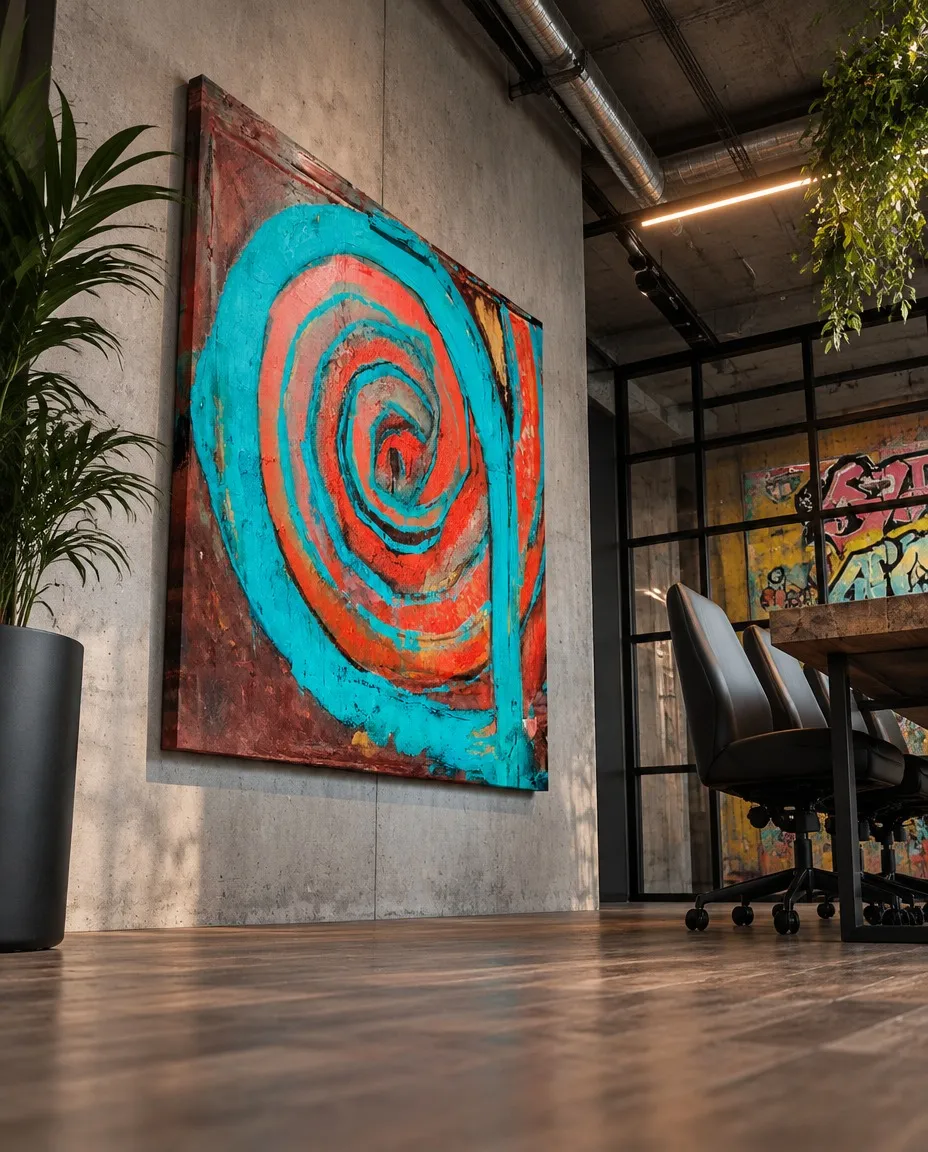
The physical presence of the artwork "HAUSTUS" imposes itself on the space through a visual impact that connects immediately with the prehistory of European territory. The gigantic spiral of turquoise blue and fiery red, roughly carved on a dark, dense, and brown background, inevitably evokes Paleolithic inscriptions and petroglyphs of Atlantic Europe—primitive marks carved in rock to delimit the sacred or register the passage of time. However, this glyph does not present itself as a clean or geometric abstraction. If Swiss psychiatrist Carl Gustav Jung identified in his studies of the mandala a symbol of psychic order, balance, and pacified centrality, the spiral in this work completely subverts that promise of harmony. Here we do not find a protective circle, but an asymmetrical, rough, and devouring whirlpool, a vortex whose matter accumulates in a chaotic and heavy manner, drawing the gaze toward a chromatic abyss that seems to swallow its own support.
To build this vortex, I have had to submit to the physical resistance of the material, experiencing the real weight of the oil and acrylic accumulated on the canvas. In dragging the palette knife with force, forcing the vibrant turquoise to slide over the lower layers of crimson and brown that still offer resistance, I do not seek to draw a line, but to inflict a physical incision in the skin of the painting. Each groove and each build-up of thick impasto preserves the memory of a raw, almost violent gesture, where the tool bites into the strata of color and reveals the hidden tensions beneath the surface. Painting is not a medium for illusion here, but a geological crust that I fight with my hands and body, letting the accidents of dragging and friction define the direction of this centripetal force.
This dynamic of rotation and constant attraction raises a profound debate on the nature of movement and repetition. On one hand, the insistent rotation of the spiral refers us to the warning of the philosopher and mystic G. I. Gurdjieff, who rigorously analyzed how human beings live trapped in automatic and unconscious mechanical repetitions, always spinning around the same conditioning without ever waking up. From this perspective, the spiral could be read as a visual trap, a hypnotic loop that absorbs consciousness in its inertia. However, the uneven workmanship of the piece, its splintered edges, and the vibration of the color point in the opposite direction, closer to the vision of Osho, the Indian thinker who championed chaotic movement and physical catharsis as indispensable ways to release vital force blocked by the rigid structures of the mind. Far from being a closed and domesticated circuit, the whirlpool of "HAUSTUS" manifests as an untamed energy celebrating its own instability.
In choosing the title "HAUSTUS"—a Latin term that refers directly to the act of drinking, absorbing, or drawing in air—I conceived the work not as a window for passive contemplation, but as an active organ of suction. The painting operates as a large lung drawing in the sensory memory of the Mediterranean landscape: the saline depth of the turquoise water and the heaviness of the clayey earth baked by the sun condense in this turbulent core. I do not paint to illustrate a geography or describe the coast; I paint to breathe through the medium, forcing viewers to experience the painting as a physical exhalation of heat, light, and density where the elements of nature are swallowed and returned in the form of pure material friction.
On the monumental scale of the 210 x 210 cm canvas, this visual metabolism finds its definitive tension in the thick vertical turquoise strip located on the far right. This solid line abruptly interrupts the circular inertia of the spiral, functioning as a brutalist architectural anchor that stabilizes the composition, or as a drainage conduit through which the outer space is vacuumed into the heart of the painting. By introducing this orthogonal axis that cuts through the rotating flow, the work avoids resolving itself into simple decorative dynamism. The composition remains suspended in an irresolvable tension, forcing whoever observes it to stand at the exact boundary where structural order surrenders and dissolves before the push of pure force.
- Original artwork
- HAUSTUS
- Actual dimensions
- 82.7 × 82.7 in / 210 × 210 cm
- Presentation
- Digital contextual visualization
Context references
paintings for design offices · brutalist abstract art · minimalist office decor paintings · Maurizio Valch HAUSTUS · exposed concrete abstract painting
About this visualization
This visualization places the artwork within an architectural context to help collectors and viewers imagine its presence in a real space. It is an interpretive reference, not an exact reproduction: the original work remains the sole authority for scale, color, surface and material presence.