Context study / HAUSTUS
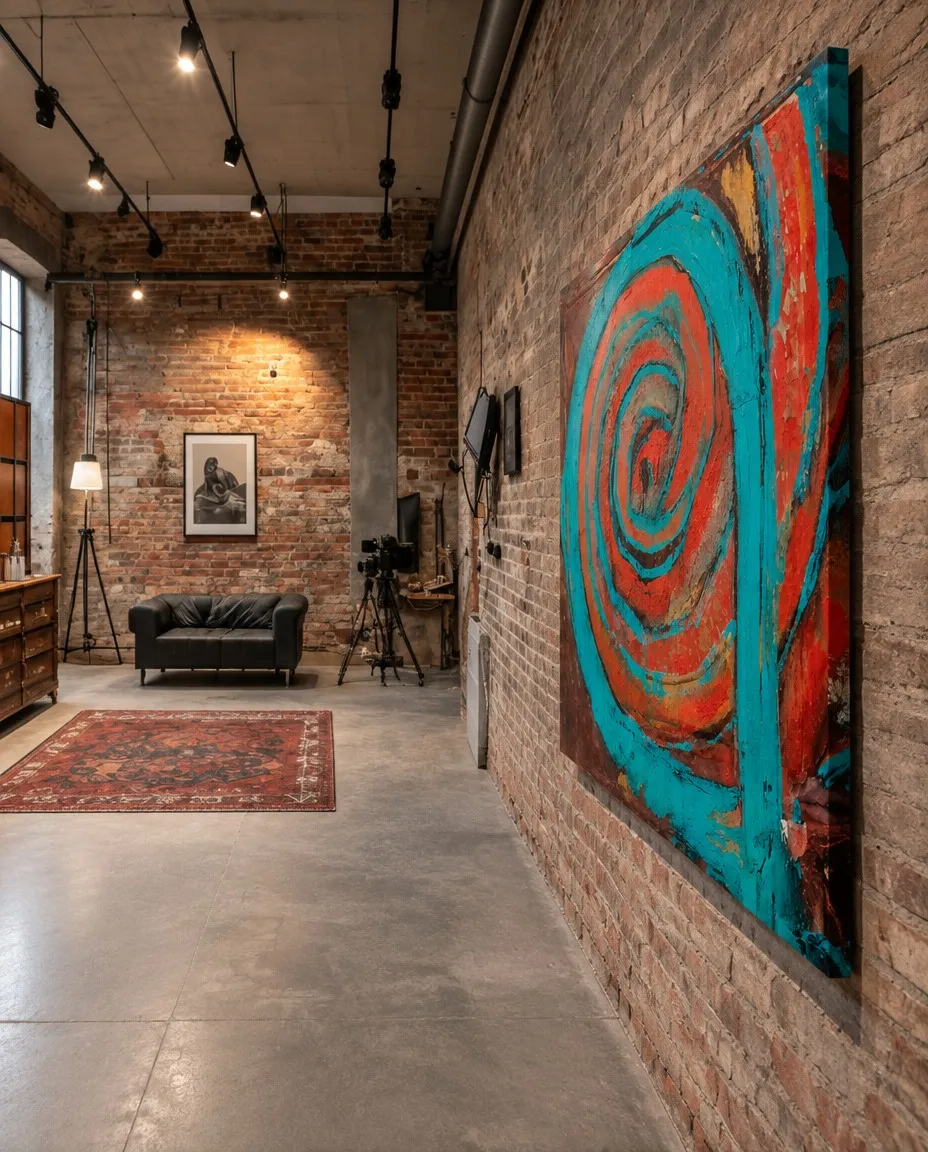
HAUSTUS Abstract Painting by Maurizio Valch in Industrial Loft | VORTEX Series
Hung on the roughness of the exposed brick in an industrial-scale space, the large format of HAUSTUS dispenses with any decorative intent to impose itself as an almost bodily presence. The 210-centimeter canvas does not describe a landscape or illustrate a psychological conflict; the painting offers itself all at once as the physical condensation of a state of tension. The violent contrast between the red mass and the turquoise channel that folds in on itself generates a force field that does not need words to convey its gravity. By placing the work in this oblique perspective, the side light scrapes the accumulated reliefs, revealing that the emotion here is not narrated, but sustained in the pure friction of the material.
I do not seek to explain what happens to me when I face the canvas; I prefer that the painting resolves it before I can give it a name. In tracing that large turquoise spiral, the movement was not born from the desire to design a clean form, but from the need to find a limit to a pressure accumulating within. Each pass of the palette knife, each area where the dense red resists being covered by the blue, is an attempt to fix a pulse that rational thought would only manage to deform with theories about myself. In the end, the painting does not tell a story about disorder or the search for peace; it is, quite simply, the material residue of that urgency.
This way of treating the canvas as a body that registers the impact of time and gesture aligns Valch's practice with the sensibility of Antoni Tàpies, where the surface functions as a wall or skin marked by erosion. However, while in Tàpies the wear evokes an archaeological memory, in HAUSTUS the matter seems to be occurring right now, under a constant pressure pushing from the center to the edges. The large turquoise channel falling down the right side, heavy as a suspended block, acts as a visual anchor that stabilizes the centrifugal force of the whirlpool. There is no before or after in this scene; the viewer stands before an absolute present, suspended in the very vibration that color and texture project onto the empty space.
There are moments during the process when I feel tempted to close the curve, to polish the edges and build a perfect order to reassure myself. But I know that order would be a lie, an artificial explanation that would bury the fact beneath a complacent interpretation. The small dark center of HAUSTUS is the place where the path breaks, an opening that resists being possessed by the blue surrounding it. Looking at it now, in the stillness of this wall, I understand that keeping that unresolved knot is the only way for the painting to keep breathing. The work's silence does not come from the absence of noise, but from having understood and contained all of its agitation within those limits.
Ultimately, the confrontation with HAUSTUS returns viewers to their own physical scale. In this quiet loft, where the high-ceilinged architecture and bare textures accompany the painting's sobriety without competing with it, the work behaves as an autonomous monolith that does not ask to be deciphered. There is no possible dictionary to translate the whirlpool, nor a psychological theory to cure the restlessness of its deep reds. The painting simply remains there, offering a tactile shore where the gaze can stumble, slide, and rest in an intensity that does not seek to convince anyone, but simply to exist with the honest gravity of matter.
- Original artwork
- HAUSTUS
- Actual dimensions
- 82.7 × 82.7 in / 210 × 210 cm
- Presentation
- Digital contextual visualization
Context references
large painting for industrial living room · turquoise and red abstract painting · industrial loft decor paintings · Maurizio Valch VORTEX HAUSTUS · large format abstract art
About this visualization
This visualization places the artwork within an architectural context to help collectors and viewers imagine its presence in a real space. It is an interpretive reference, not an exact reproduction: the original work remains the sole authority for scale, color, surface and material presence.