Context study / HAUSTUS
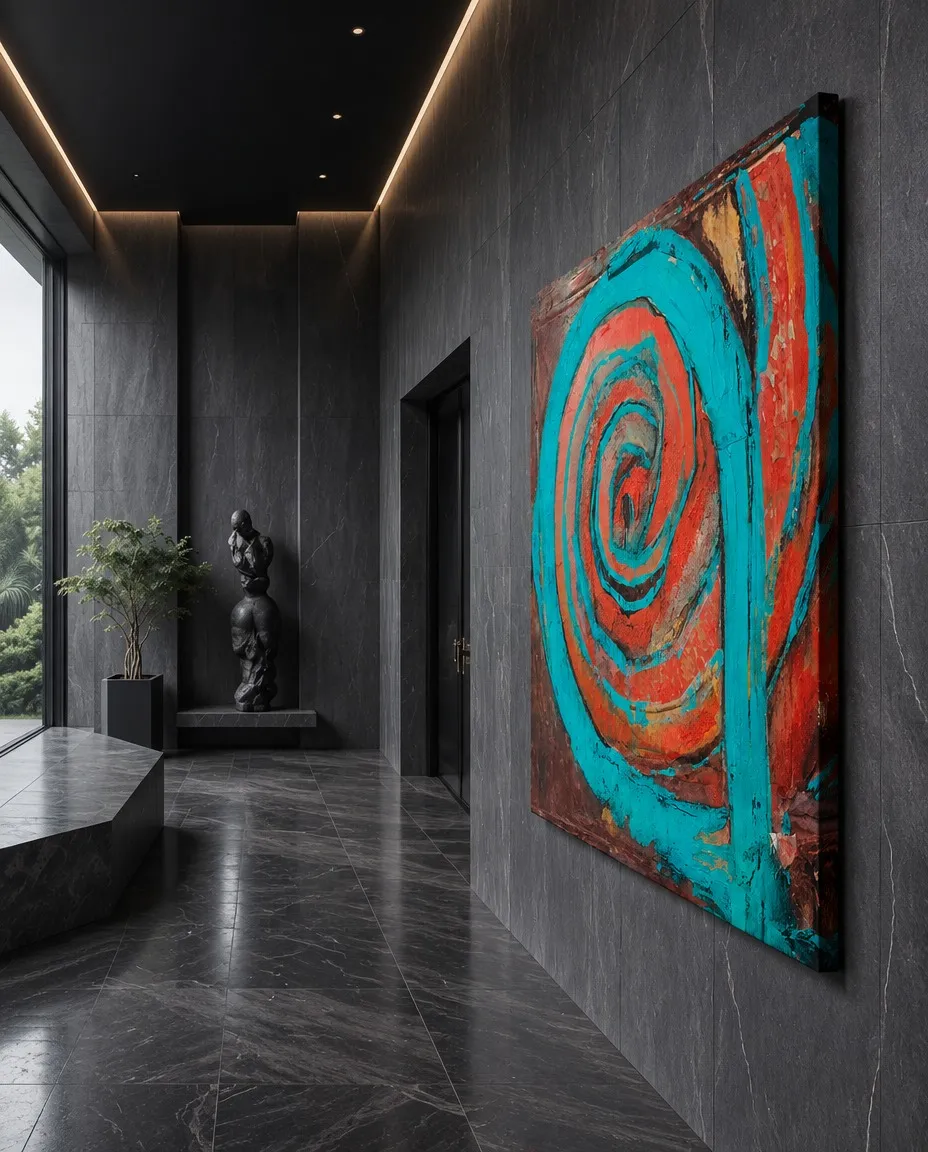
Monumental Painting HAUSTUS in Modern Dark Marble Lobby
The presence of HAUSTUS imposes itself on the space not as a window for passive contemplation, but as an absolute material limit that reconfigures the observer's scale. In its latent center, a monumental turquoise spiral unfolds on the canvas like a moving tectonic crust, a wall of thick pigment folding back on itself. This imposing barrier embodies the idea of protection, stripping it of any connotation of soft shelter or peaceful transparency. Here, protecting is an act of physical resistance; the spiral functions as a brutalist parapet, an accumulation of dense, rough matter seeking to shield an incandescent core of crimson and orange tones. This chromatic shield does not present itself immaculate, but rather as a surface that explicitly assumes the wear, friction, and hostility of the environment, turning the act of safeguarding into a material trench exposed to time.
Faced with the square format of this canvas, my intention was not to illustrate an idea of refuge, but to erect it with my own hands through the fatigue of the pigment. Working on this turquoise spiral involved an almost territorial effort of demarcation; I chose a tone that distances itself from the earthy colors of the background to establish, through its artificiality and brightness, a space of belonging. For me, belonging to this painting is not a state of contemplative rest, but a constant physical dispute with the resistance of oil and acrylic. By pressing the spatula against the support, by dragging the dense mass of color with my fingers, I define an inside and an outside. Each turn of the spiral is a trace of that bodily friction, an affirmation that the only territory that truly belongs to us is the one we have claimed through manual labor and the insistence of matter upon the void.
In the play of tensions that sustains HAUSTUS, the turquoise does not cancel out the lower layers, but coexists in a constant tension with the depths of crimson, ochre, and black vibrating beneath and along the flanks of the spiral. This chromatic confrontation gives rise to the dimension of trust, which in this work manifests as an absolute surrender to the centrifugal force of the whirlpool. There is no rational anchor or orthogonal structure in the composition to order the chaos; the viewer is invited to abandon analytical control and let themselves be swept away by the circular movement of the matter. Trusting, in the context of this painting, means accepting that the apparent disorder of the heavy impastos and curved trajectories possesses its own internal tectonic logic, a secret cohesion holding the painting together precisely where it seems the color is about to fly off the plane.
When I observe the edges of the spiral, where the paint tears and reveals the lower strata, I recognize that protection and trust are never pure or definitive states. They are conquered in error, in the imperfection of the trace. I do not seek the perfect finish of the hermetic bunker; on the contrary, I deliberately cause incisions, scrapings, and grooves with the back of the tool so that the painting breathes through its own wounds. If I closed the spiral completely, if I made it an impenetrable wall, the painting would become a sterile fortress, a dead space. These scars in the impasto are what allow the work to remain alive and vulnerable, proving that the true solidity of a structure lies not in its impenetrability, but in its capacity to absorb damage without collapsing.
Ultimately, HAUSTUS operates as a radical reconfiguration of the notions of belonging, protection, and trust, stripping them of conceptual abstractions to return them to their strictly spatial and material dimension. The work renounces being a mimetic representation of natural elements like water or fire to transform itself into a 'tactile edge,' a territory where the viewer's body and the body of the painting enter into a correspondence of weights and textures. The true refuge offered by this monumental canvas by Maurizio Valch does not consist in escaping the outside or in a sterile isolation, but in the relentless honesty of inhabiting the vibration, friction, and gravity of its own circular fall, demonstrating that the most solid sanctuary is found in the full assumption of our own shared material vulnerability.
- Original artwork
- HAUSTUS
- Actual dimensions
- 82.7 × 82.7 in / 210 × 210 cm
- Presentation
- Digital contextual visualization
Context references
luxury hallway art · paintings for dark marble wall · modern lobby decor · large luxury paintings · contemporary dark interior design
About this visualization
This visualization places the artwork within an architectural context to help collectors and viewers imagine its presence in a real space. It is an interpretive reference, not an exact reproduction: the original work remains the sole authority for scale, color, surface and material presence.