Context study / HAUSTUS
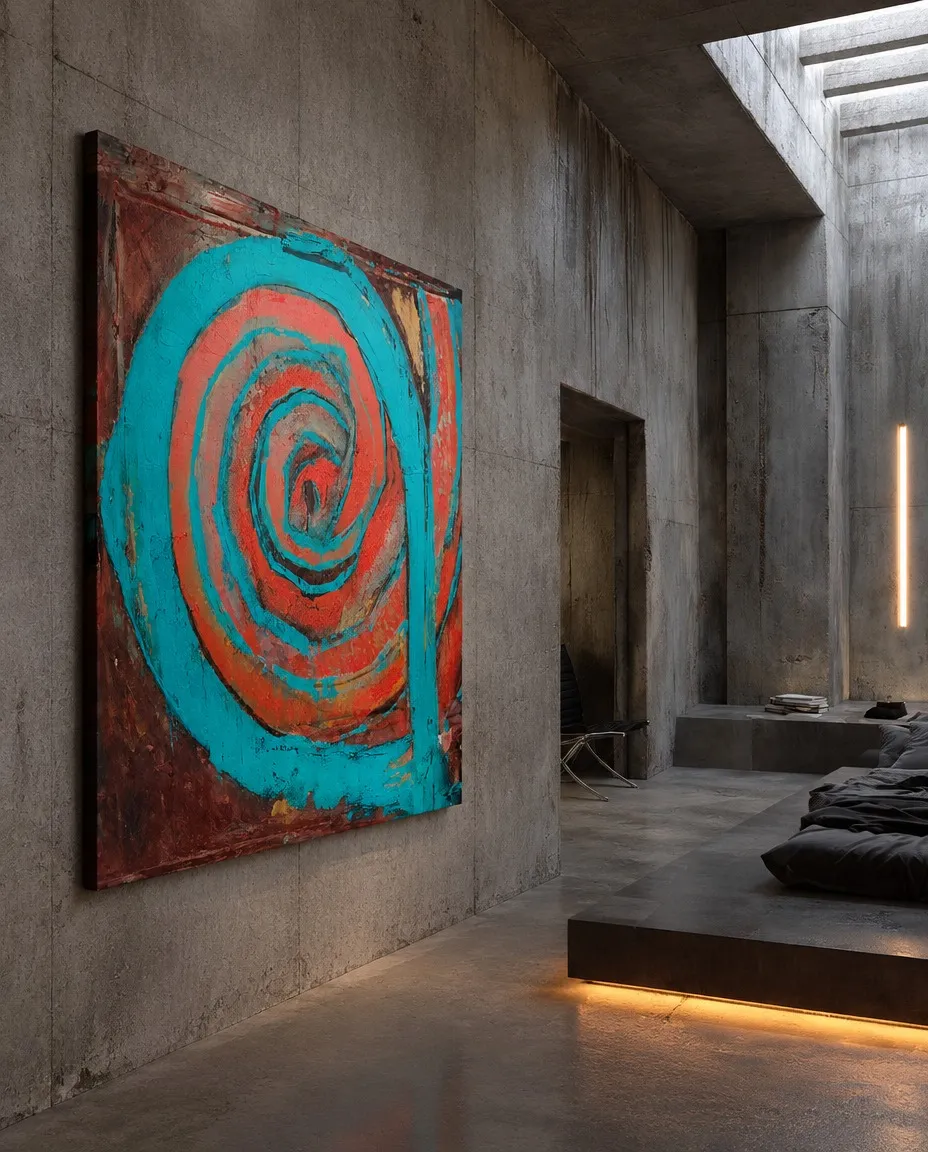
Monumental Abstract Painting HAUSTUS in Brutalist Concrete Living Room
The monumental scale of HAUSTUS in this quiet, exposed concrete room reveals that painting does not need to tell a story to record the weight of an existence. Hung on the gray coldness of the wall, the 210-centimeter square behaves like a body that has accumulated its own frictions, a map of detours where turquoise and red dispute the surface. There is no chronology of recognizable events here, no dates, nor the names of places left behind; what remains is the pure physics of wear and insistence. The work offers itself to the architectural space as a wound resolved in matter, demonstrating that a biography can be inscribed entirely in the roughness of a plane that refuses to be flat.
I have traveled thousands of kilometers on foot and by bicycle, crossing borders and inhabiting transient rooms that I forgot the next day, but I have never known how to transfer that external geography to the canvas without betraying it. This turquoise whirlpool is not the illustration of a journey; it is the pattern of my own detours, the fatigue accumulated in my legs that becomes pressure on the oil paint. I work with color and scraping because I trust the resistance offered by the material more than the explanations my mind constructs a posteriori to justify my decisions. In the end, painting is a way of clearing the fact of all its interpretations, leaving the surface to retain only the physical trace of having been there.
Faced with the neatness of the brutalist architecture that contains it, Valch’s painting reacts with the roughness of a wall weathered by time. The affinity with Antoni Tàpies’s materiality becomes evident not through a direct formal inheritance, but through the way the painting behaves like a skin sensitive to friction and the room’s sidelight. The earthy reds and grays underlying the turquoise do not function as a decorative background, but as layers of sedimented experience, areas where the paint has been covered, pressed, and reopened. The biographical event is stripped of its anecdote to embody in relief: pain, economic uncertainty, or isolation are not narrated; they accumulate in the thickness of the pigment.
I often find myself caught in the temptation to turn my life into a great heroic quest, a succession of trials and triumphs that explain why I keep painting or why I need to move houses so often. But when facing a surface of this size, that narrative of the hero collapses, and I am left alone with the clumsiness of the stroke. The dark center of this spiral is not a metaphysical secret I intend to reveal to the viewer, nor a definitive answer to my questions; it is only the point where the turn became too narrow and the material accumulated until it stopped the movement. There is no glory in that knot, only the acceptance of a zone that refuses to be ordered by thought.
The overhead light descending through the skylight of the room and sliding over the incisions of HAUSTUS reminds the viewer that time is not measured solely in hours, but in overlapping layers of paint. By removing the demand to find a linear narrative, the work becomes a space of transit where inside and outside merge into the same tactile edge. The spiral does not advance toward a glorious resolution; it rotates upon itself, forcing one to inhabit the present of the painting with an attention free of judgment. In this renunciation of explanation lies the discrete sovereignty of painting, which does not seek to impress with a display of virtuosity, but rather invites one to remain in silence before a structure that breathes through its own fractures.
- Original artwork
- HAUSTUS
- Actual dimensions
- 82.7 × 82.7 in / 210 × 210 cm
- Presentation
- Digital contextual visualization
Context references
brutalist living room decor · painting for concrete wall · minimalist interior design · concrete living room ideas · decorating with large format art
About this visualization
This visualization places the artwork within an architectural context to help collectors and viewers imagine its presence in a real space. It is an interpretive reference, not an exact reproduction: the original work remains the sole authority for scale, color, surface and material presence.