


Published work / STRATA
FREQUENTIA
STRATA · The Sedimented Time of Territory
- Size
- 31.5 × 47.2 in / 80 × 120 cm
- Series
-
STRATA
 Painting series
STRATA
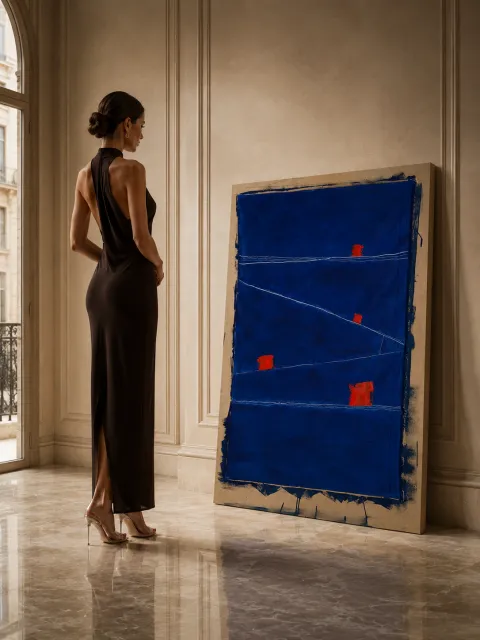
Maurizio Valch's STRATA series features contemporary abstract painting, showcasing artwork with stratified surfaces. Crafted with acrylic and oil on canvas, this series stands out for its dense chromatic fields and profound incisions, evoking an inner, archetypal territory. View series
Painting series
STRATA
Maurizio Valch's STRATA series features contemporary abstract painting, showcasing artwork with stratified surfaces. Crafted with acrylic and oil on canvas, this series stands out for its dense chromatic fields and profound incisions, evoking an inner, archetypal territory. View series
- Context studies
- 4
Conceptual Note
In FREQUENTIA, Maurizio Valch turns territory into a structure of routes, pauses, and isolated presences. The work belongs to STRATA, a series in which landscape ceases to be a recognisable place and becomes an inner archive of matter, thought, and sedimented experience. This inquiry relates to a trajectory marked by movement, paths, and transitional places, although no travel narrative appears here: only a space subject to divisions, displacements, and continuities. The small blocks of colour seem to inhabit this territory without dominating it, as forms that have acquired weight without closing down their meaning.
The work raises a question about repetition and direction: are these marks and planes really moving forward, or do they remain traversing the same area? The incised lines cross the surface like incomplete routes, but none offers an evident exit. Tension arises between the movement suggested by the diagonals and the immobility of the compact forms; between the possibility of passage and the sense that each route is inscribed once again into the same matter.
The vertical composition is organised through oblique bands descending from the blue-green upper section towards the ochres, coppers, and reds below. Across these dense fields, fine incisions separate areas without creating a rigid geometry; irregularities, scrapes, and variations in the surface remain visible. Four small blocks—red, orange, turquoise, and crimson—introduce precise interruptions and seem to measure the extension from within. Their contained scale reinforces the stillness of a scene without literal landscape, while the contrast between deep cool colour and warm mass sustains the tension between distance, matter, and passage.
Artist influences
Its territorial construction may find a critical affinity with Richard Diebenkorn, in the way abstraction retains a memory of landscape through planes and distances. Valch, however, replaces that openness with a more compact, eroded, and stratified organisation. The worked surface also enters into dialogue with Antoni Tàpies, although here the incisions do not turn the painting into a wall or a form of writing; above all, they function as boundaries and traces within a distinct chromatic territory.