Context study / FISSURA
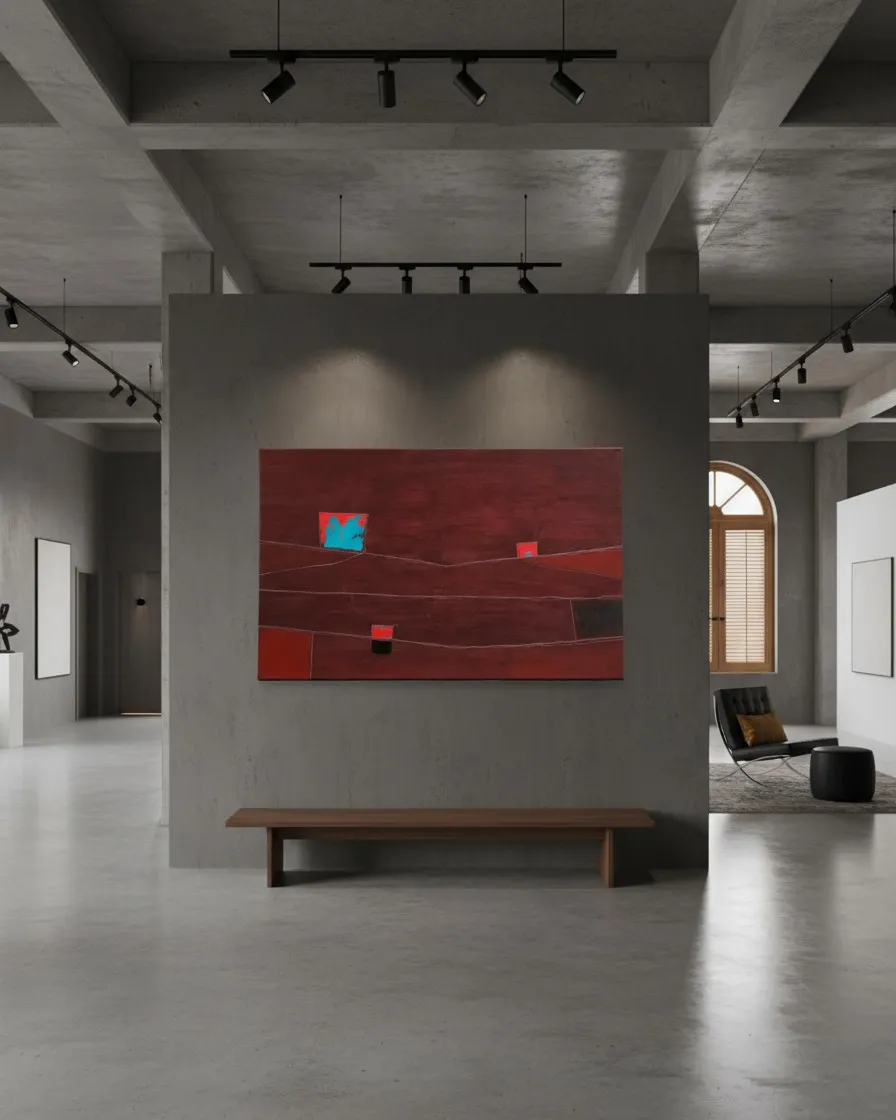
Maurizio Valch's FISSURA on a Brutalist Concrete Wall
Saturated with an ancient gravity, the large crimson plane dominating the canvas presents itself not as a mere painted surface, but as an organic tissue pulsing under its own sedimented weight. Before the eye attempts to decipher a narrative, it is the density of the color—a deep, almost coagulated red, evocative of scabs and clay soils—that assaults perception. Across this chromatic plain, the fine horizontal slits crossing the space function not as superimposed lines, but as genuine physical incisions exposing a long-contained inner vibration. It is here that the territory of DESIRE manifests: an elemental impulse scratching the surface, a quiet yet stubborn agitation that needs to break the apparent uniformity of the plane to testify that beneath the apparent calm beats a boiling current, eager to find a crack of light.
I hold the cutting tool with a rigidity bordering on a prayer, knowing that the blade I slide over the oil accumulated for weeks admits no regrets; each incision is an irreversible, subtractive journey where FEAR physically settles into the trembling of my wrist. A single slip of the hand, excessive pressure, and the delicate tension of the plane would break destructively, ruining the stratigraphy of a canvas that has breathed the studio air for months. In this vigil, those small blocks suspended on the red plain—the turquoise blue rectangle framed in incandescent carmine, the faint crimson witness on the right, and the dark block anchoring the composition at the bottom—emerge as customs stations of my own psyche; they are checkpoints and containment posts designed to guard the wound, limits I urgently place to prevent the entire plane from collapsing and the color from spilling without order or meaning into the void of the canvas.
Behind this apparent geometric stillness, the visual syncopation proposed by the suspended blocks alters any expectation of symmetry and reveals a constantly warping geography. The turquoise blue block, enclosed by its border of glowing red, operates as a chromatic exclamation that resonates with a cold, electric vibration, a violent contrast against the sobriety of the surrounding crimson bed. The incised lines rising and falling with subtle oscillations are not decorative; they function as the seams of a territory subjected to opposing tectonic pressures, where the FEAR of ultimate fracture and the DESIRE for a new dimension to emerge through the breach coexist in a precarious balance. The painting is thus revealed as a living membrane under tension, a surface where formal elements seek each other but remain suspended and interrupted by scars that prevent final contact.
Upon finishing the work and contemplating the plane from across the studio, I realize that the true meaning of the work is revealed only when I lay down the weapons of control and surrender to SURRENDER. I realize that the fissure is not an imperfection or an accident to be repaired, but the only channel through which the painting breathes and communicates with the outside; the red color, far from being confined to the front plane, extends continuously over the three-centimeter thickness of the stretcher edges, overflowing the three-dimensional boundary of the painting to claim the space of the room. Painting, I now assume, is not about ruling absolutely over matter, but learning to withdraw at the right moment, allowing the incision to become a tactile shore where my intentions dissolve and the canvas passes into the random laws of ambient light and the viewer's gaze.
Faced with the imposing 120 x 80 cm scale, the original confrontation between the forces of control and vulnerability dissolves to make way for a physical and architectural presence of a reconciled stillness. Moving away from FISSURA, the viewer understands that the wound exposed on the canvas no longer symbolizes aggression or loss, but the threshold of a necessary transformation where the rigidity of the plane yields to the flexibility of experience. The work of Maurizio Valch reminds us that the true depth of existence is not protected behind impenetrable chromatic walls, but is revealed when defensive resistance to the void ceases; the scar, far from dividing the space, becomes the definitive bridge that sutures the distance between the work, the space hosting it, and the gaze that finally completes it.
- Original artwork
- FISSURA
- Actual dimensions
- 47.2 × 31.5 in / 120 × 80 cm
- Presentation
- Digital contextual visualization
Context references
abstract painting in brutalist living room · minimalist interior decor · large paintings on concrete wall · contemporary abstract art for home · concrete living room decor ideas
About this visualization
This visualization places the artwork within an architectural context to help collectors and viewers imagine its presence in a real space. It is an interpretive reference, not an exact reproduction: the original work remains the sole authority for scale, color, surface and material presence.