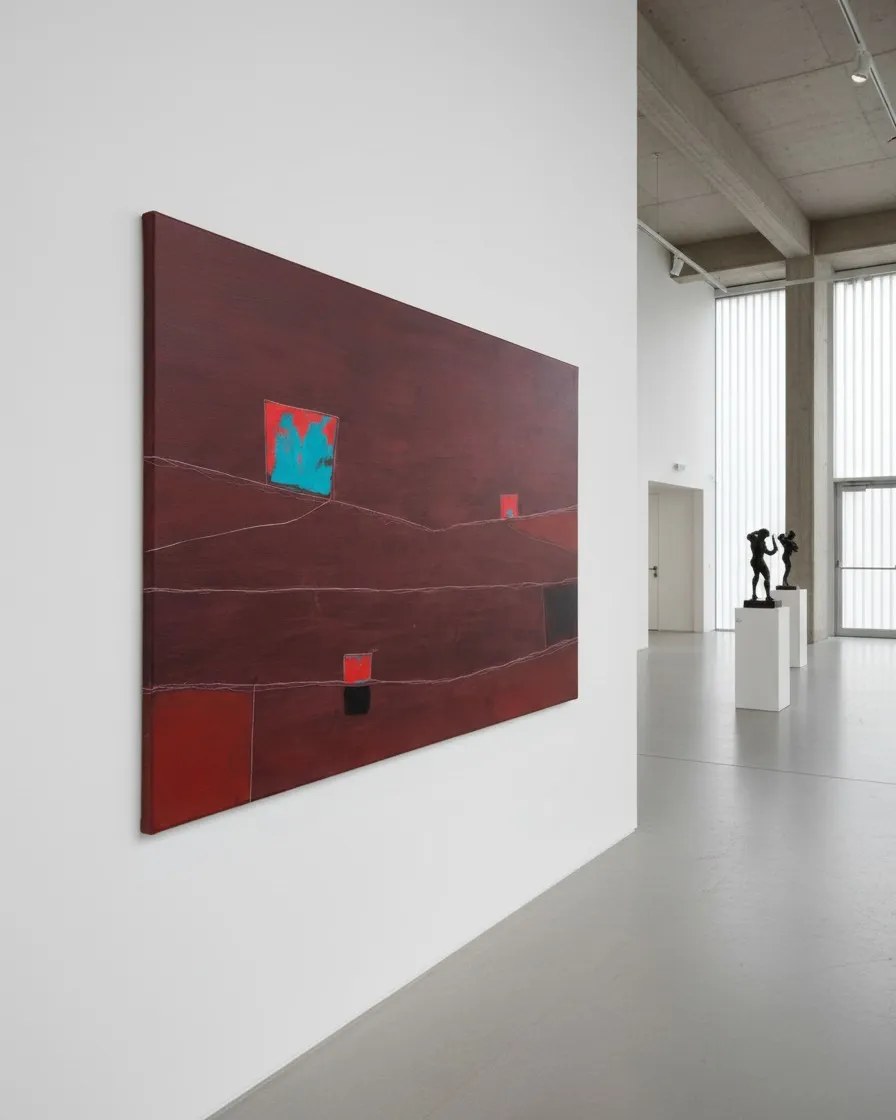
Context study / FISSURA
Maurizio Valch's FISSURA Exhibited in an Art Gallery
The vast surface of FISSURA imposes itself through an austere, dense mass of garnet, iron oxide, and dry clay—a territory of accumulated pigment that seems to have been deposited on the canvas over geological eras. Upon this textured crust, a series of incised lines cut through the plane with the precision of a needle, functioning not as ornamental elements, but as tectonic faults or ancient Paleolithic boundaries fracturing the continuity of matter. By incorporating the analytical psychology of Carl Gustav Jung, whose study of archetypes allows us to understand how latent structures of the unconscious break into waking consciousness, these lines and the isolated blocks of color acquire a deep psychic dimension. They do not represent a purely geometric abstraction, but the emergence of repressed contents cracking the numbed surface of consciousness, forcing the psyche to confront the tensions that lie beneath its apparent uniformity.
When I hold the awl before the still-wet paint, I assume my task is not to draw, but to exert a necessary violence upon the matter; carving these lines is wounding the skin of the canvas to force it to reveal the strata of color hidden in its thickness. By dragging the tool over the dense acrylic, breaking the resistance of the garnet, I seek to unearth the physical memory of the lower layers. I recall the strange vibration that ran through my hand when depositing that luminous turquoise blue, almost mineral in quality, within the red enclosure of the left quadrant. It was not a compositional or aesthetic decision, but a biological need for visual oxygen: it was like opening a well of sacred water or lighting an archaic fire in the middle of a deserted plain, a point of active resistance against the surrounding gravity.
The horizontal divisions of the work structure a rigorous system of spatial tensions that challenges the viewer's inertia. Through the thought of George Gurdjieff, who theorized about the state of automatic sleep in which human life takes place and the need for voluntary shocks to awaken, the dark and heavy bands of the painting can be read as the mechanical nature of material existence. Faced with this visual numbness, the small glowing blocks operate as 'self-remembering,' conscious interruptions that fracture the inertia of the background. However, confronting this structure with the perspective of Osho), for whom spirituality resides in unrestricted freedom and the free play of vital energy, these quadrants acquire an untamed quality; they reveal themselves as redoubts of wild desire seeking to survive within the strict limits imposed by the incisions. The canvas thus poses a physical question: are these lines protective enclosures safeguarding the vibration of color, or cages designed to contain its expansion?
Contemplating the finished scale of the painting, I recognize in its structure an inevitable connection to the memory of the land, linked to the linear markings found in prehistoric Mediterranean caves and stone dolmens where the sacred was physically demarcated from the profane. As I opened these breaches in the matter, I doubted my own role in the process, caught between the need to map my own scattered memory or the simple attempt to build a shelter against the relentless advance of time. The painting thus becomes a personal archaeological record, an attempt to fix stable marks on an unstable surface before the binder dries completely and irreversibly sets the boundaries.
Faced with the work's one-hundred-and-twenty-centimeter width, the physical scale imposes a viewing distance where the eye cannot remain static, constantly oscillating between the heaviness of the earthy background and the almost electric vibration of the small, saturated areas. The experience of the painting is not exhausted in passive observation, but demands inhabiting the intermediate space of the fracture. In the end, the work demonstrates that the crack is not an element of destruction or decay of the matter, but the only possible interval in the hardened plane; the fissure is the indispensable space of opening through which light and consciousness can begin to filter.
- Original artwork
- FISSURA
- Actual dimensions
- 47.2 × 31.5 in / 120 × 80 cm
- Presentation
- Digital contextual visualization
Context references
large painting for modern living room · abstract painting in gallery · contemporary wall art · abstract art exhibition · modern decor with art
About this visualization
This visualization places the artwork within an architectural context to help collectors and viewers imagine its presence in a real space. It is an interpretive reference, not an exact reproduction: the original work remains the sole authority for scale, color, surface and material presence.