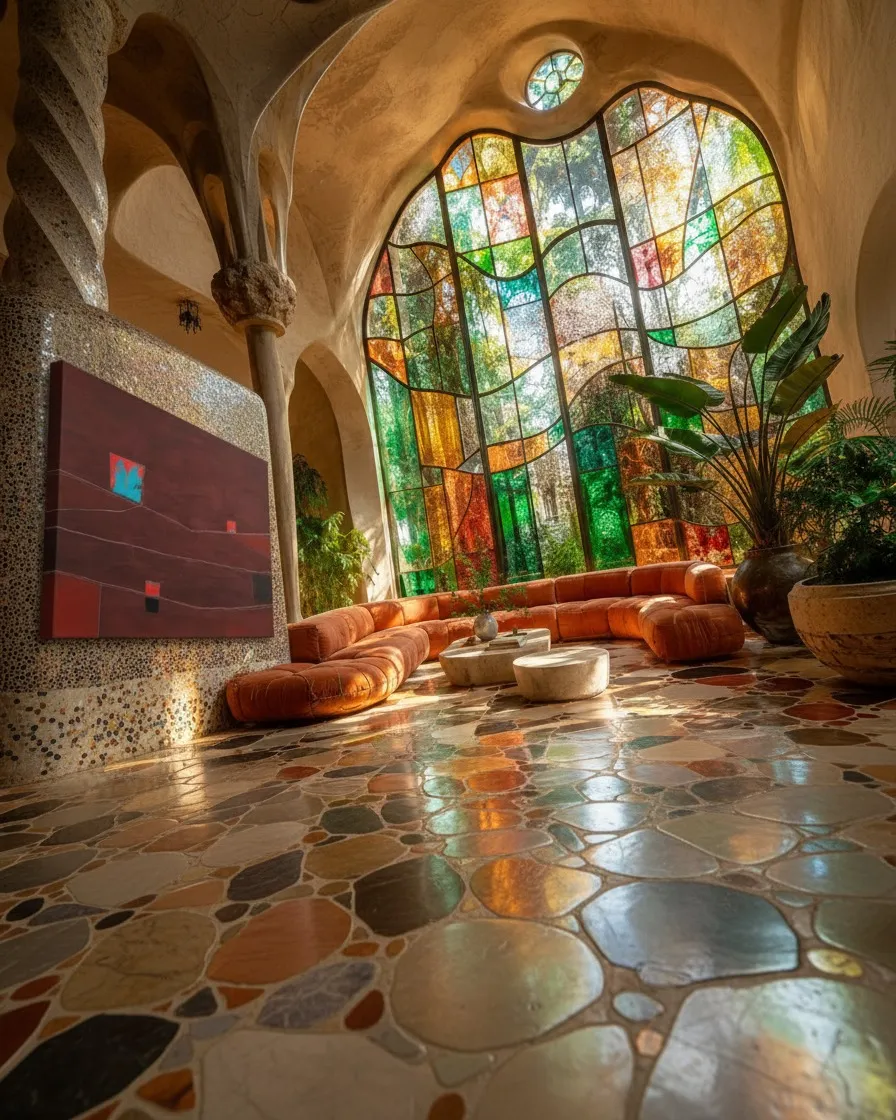
Context study / FISSURA
Maurizio Valch's FISSURA in a Spacious Room with Mosaic
From far away it looks like a dark plain, an expanse of maroon, dull wine, and burnt earth where someone has traced routes without quite deciding where they go. The horizontal lines do not stay straight: they advance, break, thin out, hesitate. They could be strata seen from an excessive height; roads so fragile that a single step would erase them; cracks that have preferred not to open entirely. Between them appear three small red-turquoise rectangles. At that distance they could be shelters, broken screens, tiny windows, flat animals lying on the ground, or traffic signs for a species that has not yet learned to read.
A child might ask: why don't those little squares fall if they are hanging from such loose lines?
The question forces one to draw closer, but in doing so the plain is no longer stable. The first horizontal line, barely crossed by the gaze, disorders the distance: what seemed like a horizon turns out to be an interruption. Below it, the dark field gains weight; above, however, the surface becomes less terrestrial, almost aerial. The upper rectangle no longer looks like a shelter. It has something of a screen that has just lost an image, or a small creature that has raised a red and turquoise ear to check if anyone is coming.
Each line functions as a fault of perception. Crossing the next, the eye must lower and slow down. The second strip does not lead: it forces a shorter breath, as if crossing it required not moving the chest too much. The small forms stop being suspended over the territory; for an instant they seem to hold it. Then the line twists again and that certainty dissolves. The central rectangle, smaller or more distant depending on where one looks at it, behaves like someone trying not to draw attention and yet wonderfully ruins any orderly reading.
I look at these divisions and cannot treat them as secure limits. I follow them and, when they seem to lead to one area, I find they have returned me to another. I feel that the maroon resists staying still under the gaze and that the turquoise appears too soon, as if it had learned to interrupt me. A small presence, which seemed almost accidental, grows to occupy more space than the entire field. I do not know if the surface lets it advance or if I am the one arriving too late to see it.
Then Jacques Lecoq enters, not as the owner of an answer, but as someone attentive to the way a body learns before explaining. Each line could be a posture instruction. The upper band would perhaps demand a tilted neck and separated feet, as if the ground could slide beneath them. The second would allow a held breath, a breath that does not want to disturb the instability of the plane. Lower down, below the bottom rectangle, the black patch poses something else: not a fall, not yet, but the rehearsal of a stumble.
The black patch weighs without becoming heavy. It settles beneath the small red-turquoise block like a shadow that does not quite match what should project it. It could be an open pocket, a gap, a stone, a crossed-out note, an animal that hid too poorly. Lecoq stops there because he discovers that the most expressive gesture would not be to advance or represent a fall: it would be to hold back the movement just before it occurs. The knees know something the gaze does not yet admit.
But the third horizontal line disarms even that preparation. Crossing it, the supposed body rehearsing the crossing seems too large. From above, anyone could turn these bands into a route, assigning starting points, dangers, rests, and arrivals. That comfort does not last. Paulo Freire appears with a simple suspicion: before asking how to read these forms, it is worth asking who can name them and from what distance.
The upper rectangle seems large because it is close to an attention that enlarges it. The middle one seems small because it has been relegated, pushed into an area where the gaze passes quickly. The lower one arrives incomplete: something interrupts it, perhaps the black patch, perhaps the line passing too close, perhaps the need not to surrender entirely to the observer. None accepts staying fixed in their role. One calls them windows; another, signals; a third, remains. But those words fall upon them from a height that begins to feel uncomfortable.
Freire does not allow Lecoq to turn the field into the stage of an exemplary crossing. It is not enough to rehearse the correct posture before the crack if the gaze retains the right to decide what is crack and what is ground. Lecoq, in turn, does not accept that everything must be resolved in the caution of naming: there are lines that make the shoulders slope before a precise word appears. Between the two, a friction arises. One wants to cross; the other asks who drew the border and who is left on the side no one looks at. The surface responds without obeying either: perhaps the lines are not paths to cross, but boundaries that learn to move when someone attempts to describe them.
The gaze goes down again. It no longer seeks to dominate the entire expanse; it follows a nearly invisible line that goes from left to right and, without warning, changes direction. Accompanying it, the upper red-turquoise rectangle loses its air of alarm and becomes a tiny domestic interruption, like a light someone forgot to turn off. Lower down, the same color reappears with a different intensity. It is not the same red, though perhaps it is. It is not the same turquoise, though it insists like a word that cannot manage to be pronounced twice the same way.
Lecoq begins to find a pedagogical question in a crack: what does a body learn when it cannot advance without modifying its way of supporting itself? Freire, meanwhile, recognizes that knowledge can begin in the slope of shoulders before a surface, in the minimal shift of the head to follow a line that almost disappears. Neither has defeated the other. The conversation becomes less comfortable and therefore more precise. The territory stops being below, stretched out and available. It also settles between the eyes, in the back, in the habit of looking at a thing and believing it is already named.
I no longer know if these lines even belong to me as lines. I wanted to draw close to them, but now they seem to recede each time a word attempts to fix them. I hear in Lecoq's question a waiting body; I hear in Freire's caution a distance that does not want to appropriate anything. Even so, I do not know what supports those rectangles. I cannot decide if they float, if they rest, or if they have learned to remain precisely because they do not accept ground. The painting has begun to look from a place where I cannot manage to position myself.
The black patch returns, but it is no longer only below the bottom rectangle. Or it is below and also in front; it can be a weight, but also an opening that prevents closing the plane. Crossing the last horizontal, the childhood question changes. It no longer seems to ask about the gravity of the little squares, but about the gravity of the one looking at them: what must a gaze let go of so that something so small does not have to fall.
The dark field remains extended, without promising depth or a definitive surface. The lines continue separating zones, but each separation has shifted the position from which they were viewed. Near the edge, one of them thins out until it is almost erased. It does not end: it remains at work.
- Original artwork
- FISSURA
- Actual dimensions
- 47.2 × 31.5 in / 120 × 80 cm
- Presentation
- Digital contextual visualization
Context references
abstract painting on mosaic wall · hall with large stained glass window · circular orange sofa design living room · irregular stone floor hall · Maurizio Valch FISSURA painting
About this visualization
This visualization places the artwork within an architectural context to help collectors and viewers imagine its presence in a real space. It is an interpretive reference, not an exact reproduction: the original work remains the sole authority for scale, color, surface and material presence.