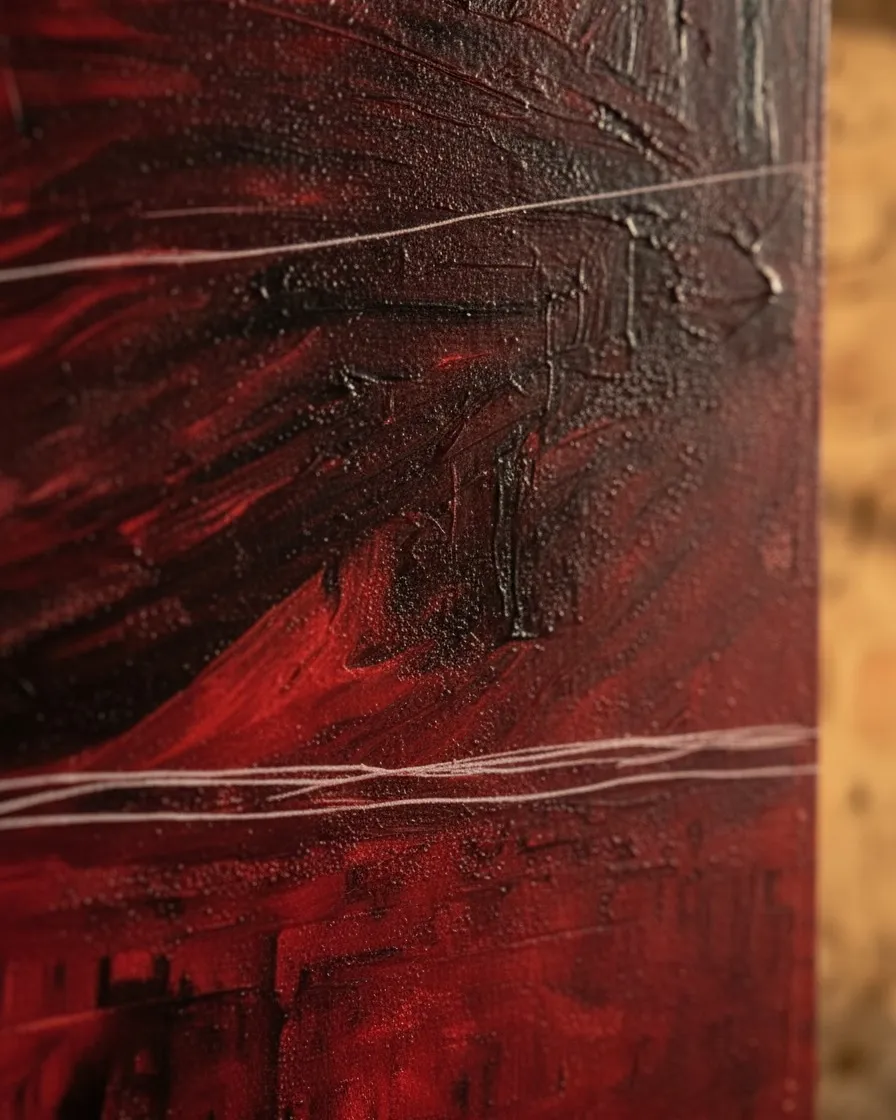
Context study / DISPERSA
Tactile Detail of the Artwork DISPERSA | Maurizio Valch
The surface of DISPERSA presents itself as a dense territory of material accumulation, where a thick, blackened crimson seems to have been dragged and gathered with force. Upon this crust of rough, almost geological oil paint, thin incised lines appear—subtractive score marks that tear horizontally across the pictorial plane. These light crevices do not add information; instead, they unveil the underlying support, acting as extremely fine wires that hold small geometric blocks, niches carved directly into the matter, in suspense. Here, belonging is redefined in a conflictual way: to belong to this space does not offer the rest of a grounded home, but rather the tension of remaining suspended over an abyss of boiling color. The blocks do not communicate fluidly; they are isolated, stranded in their respective coordinates, joined only by a subtractive trace that vibrates under the weight of the surrounding emptiness.
In the solitude of the studio, my relationship with the canvas is a physical struggle against the density of the pigment. I work the oil paint while it still offers resistance, accumulating layers of red and black to then, with a firm, sharp movement of the palette knife, wound the surface and drag the wet material. It is a process of emptying: those horizontal lines and small three-dimensional niches are not painted, they are excavated. By carving these rigid blocks in the midst of the chromatic turbulence, I seek to question protection. Are these niches a safe refuge against the crimson tide that threatens to dissolve everything, or are they cells where the self confines and isolates itself out of fear of dispersal? For me, protecting is not a soft act nor a cotton-lined refuge; it is an action that demands the hardness of the block and the precise violence of the cut upon the fabric, delimiting a space of resistance where the body can, at least for an instant, avoid being swept away.
The distribution of these geometric blocks on the surface of DISPERSA eludes any symmetry or mathematical regularity. They function as visual syncopations, material silences scattered asymmetrically that break the continuity of the gaze, forcing it to jump unevenly from one point of support to the next. This broken rhythm places us before a physical dimension of trust. To trust, in the grammar of this work, does not equal traversing a continuous and predictable path, but accepting the emptiness and distance that separate forms. The eye must cross wide areas of shadow and crimson sedimentation, devoid of anchorage, to find the next niche. Thus, trust reveals itself as a purely somatic capacity: the strength to sustain oneself in the interval and tolerate the silence between dispersed bodies, without the guarantee of an uninterrupted bridge joining them.
When I place myself before the eighty-by-one-hundred-and-twenty-centimeter stretcher, I am aware that gravity also paints. The incised lines that furrow DISPERSA do not obey the rigidity of a metal ruler or the orthopedics of the right angle; they yield, curving subtly and declining toward the margins. In that slight inclination lies my surrender, my way of understanding trust as a renunciation of absolute control over the painting and over my own hand. By allowing the stroke to decline and the blocks to seem to slip down the canvas, I expose my vulnerability and assume the error implicit in the physical support. Belonging to the real world does not consist in sustaining a perfectly horizontal line at all costs, but in accepting the honesty of the decline, learning to accompany the fall and slide with the materials instead of forcing them into a fictitious stability.
Finally, it is at the edges of the work where this investigation into bonds is consummated. The dark crimson and the incised marks do not stop at the border of the frontal plane; they overflow along the edges of the canvas, wrapping around the three-centimeter-thick stretcher and canceling any limit imposed by a conventional frame. By converting the edge into a "tactile shore," DISPERSA sheds its condition as a closed bunker and transforms into a porous membrane in direct contact with the space of the room. Here, belonging, protection, and trust converge: by eliminating the protective barrier of the frame, the painting no longer isolates its pain or its mystery, but offers itself to the open air of the physical encounter with the viewer. Dispersal then ceases to be a punishment of fragmentation and isolation, revealing itself as the only possible way to integrate, with unarmed trust, into the totality of shared matter.
- Original artwork
- DISPERSA
- Actual dimensions
- 31.5 × 47.2 in / 80 × 120 cm
- Presentation
- Digital contextual visualization
Context references
textured oil painting detail · incised marks on canvas · crimson abstract art · Maurizio Valch painting texture · large format minimalist abstraction
About this visualization
This visualization places the artwork within an architectural context to help collectors and viewers imagine its presence in a real space. It is an interpretive reference, not an exact reproduction: the original work remains the sole authority for scale, color, surface and material presence.