Context study / CUTIS
CUTIS by Maurizio Valch | Monumental Face in the FACIES Series
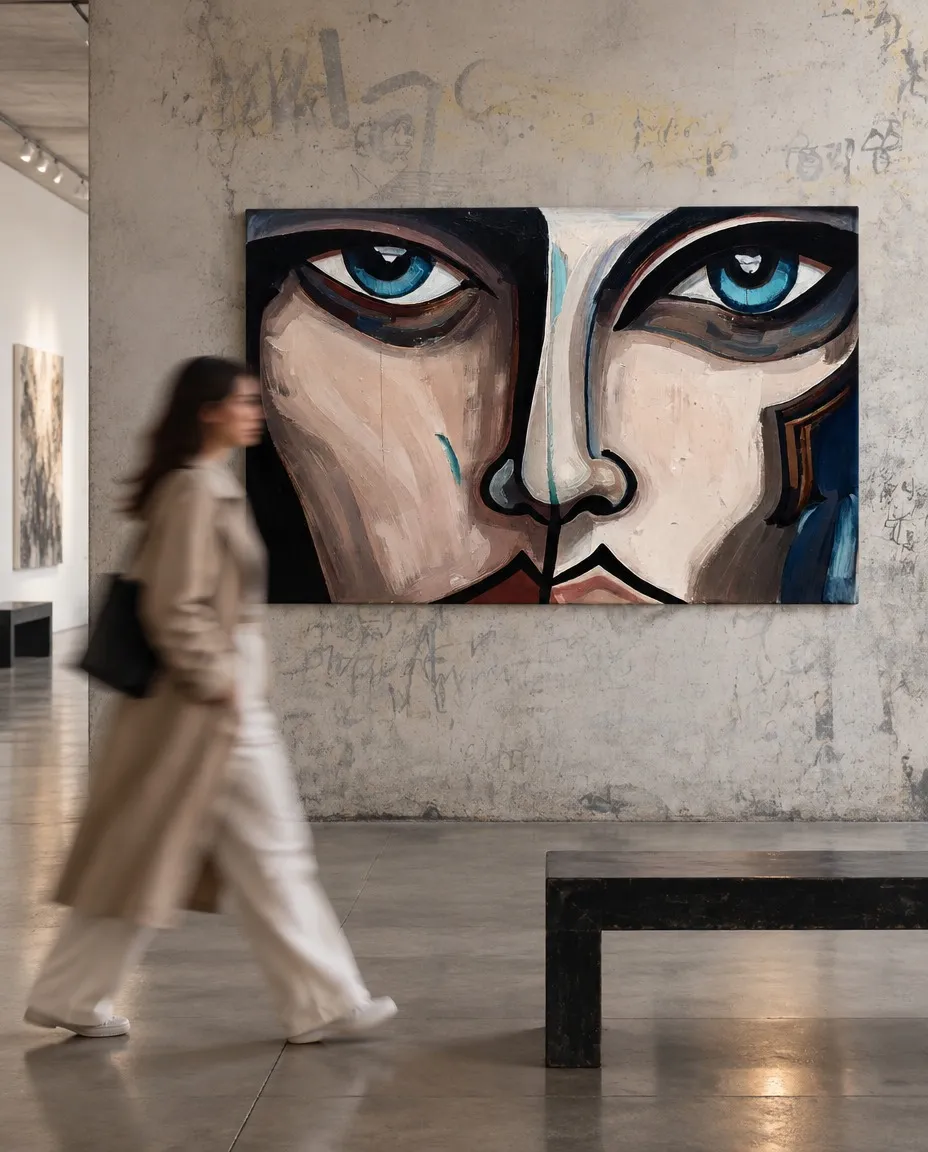
When confronted with the imposing dimensions of CUTIS (210 × 140 cm), the inhabited space is immediately subordinated to the presence of a fragmented colossus. This is not a conventional portrait, but a facial architecture that stands with the solidity of a wall and the vulnerability of exposed dermis. The composition holds an immediate, magnetic tension between an absolute stillness—anchored in the hypnotic symmetry of those immense, deep indigo-blue eyes—and the material vibration pulsing through its contours. This motionless gaze, far from inviting a facile psychological reading of melancholy or mystery, asserts itself as an inescapable physical fact; it is an icy, sovereign beacon that arrests the flow of time in the room. Before this canvas, the viewer is stripped of everyday momentum and compelled to suspend their own passage, confronted by a painted wall that does not merely allow itself to be seen, but actively assumes the act of looking.
When I faced the blank surface of this canvas, I did not seek to illustrate a face, but to establish a territory; I conceived this “cutis” as a living topography, a thick skin that had to be excavated, scratched, and built up through the physical accumulation of pigment. For me, the voluptuousness of painting lies not in the pleasing curve of graceful form or in a decorative, accommodating sensuality, but in the sheer carnal density of oil worked with a palette knife, in the almost geological gravity of earth tones, and in the muted pulse of crimson emerging beneath shadow. I wanted every stroke to be a tactile relief, a geological layer of matter resisting the two-dimensional flatness of the canvas. The central incision that divides the face is not an arbitrary dividing stroke, but an open suture, a necessary wound in the plane that gives the painting a three-dimensional, pulsating body, in which paint itself becomes untamed flesh.
The work’s great structuring axis lies in that vertical fracture: a severe, brutalist line that splits the face into two hemispheres and functions both as a constructive boundary and a tectonic suture. Yet amid the telluric heaviness of these massive features, the blue eyes emerge as a dazzling promise of flight. These magnetic pupils do not function as cloying mirrors of subjectivity, but as genuine chromatic openings; they are wedges of pure air, fragments of a free Mediterranean sky held captive within the density of a monolith of rock. The spatial contrast is striking: on one side, the architectural weight of the dark brows and eyelids laden with shadowed matter exerts an implacable gravitational force; on the other, the lightness of indigo blue offers an upward escape, a liberating window that relieves the weight of flesh and projects the gaze towards a wholly aerial dimension.
After years devoted to the abstraction of territories and elemental textures, returning to the human figure presented me with a formal paradox that I could resolve only through fracture. The unbridgeable tension between the stony stillness of the effigy and that longing for flight—understood here as an absolute formal detachment, a desire to escape mimesis—drove me to violently break the unity of the face. This is why the incised lines crossing the left cheek and the bridge of the nose are not mere ornaments, but deliberate cuts through which I free form from the dictatorship of exact representation. Painting this face was not an act of restraint or technical refinement, but a cathartic exercise in letting go: a process in which I deliberately released absolute control so that this immense gaze could assume its own wild sovereignty, no longer subject to my hands and exposed to the elements of the world.
Ultimately, CUTIS takes shape as a tactile, monumental edge where three seemingly opposed forces coexist harmoniously. On one side is the dense, carnal voluptuousness of oil paint, celebrating the body’s physical presence; on another, the severe stillness of a gaze that arrests the external flow; and finally, that intangible flight filtering through the cracks of the canvas, allowing the viewer’s consciousness to loosen itself from the bonds of fixed identity. Maurizio Valch has suspended this colossal face at the precise threshold where inner landscape merges with outer geology. Standing before it, the viewer does not encounter a mere painted representation, but passes through a physical and conceptual threshold: a space of communion in which the looking subject and the matter being looked at ultimately merge into one vibrant surface, shaped by the passage of time.
- Original artwork
- CUTIS
- Actual dimensions
- 82.7 × 55.1 in / 210 × 140 cm
- Presentation
- Digital contextual visualization
Context references
CUTIS Maurizio Valch FACIES · large frontal face painting · contemporary abstract face painting · large-scale painting 210 × 140 cm · wall art with blue eyes · monumental face in painting · material painting with earthy planes · contemporary artwork for a large wall
About this visualization
This visualization places the artwork within an architectural context to help collectors and viewers imagine its presence in a real space. It is an interpretive reference, not an exact reproduction: the original work remains the sole authority for scale, color, surface and material presence.