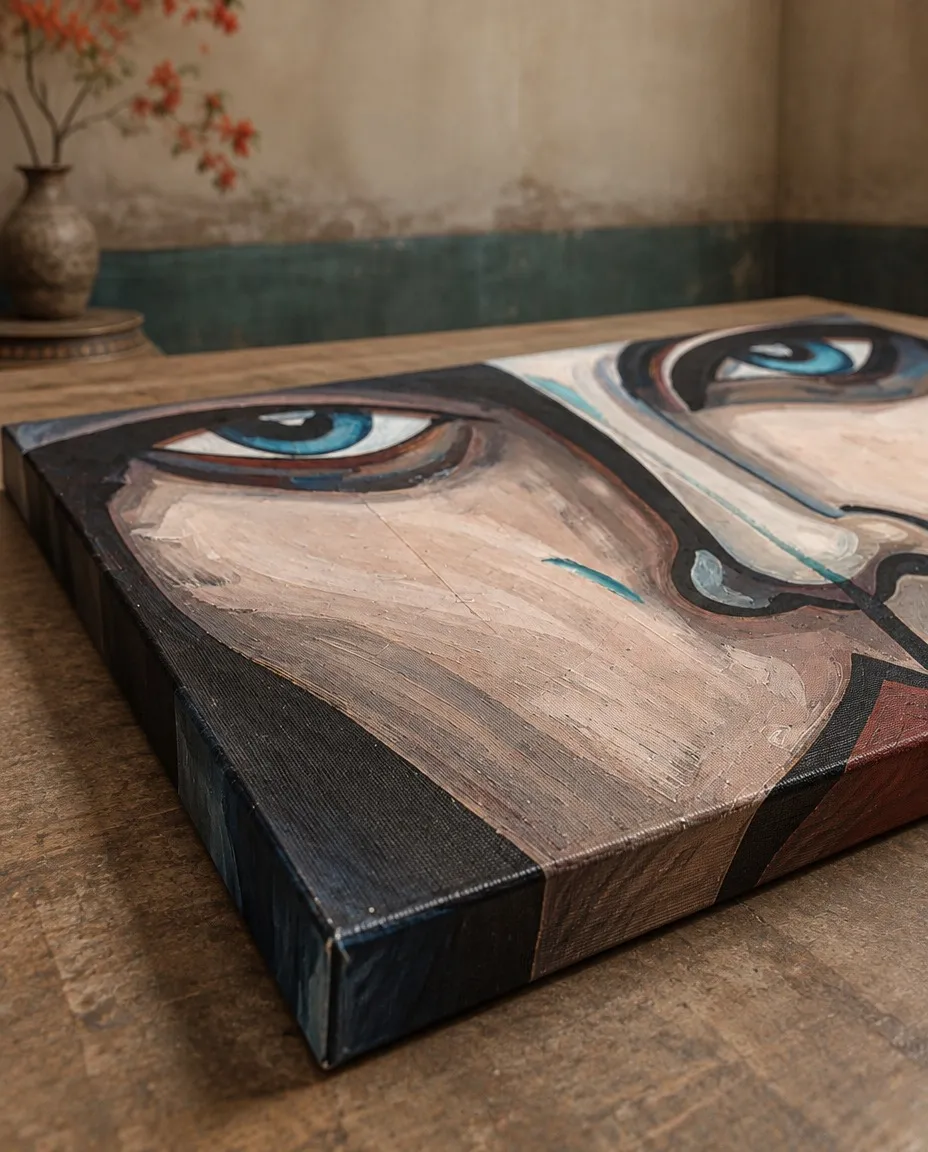
Context study / CUTIS
CUTIS by Maurizio Valch | Fragmented Face Painting
To contemplate “CUTIS” at its imposing scale of 210 × 140 centimetres is to confront a presence that exceeds the conventional limits of portraiture, becoming a wall of flesh, a tactile and brutalist geography in which oil and acrylic operate like geological sediments. The monumental face that dominates the canvas does not present itself as an accommodating surface, but as a territory eroded by time and matter; dense brushstrokes, applied decisively with a palette knife, evoke cracked skin, marked by weary ochres and browns that sink beneath the eye sockets. It is within this rough topography that fragility emerges most strongly, embodied eloquently in the incision of bright turquoise that cuts horizontally across the left cheek. This mark of pure, cool pigment acts like a crack in the earth’s crust, a reminder that the surface that contains and defines us—skin as the archive of our existence—is always exposed to the elements and to inevitable fracture, revealing the body’s material vulnerability beneath the weight of its own history.
When I faced the blank space of the canvas, I understood that this face would only truly come alive through the rigor of the cut; I therefore drew the large vertical incision that descends relentlessly through the centre of the composition, dividing the bridge of the nose and bifurcating the lips. This dark, emphatic line is not merely a device of formal balance, but the materialisation of a never: an absolute physical and conceptual limit, an impassable boundary that separates the two halves of this mask forever, foreclosing any possibility of symmetrical reconciliation. During the process of making the work, as I scraped away successive layers of acrylic and oil with the palette knife, I felt that each gesture of abrasion consecrated an irreversible loss, a wound in the support that refuses to recede. “Never” is the law governing my painting: the certainty that the canvas, once worked with the vehemence of metal against cloth, retains the memory of the cut as a structural scar that cannot be erased, turning the surface into a silent testimony to what has been irreparably split.
Amid this surface ravaged by scraping and fractured by the central line, the two immense blue eyes that dominate the composition impose a magnetic silence. These spheres of pure, translucent colour, sharply contrasting with the earthy heaviness around them, sustain a gaze that appears suspended beyond chronological time. Here beatitude emerges, understood not as complacent joy or naïve lightness, but as a strange and solemn grace reached precisely when resistance has ceased and pain has run its course. The pupils of “CUTIS” neither seek the viewer’s approval nor flee their divided condition; instead, they contemplate space from an expanded, timeless present, showing that the deepest stillness is not born of immunity to the wound, but of the sovereign capacity to meet the gaze directly, with unshakeable dignity, from the very heart of the fracture.
I conceive this monumental “cutis” not only as the skin of an anonymous figure, but as the outer layer of the earth itself: an exceptionally sensitive membrane in which the individual and the collective settle into layers of chromatic memory. In my daily practice, I experience a constant tension between the extreme fragility of translucent glazes that suggest flesh and the brutal resistance of the heavy dark blocks framing the head, constraining the pictorial space. I know that I am not seeking idealised beauty or a spiritual escape into pure abstraction; for me, the subject’s true ascent or transfiguration does not occur by evading matter, but by sinking deeply into it. Working from the roughness of the textured canvas, building pigment up and dragging it forcefully to reveal the lower strata, is my way of inhabiting the real limit of flesh, accepting that transcendence is possible only when we dare to excavate our own ruins.
Ultimately, “CUTIS” dissolves the contemplative distance between the work and its viewer, turning the exhibition space into an emphatically tactile edge where the spectator is addressed by an almost architectural presence. The work functions as a mirror of the human being’s psychophysical unity, in which painted matter and psychological dimension are integrated seamlessly. By bringing together the fragility of that worn surface, the unalterable limit of the never imposed by the central incision, and the unwavering beatitude of those blue eyes, Maurizio Valch offers a visual meditation of considerable poetic force. It is precisely the unconditional acceptance of that “never”—of the definitive cut that constitutes us and of time that does not turn back—that allows the vulnerability of flesh to be transfigured into a suspended peace: a quiet, enduring grace that proudly inhabits the beautiful imperfection of a canvas that resists healing completely.
- Original artwork
- CUTIS
- Actual dimensions
- 82.7 × 55.1 in / 210 × 140 cm
- Presentation
- Digital contextual visualization
Context references
CUTIS Maurizio Valch · fragmented face painting · blue eyes painting · contemporary art with abstract face · large-scale material painting · textured painting with incisions · abstract figurative wall painting · wall art with monumental face
About this visualization
This visualization places the artwork within an architectural context to help collectors and viewers imagine its presence in a real space. It is an interpretive reference, not an exact reproduction: the original work remains the sole authority for scale, color, surface and material presence.