Context study / CUTIS
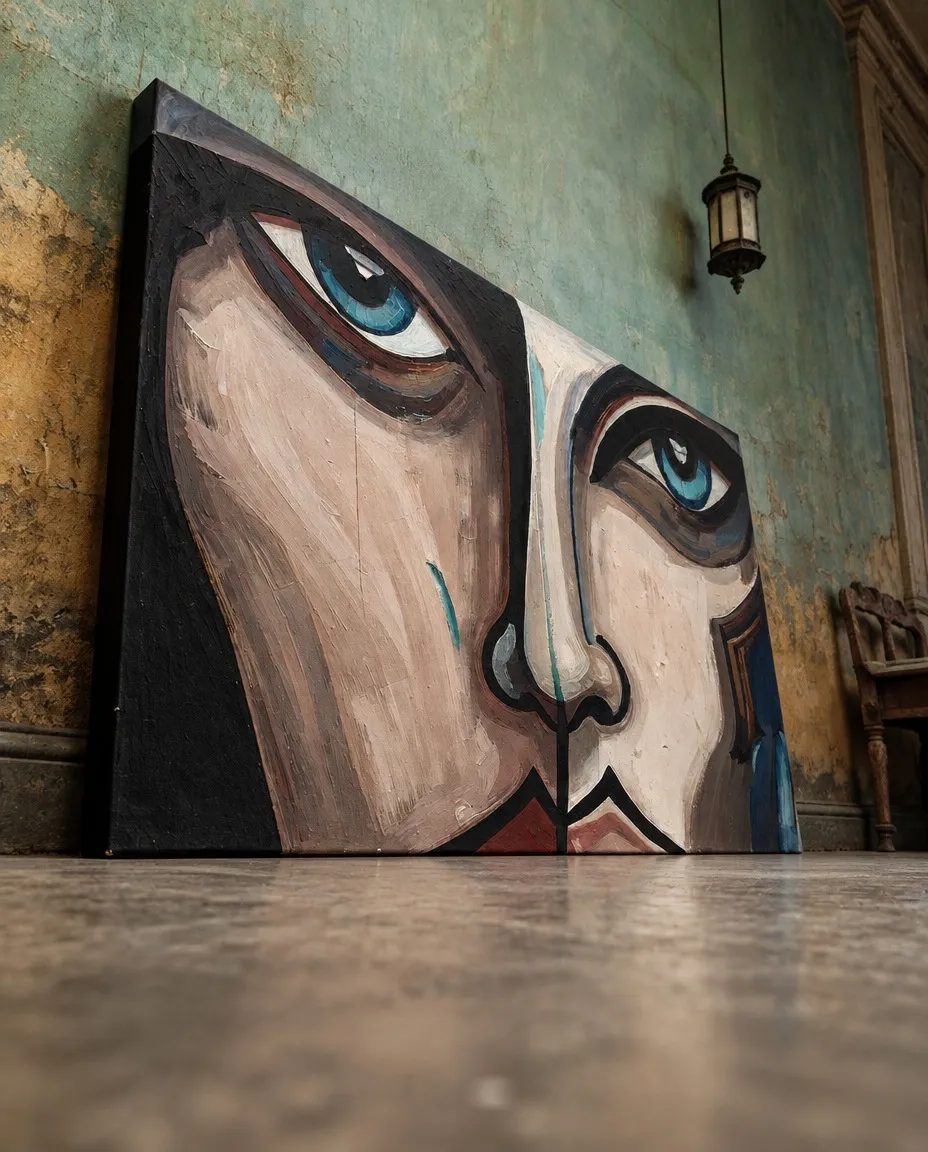
CUTIS by Maurizio Valch, side view of the surface
In “CUTIS”, portraiture abandons its traditional function of mimesis and identity to become a cartography of the face-as-territory: a space of resistance in which skin is understood as a surface of geological sedimentation and an existential boundary. Far from the complacency of harmonious physiognomy, the work confronts us with a fractured symmetry, vertically divided by a pronounced and brutal central dark line that functions like a surgical incision or territorial fissure, setting up an irreconcilable visual tension between two halves of the same psychological experience. It is in the magnetic gaze of those eyes of indigo blue and vivid turquoise that longing ceases to be a projection into the future or a melancholic lament, becoming instead a stagnant presence: a muted, pulsating desire beating behind impasto oil paint and superimposed layers of colour, addressing the viewer from an absolute, suspended present.
When I approached the canvas to bring this face to life, I knew that my task was not to illustrate a volume, but to wound and construct painted matter in order to make flesh emerge from the physical conflict of oil paint itself. After years of exploring pure abstraction, incisions, and the superimposition of layers in series such as STRATA, I felt an urgent need to move that geological language towards the fragility of figuration. Painting this cutis thus became an act of complete surrender to the untamed nature of painting; it meant abandoning the rigidity of geometric structures in order to allow oil paint to behave like a living body that suffers the pressure of the palette knife, resists the brush’s scraping, and finally exposes itself in utter nakedness to another’s gaze, accepting its own material vulnerability.
The surface of the painting is thus offered as a tactile shore, a rough boundary where looking inevitably becomes an experience of epidermal and bodily contact. The chromatic details reveal a delicate archaeology of damage: the muted crimson tones of the sealed lips suggest a silence laden with history, while the turquoise incision on the left cheek appears as an exposed scar, a watermark or wound of memory inscribed in the fabric of the face. All of this is framed by dark shadows of a brutalist character that accentuate the gravity of the gaze. It is here that mercy manifests itself—not as a condescending sentiment of pity, but as a somatic disposition within the painting itself to sustain its gaze before an identity that is fragmenting. Care and compassion reside in the fact that the painting does not conceal its scrapings, glazes, or revisions, offering a dignified refuge for what is unfinished and wounded.
I understand perfectly that holding one’s gaze before those immense eyes I have painted generates an almost unbearable ethical and emotional tension, a mirror questioning the depths of anyone who pauses before the canvas. In my creative process, mercy is neither a sacred concept nor a mystical absolution, but the human and honest acceptance of the imperfection of pictorial form; it is my conscious decision not to erase the wounded line or conceal the violent asymmetry of the face. By preserving this wound on the canvas, I seek to establish a genuine bond with the viewer—a silent bridge through which painting ceases to be an object of visual consumption and becomes a threshold of tactile contact, a meeting place where both of us may recognise ourselves as vulnerable and therefore profoundly connected.
In conclusion, in “CUTIS,” longing, surrender, and mercy cease to be abstract concepts or external psychological readings and become definitively embodied in the geology of oil paint itself. Standing before Maurizio Valch’s work, the viewer finds themselves reflected in that monumental, two-sided gaze, accepting that every identity is a stratified construction, a territory we inherit and continually transform through contact and conflict with others. The real force of this piece lies in its capacity to suspend analytical control and the urge to explain, poetically inviting us to inhabit the edge of this fragmented face without ever attempting to tame its overwhelming mystery.
- Original artwork
- CUTIS
- Actual dimensions
- 82.7 × 55.1 in / 210 × 140 cm
- Presentation
- Digital contextual visualization
Context references
CUTIS Maurizio Valch side view · fragmented face painting detail · painting with blue eyes and earthen planes · canvas depth in contemporary painting · painted surface with visible brushstrokes · Maurizio Valch FACIES artwork
About this visualization
This visualization places the artwork within an architectural context to help collectors and viewers imagine its presence in a real space. It is an interpretive reference, not an exact reproduction: the original work remains the sole authority for scale, color, surface and material presence.