Context study / CUTIS
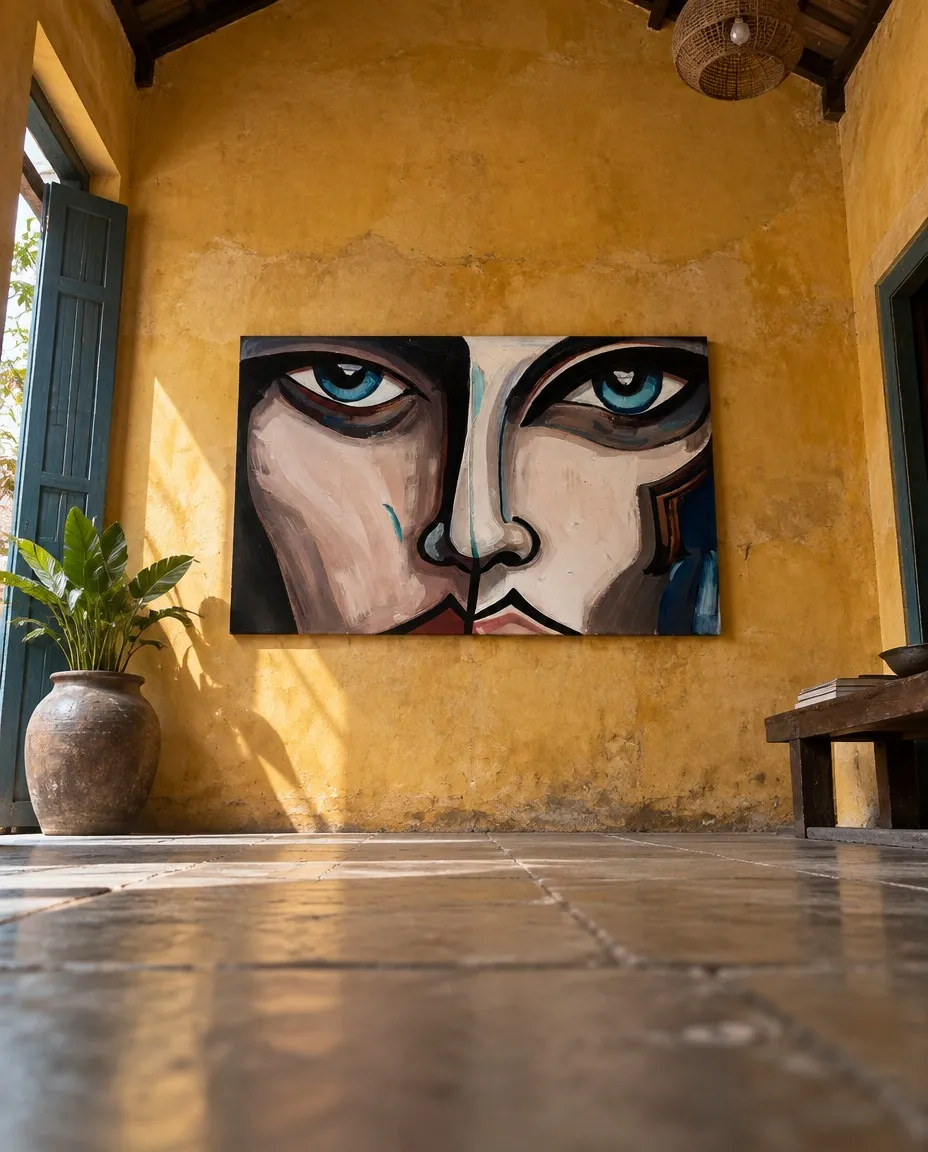
CUTIS by Maurizio Valch in an interior with a yellow wall
The monumentality of “CUTIS”, realised in its imposing dimensions of 210 by 140 centimetres, immediately overturns the traditional notion of portraiture in order to establish a purely geological and material territory. Here, the face does not function as a mirror of inner psychology or personal narrative, but as a wall of pigments and tactile sedimentation in which identity is redefined as a surface of friction and boundary. This exposed identity is manifested in the brutal asymmetry that divides the physiognomy: a split plane that disrupts anatomical harmony to propose a map of harsh tensions. The turquoise incision cutting across the left cheek acts as a chromatic landmark, a scar reminding us that the self is not an immutable core, but a covering exposed to the elements of space and the gaze of others—a membrane in which being is defined precisely through its own fracture.
When I confronted this large-format canvas, I understood that painting did not consist in filling a void, but in excavating the density of matter to find its biological pulse. I remember the exact moment I decided to draw that emphatic vertical line across the bridge of the nose, splitting the lips into two autonomous halves; it was not a destructive gesture, but an act of physical opening, a necessary cut through which to introduce breath into the studio. As I cut into the mass of oil paint, the outer air seemed to claim its place within the painting, transforming the static surface into a living organism that inhales and exhales through its pores of acrylic and oil. In that violent caesura, I lost absolute control over representation: I stopped directing the work and became a witness to the way the painted plane began to ventilate itself, pulsing under the weight of its own gravity and reminding me that painting must breathe before it can signify.
The magnetism of the composition crystallises inexorably in the abyss of its two colossal blue eyes, whose visual impact draws the viewer into a state of profound perceptual intoxication. This intoxication is not associated with a loss of reason, but with a purely sensory rapture, an optical vertigo that destabilises the frameworks of everyday logic before the immensity of the pupils. There is a compelling tension between the brutalist heaviness of the dark, earthen brushstrokes enclosing the eye sockets—dense strokes that form an almost stony basin—and the liquid, electric, clear vibration of the blue pulsing at their centre. In holding this face-to-face encounter, the oversized gaze in the painting dissolves the physical boundaries of the observer, drawing them into a chromatic immersion where the weight of their surroundings disappears and their body is left suspended, held by the power concentrated within this monumental skin.
Coming from a practice in which territorial abstraction and the canvas’s orography were everything, approaching a human face presented a paradox that I could only resolve through stripping away. I did not wish to portray anyone; my effort was to systematically erase every trace of biographical anecdote or recognisable physiognomy, scraping back the dark contours and building up layers of matter in order to retain only the skeletal and elemental structure of presence. In the intimacy of that process of suppression, my own identity as a maker dissolved completely; I allowed myself to be carried by a technical intoxication in which the weight of pigment dictated the path and the palette knife moved between geometric control and the acceptance of physical accident. In that dialogue with error and the rubbing of paint, I discovered that, for this monumental face to emerge with its full anonymous force, I too had to disappear into the tactile crust of the canvas.
Ultimately, “CUTIS” stands as a visual syncopation within the noise of everyday life, an interval of rhythmic silence that interrupts contemporary acceleration and returns us to the density of the instant. Bringing together the tension of a fragmented identity, the rhythmic breath of its divided forms, and the silent intoxication of its cerulean pupils, Maurizio Valch’s work ceases to be a mere figurative window and becomes an absolute material boundary confronting us with our own corporeality. There is no illusion or escape in this wall of oil paint; there is a tactile invitation to set aside the masks of social identity and rest in the density of an unfinished present. On this surface, wounded by incisions and ignited by blue, the viewer ceases to seek fixed meanings and yields to the astonishment of a pure presence that simply takes place before them.
- Original artwork
- CUTIS
- Actual dimensions
- 82.7 × 55.1 in / 210 × 140 cm
- Presentation
- Digital contextual visualization
Context references
CUTIS Maurizio Valch · divided face painting with blue eyes · large-format artwork for a yellow wall · contemporary painting for a Mediterranean interior · large-format abstract figurative art · Maurizio Valch FACIES artwork
About this visualization
This visualization places the artwork within an architectural context to help collectors and viewers imagine its presence in a real space. It is an interpretive reference, not an exact reproduction: the original work remains the sole authority for scale, color, surface and material presence.