Context study / CUTIS
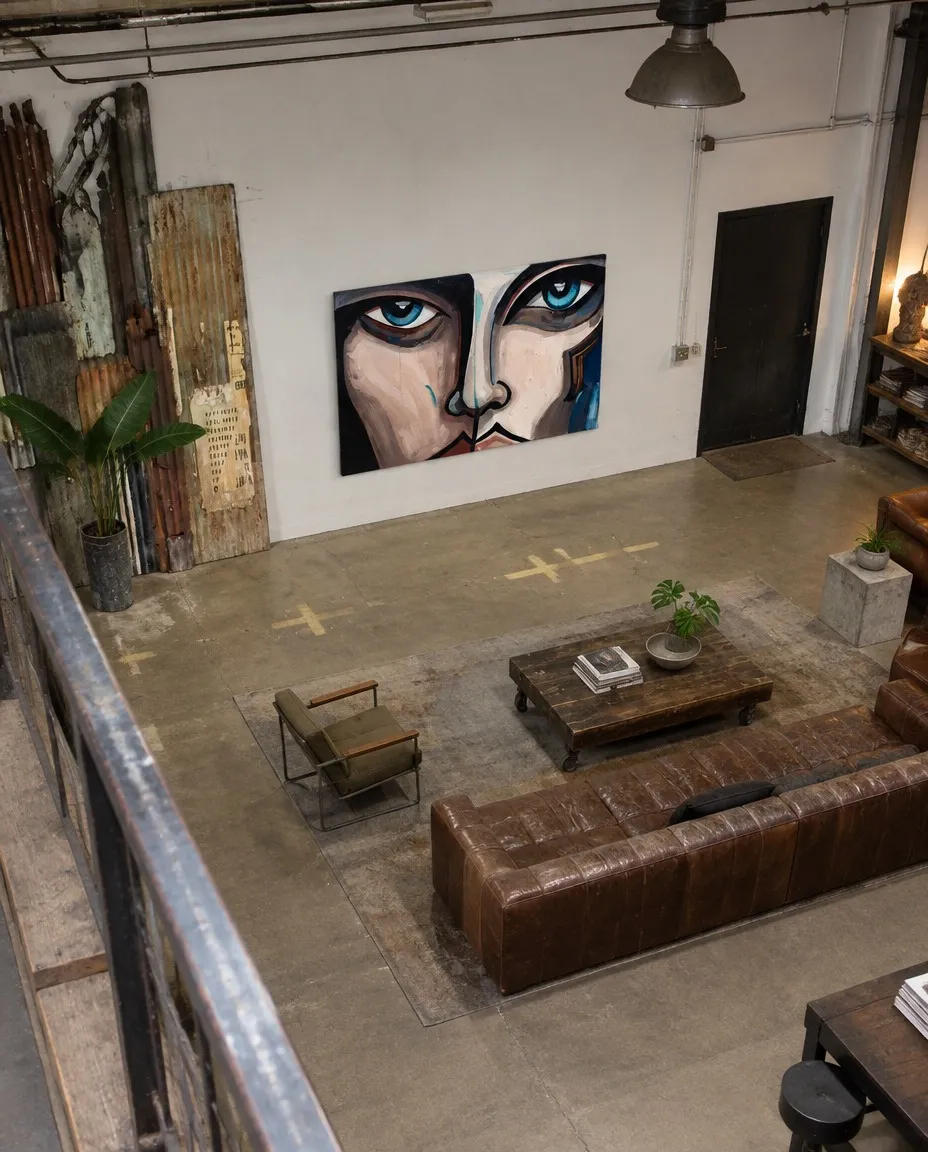
CUTIS by Maurizio Valch in an industrial living room
The monumentality of “CUTIS” asserts itself in space not as a mere representation of human physiognomy, but as a tectonic wall that constricts the limits of the frame until any possibility of background is suffocated. Stripped of a protective atmosphere or referential context, the face is pushed towards a brutal immediacy in which the canvas surface merges with skin itself. This physical and compositional proximity places the viewer before the radical notion of exposure to the elements: the face does not shelter behind the distance of conventional portraiture, but offers itself wholly exposed, unprotected against the forces of its surroundings. Areas of dense shadow, an almost architectural black outlining the forehead and cheekbones, do not operate here as transitions of light, but as buttresses containing the painted mass. Amid this mineral aridity, the sharply blue eyes do not act as windows onto a psychological interior, but as two icy horizons, two basins of still water suspended in a territory of rock, dust, and pigment.
When I confront a canvas on this scale, I understand painting not as an illustration of a countenance, but as an excavation into the support—an attempt to transfer my earlier exploration of geological strata and territory to the living surface of skin. For me, acrylic and oil are not mere vehicles for colour, but physical sediments that I accumulate with the palette knife, seeking to make matter itself embody weariness: a weariness that should not be understood as weakness or surrender, but as the historical accumulation of tensions, pressures, and frictions across the surface of the painting. Each pass of the tool is a stratum weighing upon the preceding one. Thus, the vertical incision that divides the nose and mouth, as well as the blue-green mark that tears across the cheek, are not calculated drawn lines; they are physical cuts, grooves in which the palette knife wears away the plane to reveal the resistance of the underlying support, exposing the fragility and erosion of a crust that has borne its own process of sedimentation.
A fundamental paradox lies in the structure of this work, defined by the violent black line that cuts vertically through the face, threatening to divide it into two autonomous halves, strange to one another. Yet in the face of this explicit fracture, a force of somatic continuity operates, suturing both parts and holding them together within a single structural tension. This continuity is not achieved through a peaceful or harmonious balance, but through rigorous chromatic cohesion: earth tones, muted ochres, ash greys, and flesh-like shades move from one side of the plane to the other, crossing the boundary of the black incision as though seeking a reconciliation of matter. In this way, cutis is revealed as a cartographic map in which the tectonic plates of the face, despite being displaced and cracked, refuse to break apart. Together they withstand the pressure of the surrounding void, showing that fracture is also the place where parts recognise and need one another.
When I hold the palette knife and define the gaze of those two monumental eyes, my intention is to question outer space through the density of matter. Holding the viewer’s gaze through oil paint entails an exhausting physical effort: I must tension the colour and precisely adjust the edges of the eyelids so that the form neither collapses nor dissolves into pure abstraction. The use of indigo blue and turquoise in the pupils responds to the need to introduce a disruptive element, a cool discharge interrupting the mineral, earthen heaviness of the skin. For me, painting these eyes means establishing a boundary; it means placing the face on an unstable threshold where exposed anatomy resists the exposure to the elements of daylight, refusing to become a purely geological landscape and claiming, in its symmetrical fixity, an active presence that returns the gaze with the same force with which it is observed.
Ultimately, “CUTIS” takes shape as a rigorous record of time and physical action upon matter. The three forces running through the work—the weariness of paint strata built up with the palette knife, the harshness of an exposure to the elements that strips the face of every refuge, and the continuity of a structure that survives its own division—are resolved in the painting’s textured surface. Far from proposing a metaphorical or spiritual resolution, Valch’s painting asserts its strict objecthood: the work is a rough, wounded, dense crust that, like human skin or the earth’s outer layer, preserves the traces of the pressures, cuts, and frictions that have shaped it. The canvas does not simulate life; it becomes a physical body claiming its own sovereignty in space, appearing before us as a weathered relief that remains unaltered by the passage of time.
- Original artwork
- CUTIS
- Actual dimensions
- 82.7 × 55.1 in / 210 × 140 cm
- Presentation
- Digital contextual visualization
Context references
CUTIS Maurizio Valch · face painting for an industrial living room · contemporary painting for a loft · wall art for an industrial-style living room · abstract face with blue eyes · Maurizio Valch FACIES artwork
About this visualization
This visualization places the artwork within an architectural context to help collectors and viewers imagine its presence in a real space. It is an interpretive reference, not an exact reproduction: the original work remains the sole authority for scale, color, surface and material presence.