Context study / CUTIS
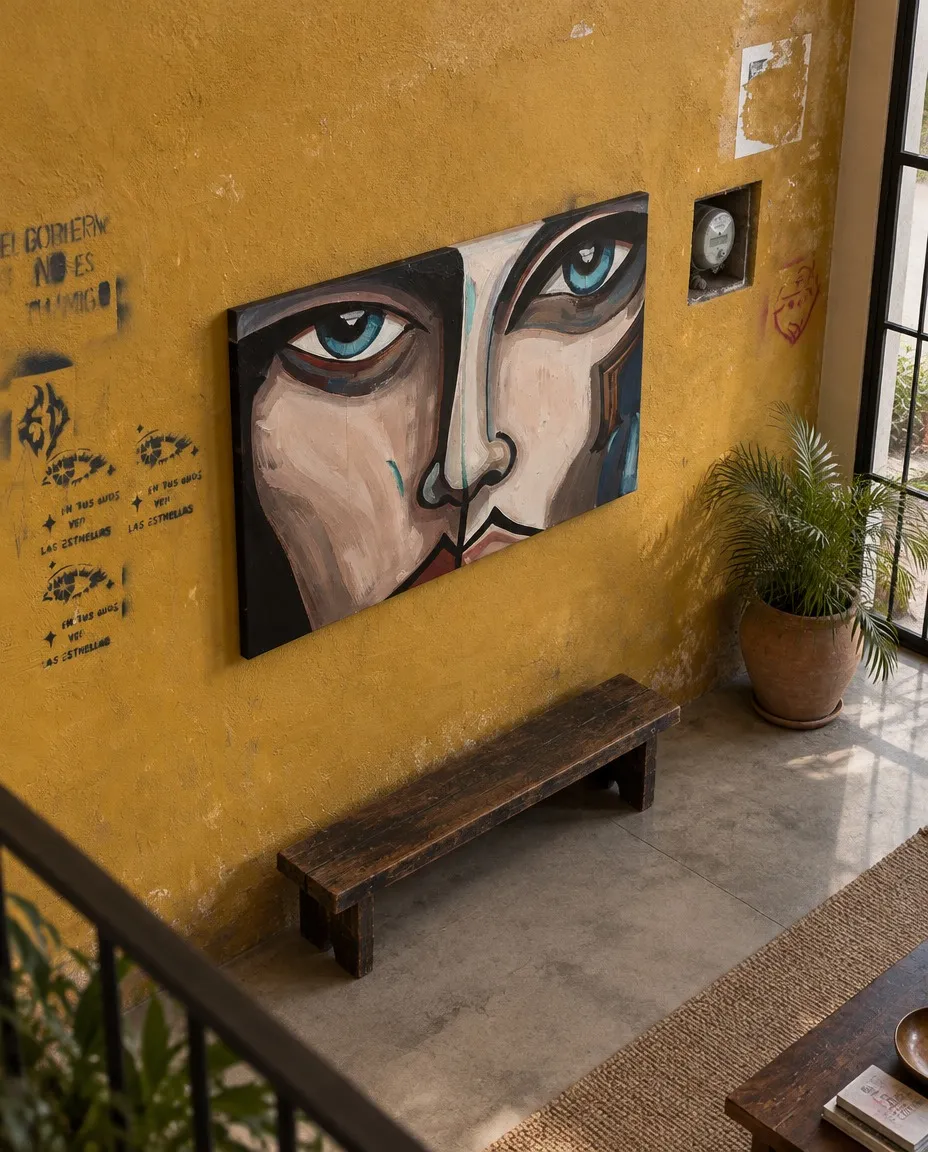
CUTIS by Maurizio Valch in an ochre-walled interior
The surface of CUTIS does not function as a window simulating depth, but as a territory under constant physical pressure. Oil and acrylic accumulate on the 210 × 140 cm support with the density of a geological crust, where the human face is exposed to a vertical cut that segments it relentlessly. This tectonic fault alters the symmetry of the nose and displaces the corner of the lips, creating an uncertainty that does not belong to the realm of mental doubt but to the physics of form. The viewer stands before a map of chromatic planes held in tension, where the face appears to oscillate between imminent disintegration and the resistance of its own mass. The two halves do not quite fit together; the flesh of the canvas reveals that identity, far from being a smooth or pacified surface, is a continuous friction of material plates seeking an unattainable balance.
In working on this canvas format, my interest does not lie in illustrating a physiognomy, but in registering the behaviour of matter under the weight of my own gesture. I construct this face through superimposed dense layers, pigment sediments and reductions that carve volume across the horizontal plane. When I decide to draw that turquoise incision on the left cheek, I do not seek to represent an open wound or a destructive gesture; on the contrary, I understand that precise cut as an act of strictly material shelter. The incision cuts through the heaviness of the earth and grey tones, opening a slit that allows the painting to breathe and hold itself up. For me, the shelter offered by painting is not symbolic consolation, but the capacity of a rough surface to contain the trace of a physical action, to offer a resistant framework and a tactile refuge where the memory of matter may consolidate against the passage of time.
The painting’s true dynamism is concentrated in the vibration of the irises, where colour abandons its descriptive function to become a flash that cleaves the composition. Joy emerges from this gaze not as a cheerful emotion, but as a discharge of pure energy, a turquoise and indigo burst that interrupts the gravity of the dense dark masses surrounding the eyelids. This chromatic force acts as a physical resistance to the inertia of ochres and greys. There is a constructive forcefulness in the way blue claims its space within the cut of the face, operating as a threshold or suspended portal that seems to push matter out from the plane. Joy here is measured by the intensity of that optical vibration, by the purity of a pigment that refuses to be assimilated by the surrounding shadow and remains active, vibrating before the eye that confronts it.
I conceive the space of the painting as a tactile edge, a boundary where my body and the volume of the work come into contact before it is delivered into the space of the room. In raising these two immense blue eyes, my intention is not to propose a psychological narrative with which the observer can immediately empathise, but to return a physical presence, a mute volume that alters the temperature of the room. I constantly ask myself how the uncertainty of this fragmented gaze and the strident joy of its colour resonate in the body of the person who pauses before it. In the end, painting this face is an attempt to compel the viewer’s body to recalibrate its distance, to require a silence and attention that cannot be resolved in a quick glance, but in recognising a pictorial mass that occupies real space and resists according to its own laws of gravity.
In the material resolution of CUTIS, shelter, uncertainty and joy cease to be divergent concepts and come together, sustaining one another on the same textured surface. The painting shows that a face’s true shelter lies neither in perfect symmetry nor in concealing its fractures, but in its capacity to incorporate the uncertainty of the dividing line as its structural axis and to project the joy of its blue gaze as a bastion of formal persistence. The work does not ask to be deciphered, translated or reduced to a stable meaning; it demands that the observer remain before its physical weight, its monumental scale and its undeniable material honesty. It is in that silent duration that the painting is completed—not as a resolved enigma, but as a block of paint and canvas that sustains the gaze with the dignity of an untamed geography.
- Original artwork
- CUTIS
- Actual dimensions
- 82.7 × 55.1 in / 210 × 140 cm
- Presentation
- Digital contextual visualization
Context references
CUTIS Maurizio Valch · fragmented face painting with blue eyes · large painting for an ochre wall · contemporary art for a rustic interior · face painting in industrial decor · FACIES work by Maurizio Valch
About this visualization
This visualization places the artwork within an architectural context to help collectors and viewers imagine its presence in a real space. It is an interpretive reference, not an exact reproduction: the original work remains the sole authority for scale, color, surface and material presence.