Context study / CUTIS
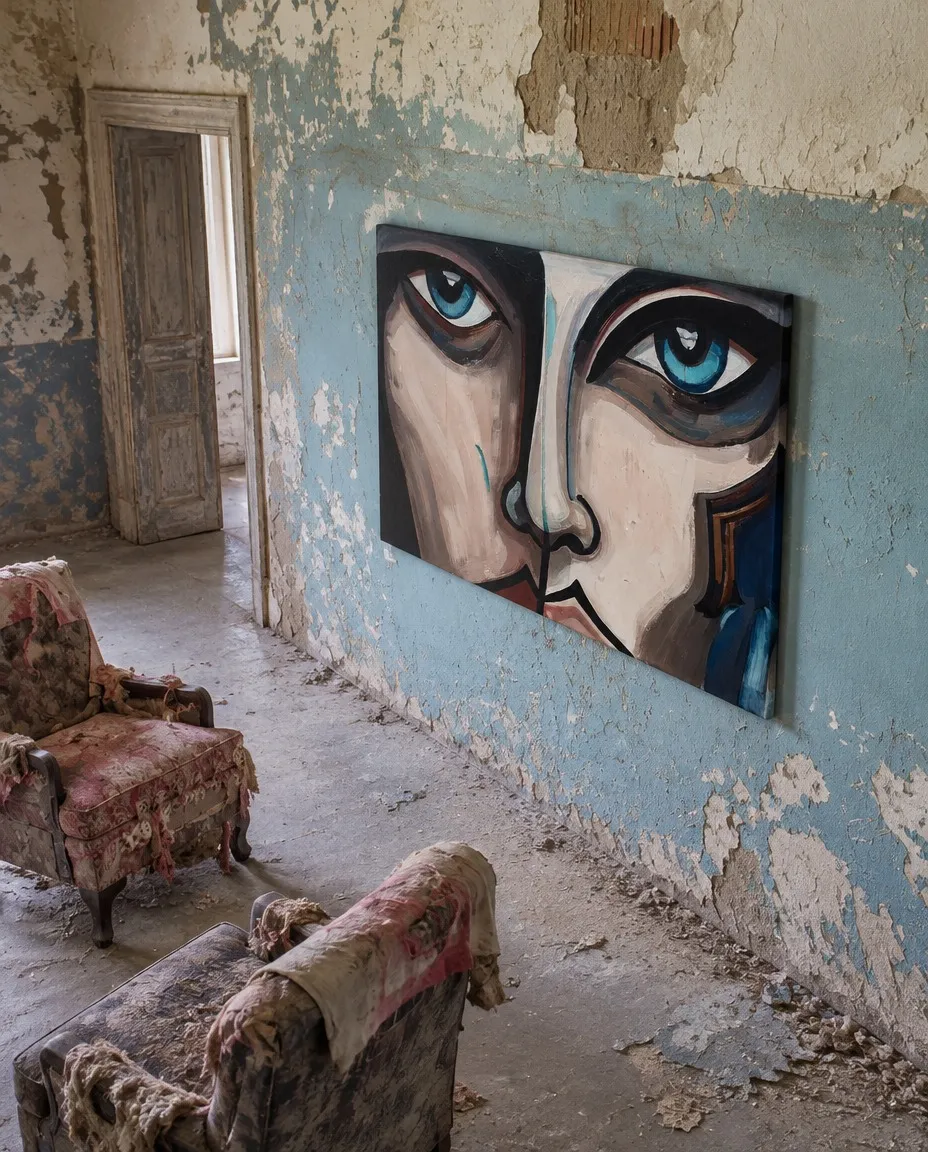
CUTIS by Maurizio Valch in a room with a weathered blue wall
The visual confrontation with CUTIS occurs all at once, like a physical jolt that alters the scale of the surrounding space. The monumental face dominating the composition asserts its presence not through figurative mimesis, but through a rigorous organisation of formal tensions. The clarity in this work from the STRATA series should not be understood as the cleanliness of overhead light or the unveiling of a peaceful truth; on the contrary, it is a resistant clarity, born from the symmetrical and magnetic gaze of those piercing blue eyes that address the viewer directly. This organising force finds its axis in the vertical incision, a turquoise and sky-blue stroke cutting through the face from top to bottom. Far from being a mere dividing line, this chromatic scar acts as an element of structural order: it is the fissure that, by fracturing the surface of the face, introduces an inner light and defines the spatial coordinates of the painting, allowing the composition to breathe amid its material density.
In my studio process, the essence of a face is not revealed by stripping away its surface attributes in search of an invisible soul; for me, essence lies in the relentless accumulation of material on the canvas. Working with oil and acrylic, I do not intend to illustrate skin, but to build it through successive impastos, scrapings and glazes layered like geological sediments. Each layer that I apply and then wear down with the palette knife or coarse brush seeks to transform the portrait into a territory of tactile memory. When I make the vertical incision that fractures the nose and lips, I am not destroying the form but founding a new topography. It is a physical act of penetrating the support, in which dense matter and the wound in the pictorial plane cease to be accidents and become the very structure of the identity I seek to establish in every work of STRATA.
This particular morphology of the canvas activates a phenomenon of rigorous reciprocity between the work and the person who contemplates it, collapsing the safe distance that usually separates the viewer from the art object. The monumental blue eyes of CUTIS, suspended in an almost architectural fixity, return the gaze with an intensity that disarms passive contemplation. The observer does not stand before an inert two-dimensional representation; they stand before a surface that looks back, a material mirror reflecting their own vulnerability. The flesh, dark and earthen tones surrounding the gaze contrast sharply with the coldness of the blue, establishing a mutual correspondence in which the viewer is incorporated into the work through the rough texture of the canvas, recognising themselves in the strata and reliefs that simulate the marks of time.
By dividing this face into two halves, I seek for the clarity of the dividing line and the search for material essence to meet in the pure reciprocity of opposites. I work each half of the canvas as an autonomous plane that nevertheless needs the other to sustain its weight: the left side sinks into a dense, earthy penumbra, while the right emerges beneath a cleaner, more modelled light. The icy, electric blue of the eyes functions as a thermal bridge against the warm crimson and ochre tones of the cutis. For me, the canvas is neither an illusory window nor a wall decoration; it is an exposed body breathing its own gravity, a support in which the friction between light and shadow generates a real physical tension that sustains the gaze of anyone who dares to stand before it.
Finally, CUTIS is defined as a radical reconfiguration of the concept of the boundary, in which skin no longer functions as a sealed barrier isolating individuality, but as an active membrane of contact and friction with the outside. In this final stratum of the STRATA series, structural clarity, material essence and the reciprocity of the gaze dissolve into an inseparable synthesis. The skin painted by Valch ceases to be the covering of a skull and becomes a border territory where the pictorial plane and the viewer’s space converge. In the end, the painting does not illustrate another person’s face, but embodies the precise place where matter and consciousness touch, recognising their mutual existence in the shared wound that divides and, paradoxically, unifies the composition.
- Original artwork
- CUTIS
- Actual dimensions
- 82.7 × 55.1 in / 210 × 140 cm
- Presentation
- Digital contextual visualization
Context references
CUTIS Maurizio Valch · divided face painting · large contemporary face painting · wall art for a vintage interior · painting with blue eyes and earth tones · FACIES work by Maurizio Valch
About this visualization
This visualization places the artwork within an architectural context to help collectors and viewers imagine its presence in a real space. It is an interpretive reference, not an exact reproduction: the original work remains the sole authority for scale, color, surface and material presence.