Context study / CUTIS
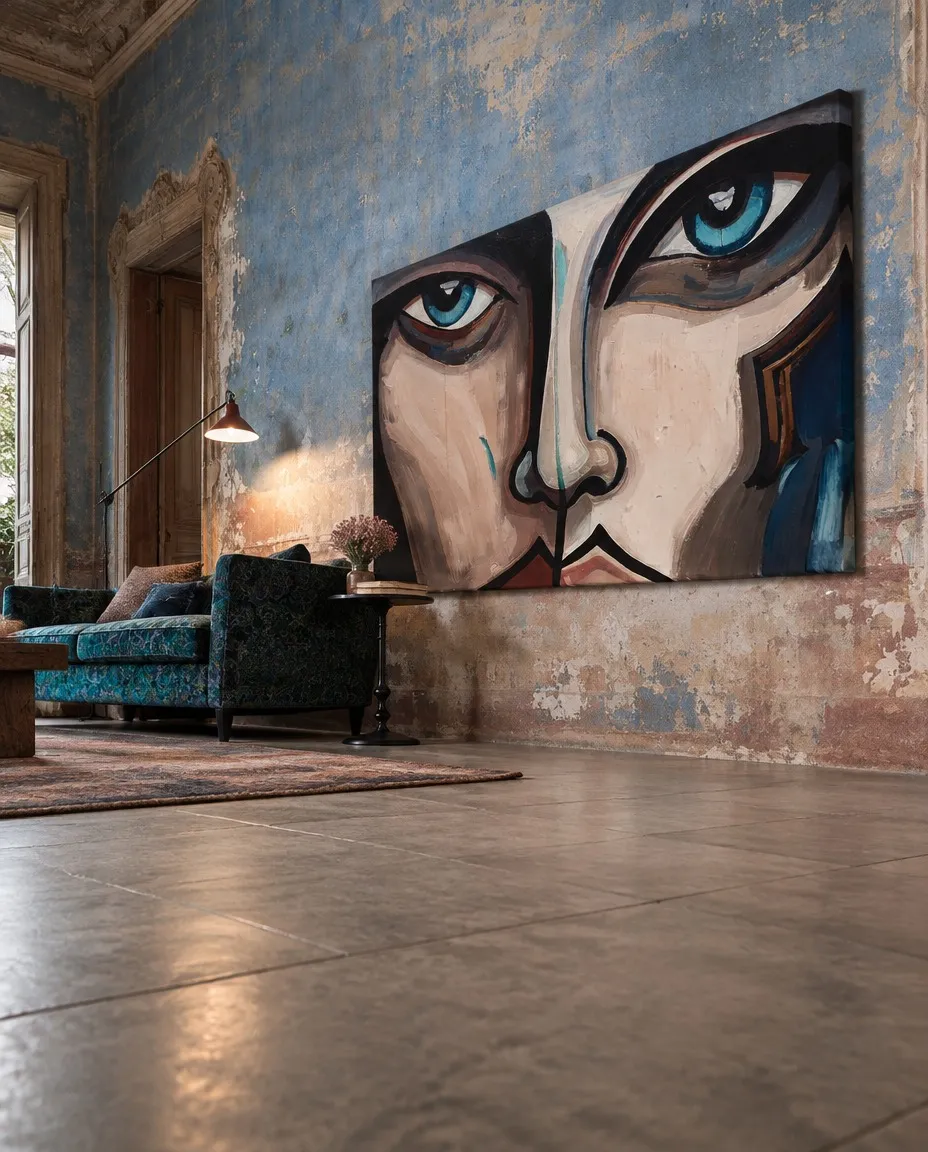
CUTIS by Maurizio Valch in a living room with an aged blue wall
Standing before the monumentality of “CUTIS”, the first glance is a tectonic shock that takes the breath away: two colossal eyes of electric, magnetic blue pin us to the ground with the force of an archaic immutability, as though they belonged to a prehistoric deity or a monolith that has withstood the erosion of centuries without yielding. This fixity, however, is not a peaceful territory but a silent battlefield; the face is crossed by a vertical cleft, a dark and brutal incision that divides it into two asymmetrical halves and breaks every attempt at classical harmony. Refusing to operate as a conventional psychological portrait, the painting presents itself as a wall of flesh or a cartographic territory in which symmetry is deliberately sabotaged, establishing an irreconcilable spatial tension that forces us to abandon the comfort of passive contemplation.
When confronting this large-scale canvas, I felt the physical urgency to intervene in the material not as one who illustrates a likeness, but as one who excavates the geography of deep flesh. I worked by layering dense coats of beige, ochre, black and flesh tones, seeking to have the palette knife and brush register the fatigue of the support itself; but it was the violent central line that ultimately structured the meaning of the painting, granting radical independence to each half of the face. I wanted the left and right eye, the left and right cheek, to cease belonging to a single harmonious identity and to begin claiming their own pictorial space, separating from one another like drifting tectonic plates. For me, this central incision is neither a graphic ornament nor a surface accident, but a real cut into the skin of the canvas that makes the forms independent and exposes the layers of memory and matter lying beneath the apparent unity of our social mask.
If we pause to examine the tactile details of the work, we discover that beneath the appearance of this great rigid, unchanging mask there beats a sensual and unsettling vibration. On the figure’s left cheek, an incised mark in turquoise and aqua green shines like a chromatic anomaly, a pulse of cold light disrupting the warmth of the earth tones. This luminous scar, together with the wet, dense, almost erotic brushwork outlining the corners of the mouth and the folds of the eyelids, turns the surface into a real “cutis”: a living, vulnerable and moist membrane that breathes before us. The vibration of the pupils, lit in a blue of mineral purity, introduces a visual counter-rhythm, a pulse that prevents the work from freezing into the final silence of immutability and transforms contemplation into a tactile, bodily encounter.
Now, as I stand before this creature that has come to life in my studio, I experience the strangeness of being watched by my own creation; these eyes, which I myself drew in oil, return a gaze charged with defiant immutability while also resonating with a profound and secret inner vibration. I wonder whether, in cutting the face with that great dividing line, I was in fact fleeing a suffocating symmetry that condemns us to paralysis, seeking instead the wild freedom of liberated matter. I understand then that the “cutis” of this canvas behaves exactly like my own skin and that of each of us: a living archive of pressures, frictions, cuts and everyday discoveries, where the true beauty of existence becomes visible and intelligible only when we dare to show the wound of our own fragmentation.
In its final resolution, “CUTIS” collapses any analytical distance and reveals itself to the viewer as a “tactile edge”, a threshold of pure friction where opposites reconcile without merging. In this canvas by Maurizio Valch, the immutability of the sacred mask that defies time, the independence of its two halves in permanent territorial dispute, and the sensual vibration of its textures and chromatic incisions coexist in a seamless unity. The work thus compels us to sustain our gaze before what is divided and held in tension, offering an unavoidable aesthetic and vital lesson: consciousness, art and life itself never arise from smooth, anaesthetised perfection, but from the rough density of skin that has had the courage to accept, register and beautify its own cuts.
- Original artwork
- CUTIS
- Actual dimensions
- 82.7 × 55.1 in / 210 × 140 cm
- Presentation
- Digital contextual visualization
Context references
CUTIS Maurizio Valch · monumental face painting · large blue-eye painting for a living room · contemporary art for a blue wall · asymmetrical face painting · FACIES work by Maurizio Valch
About this visualization
This visualization places the artwork within an architectural context to help collectors and viewers imagine its presence in a real space. It is an interpretive reference, not an exact reproduction: the original work remains the sole authority for scale, color, surface and material presence.