Context study / CUTIS
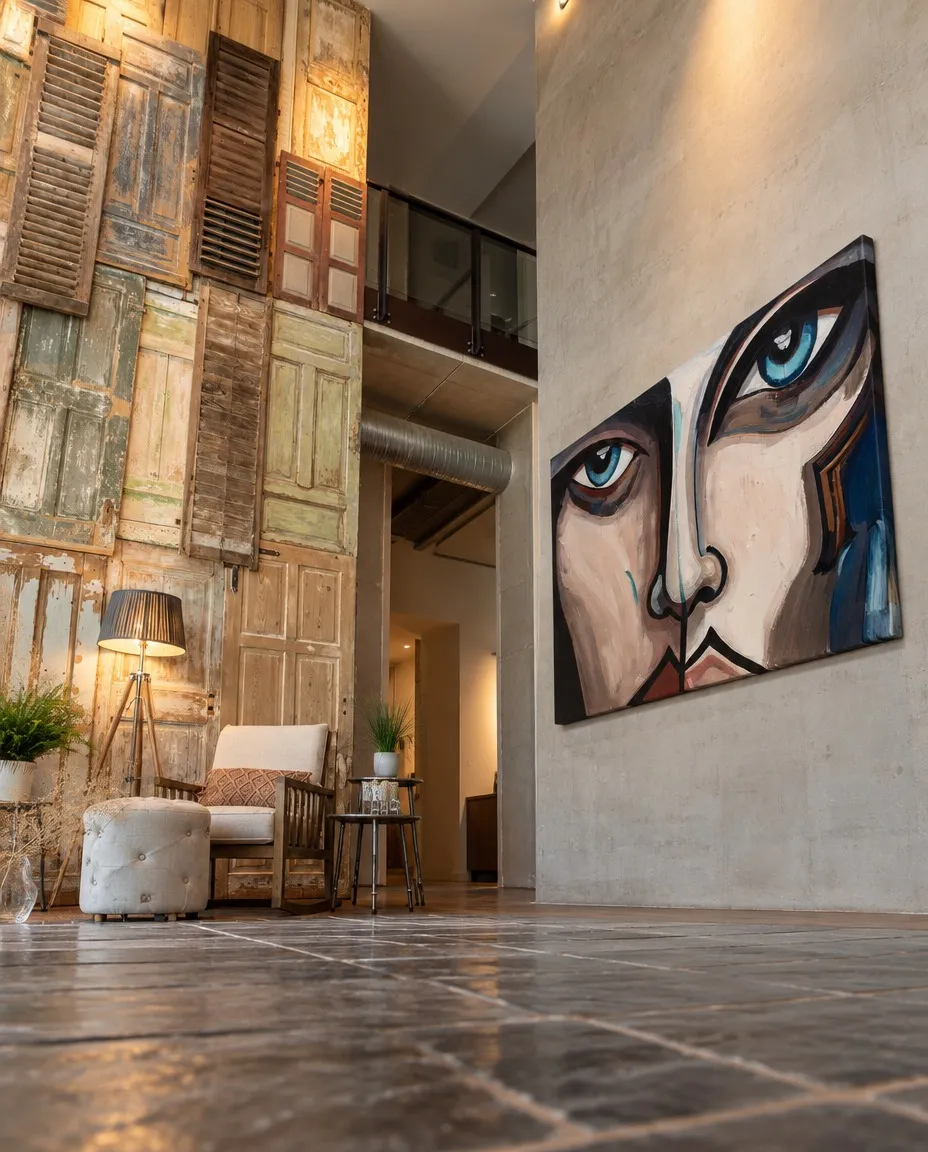
CUTIS by Maurizio Valch in an industrial-style loft
At the imposing scale of CUTIS (210 × 140 cm), the face ceases to function as a mere physiognomic representation and becomes a strictly material, exposed topography. Maurizio Valch does not offer a conventional psychological portrait here, but a geography of presence in which the extreme framing cuts off the forehead and the edges of the face, compelling us to confront a dense, magnetic blue gaze. The canvas surface becomes a tactile membrane that accumulates tensions; this is evident in the vertical marks and in the turquoise-green incision running down the cheek, a line that operates as a physical scar across the impasto. This pictorial skin—the cutis—functions as the record of a pain that avoids the theatricality of drama in order to manifest itself as a concrete mark: a precise cut in the material that interrupts chromatic continuity and exposes the vulnerability of the underlying layers.
When I face a canvas of this scale, my relationship with oil and acrylic becomes purely physical; I do not seek to illustrate pain, but to touch it through the weight and gesture of the material. Every pass of the palette knife across CUTIS has been a confrontation with the limits of my own language, an exercise in persistence in which I scrape, drag and attack the paint in order to force it to reveal its inner structure. That vertical incision dividing the face is not a graphic embellishment, but the result of a deliberate cut through which I seek to fissure the surface and find the threshold at which form resists. In the end, while working in the absolute solitude of the studio, I realised that those deep blue eyes emerging from the material were not merely a painted gaze, but the very territory of the work looking back at me, returning the question of my own vulnerability.
The duality structuring the composition of CUTIS dismantles any claim to a harmonious or unified identity. A dividing line descends relentlessly along the axis of the nose and lips, fragmenting the face into two distinct chromatic and emotional zones: on the left, a dense penumbra, almost brutalist and darkened in tone, suggests a defensive withdrawal; on the right, a harsh, exposed clarity reveals the nuances of the flesh without filters. This irreconcilable asymmetry places the viewer in a position of unavoidable confrontation. As one holds the fixed, monumental gaze of those blue eyes, contemplative distance disappears altogether. The viewer is drawn towards the tactile edge of the painting, where pain ceases to belong to the realm of the other and becomes a space of mutual resonance, a vibrating echo between the body that looks and the skin that is looked at.
For me, the surface of a face operates in the same way as the eroded walls of my STRATA series: it is an accumulator of time, a map of sediments in which every experience leaves an indelible trace. In painting this work, I conceived of the cutis as the ultimate territory of human experience, a crust exposed to the weather of existence. I often ask myself whether that incision in cold, intense tones crossing the cheek is testimony to a wound that remains open or, on the contrary, whether it represents the point of suture where a profound transformation begins. I am convinced that the true beauty of matter lies neither in symmetry nor in the correctness of forms, but in the honesty of collapse, in the refusal to conceal the seams and cuts that constitute us as vulnerable beings.
Ultimately, CUTIS does not present itself as an elegy to suffering, but as a profound statement on accepting fragility as the only possible condition for consciousness and movement. By dispensing with the defences and trench-like architecture that usually protect the socialised face, Maurizio Valch’s work offers itself as an open membrane in which interior and exterior enter into an unreserved dialogue. The fixed gaze of the canvas, stripped of any dramatic excess and sustained with unyielding sobriety, acts as a mirror inviting us to lay down our own everyday masks. It is a quiet reminder that only by accepting the honesty of our scars and the vulnerability of our skin can we allow light and change to enter through the incisions, transforming the original pain into a threshold of reconstruction and freedom.
- Original artwork
- CUTIS
- Actual dimensions
- 82.7 × 55.1 in / 210 × 140 cm
- Presentation
- Digital contextual visualization
Context references
CUTIS Maurizio Valch · face painting for an industrial loft · large contemporary painting for a living room · wall art with a face and blue eyes · large-scale contemporary figurative painting · FACIES work by Maurizio Valch
About this visualization
This visualization places the artwork within an architectural context to help collectors and viewers imagine its presence in a real space. It is an interpretive reference, not an exact reproduction: the original work remains the sole authority for scale, color, surface and material presence.