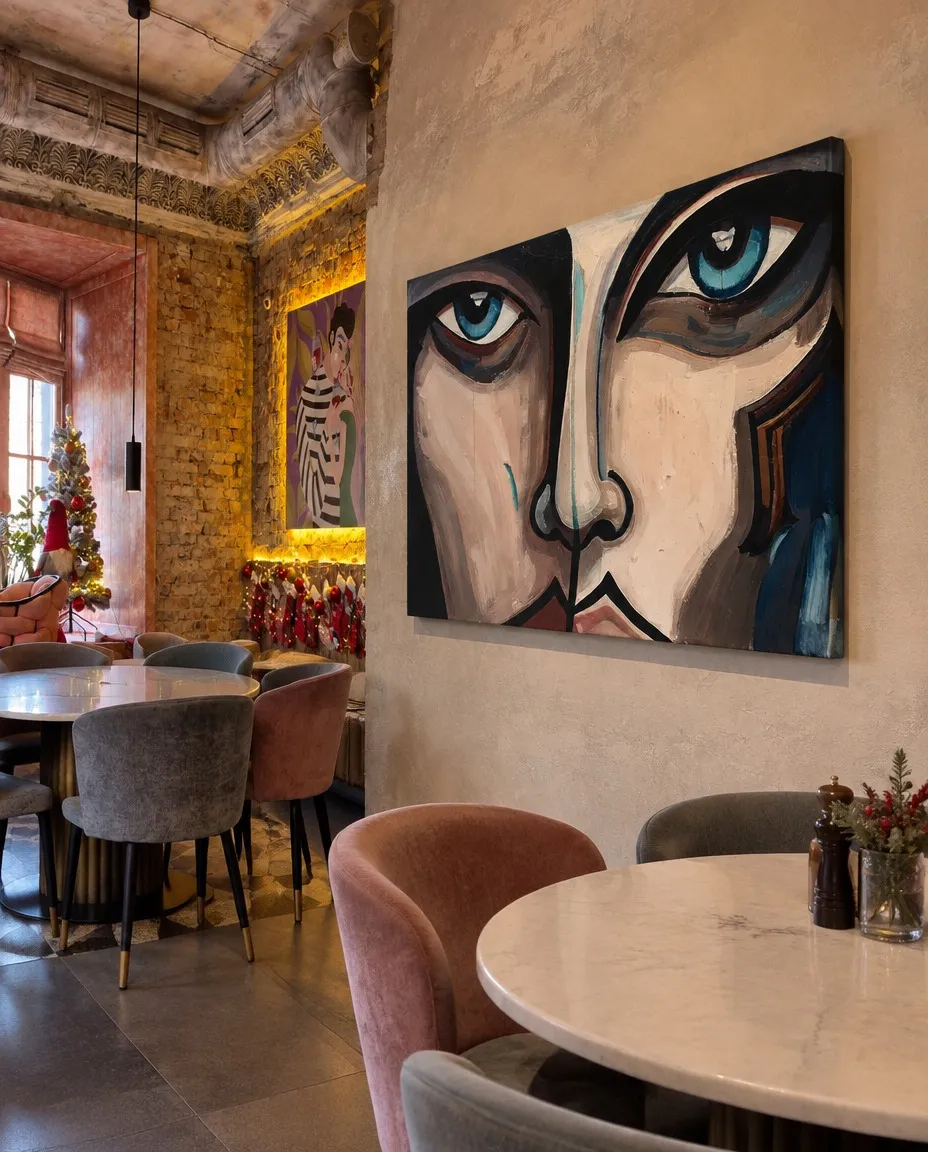
Context study / CUTIS
CUTIS by Maurizio Valch in a Restaurant Interior
“CUTIS” commands the space at a monumental scale, exceeding the format of traditional portraiture to become a cartography of matter. This colossal 210 × 140 cm face, captured in a constricting close-up that crops the limits of the skull and neck, is crossed by a vertical dividing line that fragments it into two asymmetrical hemispheres, turning the physiognomy into a kind of territorial abstraction. Earth, ochre, and flesh tones, applied with a pasty, mineral density, are interrupted and defined by dark, almost black strokes that delimit the features with an inescapable graphic violence. In this geography of painted flesh, the portrait loses its representational function and becomes an eroded surface. It is in this absolute exposure of the canvas’s crust that helplessness appears: a radical vulnerability of exposed skin, a territory cut open and offered to another’s gaze without the shelter of a defined identity or protective narrative.
When I face a support of these dimensions, I understand my work in the studio not as the illustration of a psychology or subjective emotion, but as a physical excavation into the depths of the canvas. I take palette knife and brush loaded with oil and acrylic paint to build up matter, drag it across the surface, and consolidate it into areas of high tactile density, refusing the mere complacency of flat drawing. In this process, endurance is played out on the canvas not as a static or idealised eternity, but as the successive accumulation of layers that withstand the passage of time. Each stratum of paint that I overlay and drag acts as the sediment of an ancient wall or a stone monolith that refuses to be erased; I paint to attest to a volume that endures, a body that accumulates physical accidents and abrasions, holding firm against the erosion of the contemporary gaze.
The composition’s tectonic rigour is broken by precise chromatic anomalies that divert a purely mineral reading of the work. The broad, geometric eyes concentrate the face’s tension in a magnetic indigo blue, but the most significant disturbance takes place on the figure’s left cheek—on the viewer’s right—where an incision or incised mark of bright turquoise cuts through the flesh-toned sobriety of the skin. This subtractive scraping, which exposes a flash of cool light amid the impasto, is the precise place where wonder emerges. Far from being a formal defect, this physical wound in the material turns the scar into a threshold of light, reminding us that astonishment and beauty do not arise from untouched perfection, but from the crack where the surface has broken.
I draw that dividing line descending along the bridge of the nose in an attempt to gauge the constant tension between the order of structure and the form’s imminent fracture. By dividing the gaze into two worlds that barely touch, I experience how the helplessness of this split gaze encounters the wonder of making in the studio. Scraping the wet material, lifting fresh oil paint to reveal the underlying layers of the canvas, is my way of seeking a somatic truth, a raw pulse that perfect symmetry and the asepsis of daily life tend to numb. I do not intend to offer a harmonious face or a flattering reflection; my purpose is to register the physical conflict between matter that yields and colour that insists on emerging from the ground.
Ultimately, “CUTIS” operates in what might be called a “tactile shoreline,” a territory of friction where the painting ceases to be a passive representation and becomes an active membrane in relation to the viewer. Whoever stands before this work does not merely observe a pigmented surface, but is looked at by those enduring eyes, which hold at once the weight of time deposited in their strata (endurance) and the fragility of a being exposed to the elements (helplessness). In this exchange of gazes, the turquoise scar and the weight of the strokes remind us that painting is a space of material resistance, where the fracture of flesh becomes monumental and wonder appears as the luminous residue of a body that insists on enduring.
- Original artwork
- CUTIS
- Actual dimensions
- 82.7 × 55.1 in / 210 × 140 cm
- Presentation
- Digital contextual visualization
Context references
large painting for restaurant · restaurant wall art · abstract face painting in a restaurant · contemporary painting for dining interior · large-scale artwork on a restaurant wall
About this visualization
This visualization places the artwork within an architectural context to help collectors and viewers imagine its presence in a real space. It is an interpretive reference, not an exact reproduction: the original work remains the sole authority for scale, color, surface and material presence.