Context study / CLIVUS
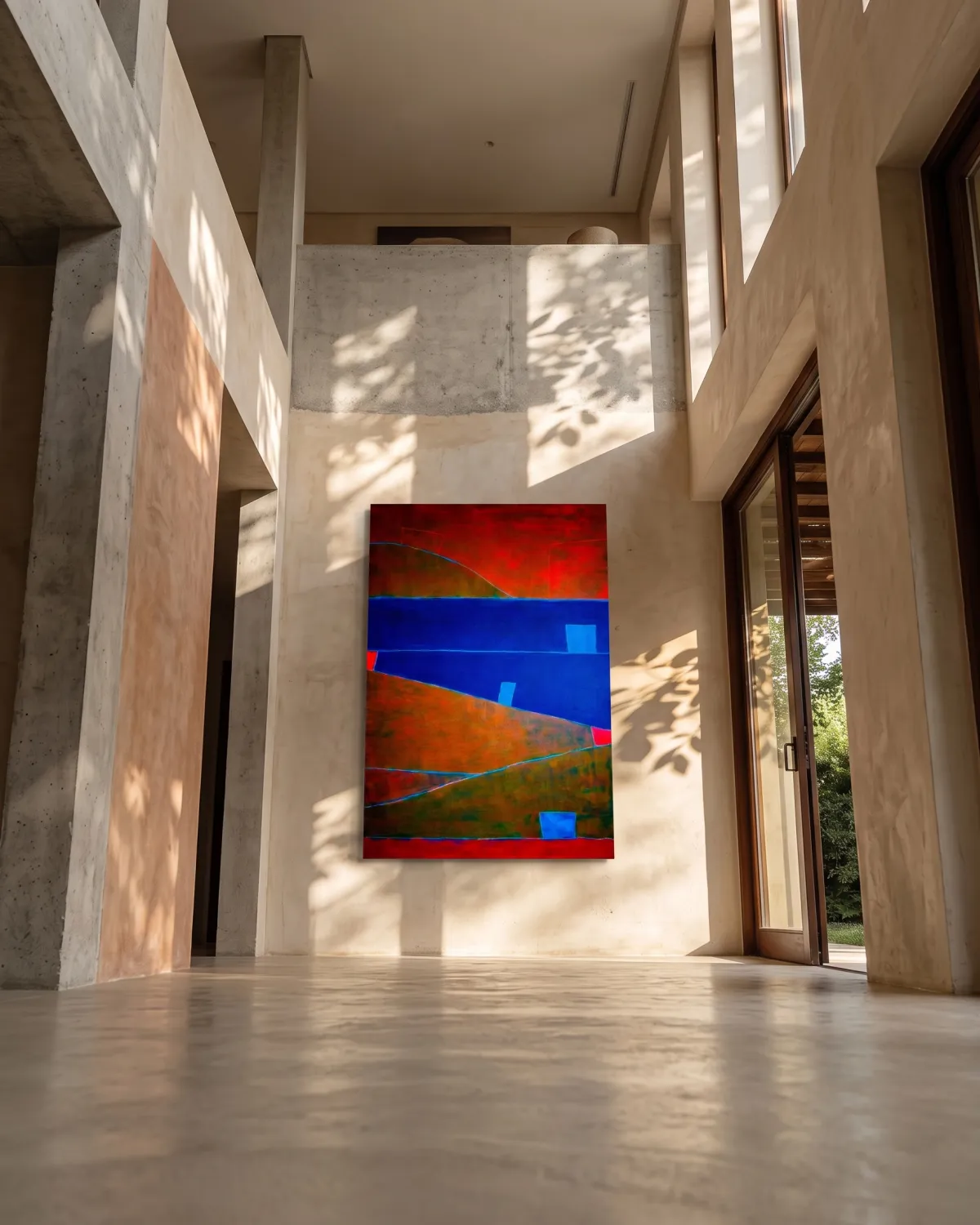
CLIVUS monumental painting in a high-ceiling brutalist space
Entering this space of bare concrete and filtered light is not done through distraction, but through a gradual slowing down of the body. At the far end, suspended on a wall that retains the roughness of plaster, CLIVUS presents itself not as an image to be deciphered, but as a threshold of silence that halts transit. The monumentality of the surrounding architecture, far from dwarfing the painting, seems to retreat into it, turning the low afternoon light into an active element brushing against its reliefs. There are no symbols here pointing to a codified devotion, no iconography claiming prior faith; the experience of what touches the sacred occurs through pure material gravitation, through an elemental order of planes where the dense red and abyssal blue establish a scale that exceeds the viewer's measure.
When I plunge the palette knife to open those fissures that divide the chromatic fields, I am not seeking to trace a navigable map or illustrate an inner revelation. I am interested in the moment when matter resists, when the accumulated oil rips open and lays bare the layer beneath, revealing a temporality that the surface sought to hide. In CLIVUS, the great blue void that horizontally cuts across the canvas does not function as a metaphor for the sky or distance, but as a physical limit where my own mental noise is forced to fall silent. Constructing this territory is, for me, an exercise in dispossession: removing ornament, stripping the surface of psychological intentions, and allowing the density of the crimson color to sustain the weight of its own silent presence.
Beneath this compositional sobriety beats a tension akin to that of those ancient spaces where emptiness was experienced not as absence, but as contained fullness. The wedges of pink light and the blocks of light blue that resist the slope of the pictorial terrain operate like the marks of an unknown ritual; they explain nothing, but they stabilize the collapse of the landscape. By dispensing with figurative representation, the work situates itself in a territory close to negative theology, where the approach to the ineffable is made by subtracting the word. The painting does not illustrate the mystery; it preserves it through a severe geometry that forces the eye to abandon the tyranny of interpretation and rest in the immediacy of the plane.
I often find that thought attempts to turn each of my technical decisions into a heroic quest over resistance or pain. However, observing the finished work under this skylight that slowly moves across the room, I understand that the true movement has been the opposite: a voluntary renunciation of the painter’s persona. Those incised lines that look like scars in the crimson are not laments or narratives of a past conflict; they are simply material facts, physical marks of the passage of time on the canvas that return the gaze to the present. The trust I seek in the studio is not the security of perfect technique, but the capacity to leave the canvas open, accepting that the crack is the only place through which the light of the original support can re-emerge.
In front of the 130-centimeter height of CLIVUS, analytical distance collapses to make way for a presence felt in the body itself. The decline of the forms and the subtle vibration of the canvas edges, which cast their shadow on the wall, transform pure visuality into a somatic encounter. The transcendence of the image does not reside in a promise of future salvation or an escape from the physical world, but in radical immersion in the weight, temperature, and decline of the now. At the end of this silent journey, the spectator discovers that the work is not a window to another place, but a material mirror that, by suspending the explanations of the mind, allows them to experience the gravity of their own existence.
- Original artwork
- CLIVUS
- Actual dimensions
- 31.5 × 51.2 in / 80 × 130 cm
- Presentation
- Digital contextual visualization
Context references
living room decor with high ceilings and large paintings · contemporary artwork for minimalist homes · Maurizio Valch paintings collectors · blue and crimson abstract painting monumental living room · luxury conceptual and decorative art
About this visualization
This visualization places the artwork within an architectural context to help collectors and viewers imagine its presence in a real space. It is an interpretive reference, not an exact reproduction: the original work remains the sole authority for scale, color, surface and material presence.