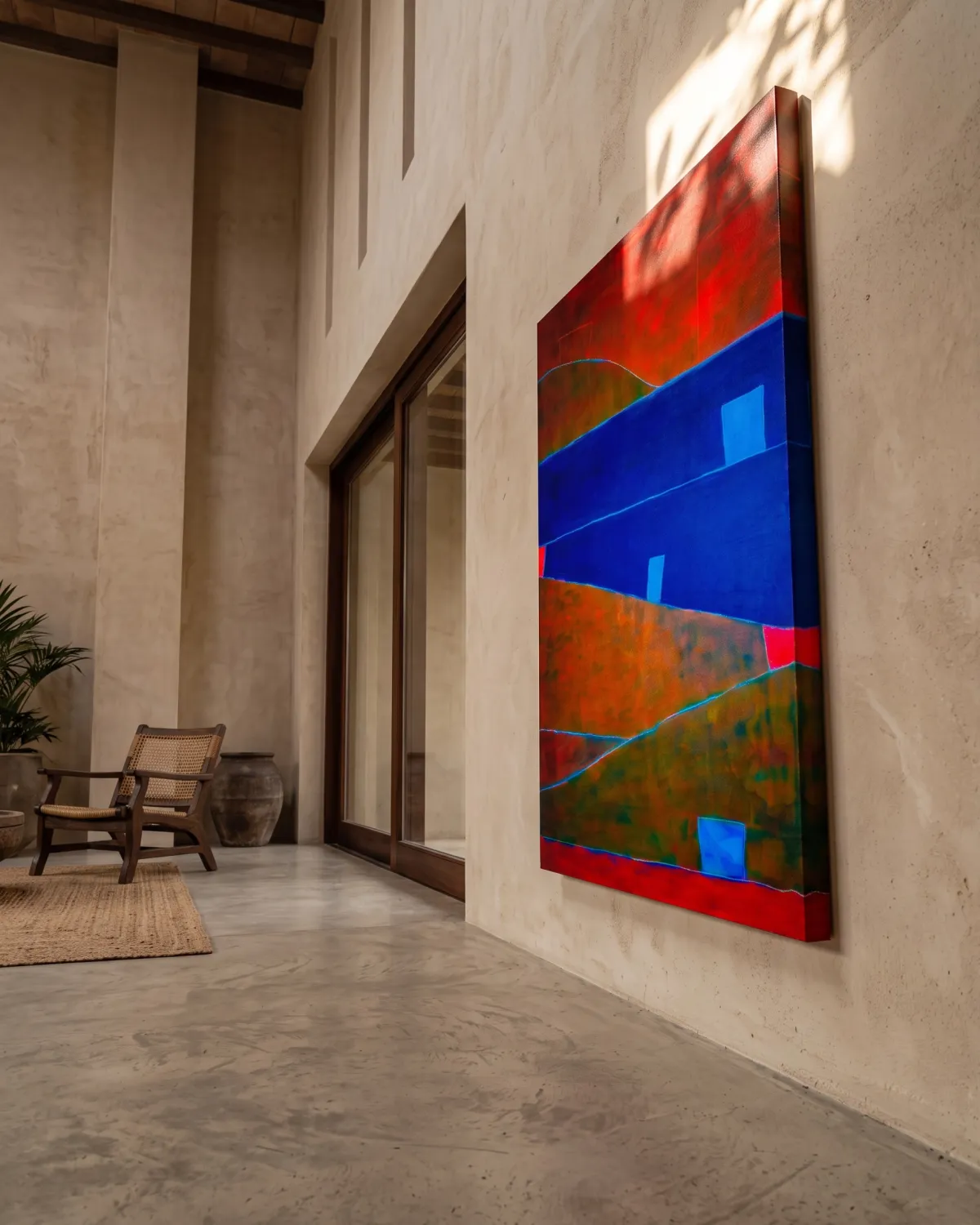
Context study / CLIVUS
CLIVUS Abstract Art by Maurizio Valch | Architectural Perspective
Customs record for a tilted territory
Arrival occurs before the gaze has decided what it is seeing. From afar, the central blue strip of CLIVUS does not invite: it halts. It stretches out with a smooth, dense authority, cutting off the advance of the reddish, ocre, and greenish masses, as if someone had set up an inspection table in the middle of a slope. Above, the red seems to approach with warmth and weight; below, the earthy and green tones shift without fully settling. Between them, the blue declares its own jurisdiction. A red line descending toward it would have to announce itself. An ocre slope would have to empty its pockets. Even a greenish vibration would have to answer uncomfortable questions: where does it come from? How much does it weigh? Is it carrying something that cannot cross?
The customs post does not look like a river or a road or a division between two recognizable landscapes. It does not offer the peace of geography. Its edges are thin, electric, sometimes almost trembling; they seem more like the boundaries of a decision still in progress. The blue occupies the center, but it does not behave like a stable center. It presses upward and downward, absorbing the gaze while remaining vulnerable to any tilt touching its edge. The gaze stops there like someone halting before a counter, not knowing which document they are missing.
I never quite decided where that border begins. The painting insists on separating itself from my intention: the blue becomes a presence I can no longer treat as an obedient zone, and the accompanying line resists being merely a boundary. Sometimes I feel that the surface returns an order I did not give: to look slower, to accept that something remains held back without being entirely locked in.
At the next checkpoint, bodies are inspected instead of papers. Jacques Lecoq, a theater pedagogue who investigated how the body, movement, and silence can think before words do. Faced with CLIVUS, his attention would not fall solely on the diagonals: he would see impulses. The upper part falls without falling; the lower part rises without quite standing up; the blue interrupts both forces like a physical rule applied to a back, a neck, a breath.
Those who look can feel it in their bodies: the neck tilts slightly to one side, as if seeking to level the painting; the breath is held at the edge of the blue band; the eyes do the clumsy work of feet when crossing a slope while carrying a full glass. Nothing spills, but there is no rest either. The diagonals produce that kind of ridiculous and serious balance: one corrects oneself before falling, without being sure of having started to move.
Lecoq would perhaps make a fertile mistake here. He would want to turn everything into action: the red advancing, the green resisting, the blue imposing a pause, the small rectangles rehearsing entries and exits. But the painting does not grant a scene so easily. Movement does not guarantee a crossing; a tilt can be a way of remaining trapped. A body can cross the blue band and continue to obey the same gravity that stopped it. It can learn to pass without having learned to name the edge.
Paulo Freire, an educator who understood learning as a conversation capable of returning critical reading of their world to people. His presence complicates the inspection. Before deciding what crosses, he would ask who invented 'above' and 'below', who called one direction a 'path' and another an 'obstacle'. Perhaps the blue strip is not a natural authority, but an authority that has learned to seem inevitable. Perhaps the warm tones are not trying to conquer it or escape it: perhaps they are being classified by a gaze that needs to see them as before and after.
Then the small cyan rectangles appear. One floats within the blue, another approaches from below, another seems to have lost its balance near a red edge. They do not serve as an explanation; they interrupt it. They could be credentials, windows, emergency signs, tiny visitors, remnants of a language that does not yet have a grammar. Their size makes the blue strip seem larger: not because it dominates them completely, but because it forces us to measure it from the fragility of what it contains.
Freire would listen to those rectangles as signs that have not yet learned to read or be read. What language do they speak? What do they know of the large blue? Have they been admitted, detained, forgotten? Lecoq would perhaps ask them for a gesture, a fall, a brief leap. Freire would reply that not every small body wishes to act to prove it exists. There are signs that do not demand attention: they deflect it. There are forms that, precisely by not explaining their function, force us to revise the function of everything else.
And then the question arrives with a disarming, almost too simple logic for such a solemn customs post: 'If those little blue squares are so light, why don't they fly away from the large blue?' The question alters the entire file. It is no longer enough to say that the blue contains, divides, or stops. If the rectangles seem light, if they have their own clarity within the large blue mass, what holds them? Perhaps they are not trapped. Perhaps they support from within the band that seemed to support everything. Perhaps the large blue depends on those small presences to avoid becoming a closed surface, too sure of its power.
I do not know why such a minimal form persists in this way. That small light blue can seem almost insignificant for a moment, but then it returns and changes the tilt of what surrounds it. I cannot remove it from the painting or reduce it to a sign. It continues to work on me like a light thing that, nevertheless, does not let itself be lifted easily.
The final attempt to cross fails partially, which is perhaps the only honest way to fail before this work. The border does not open completely, but neither does it remain intact. The blue band retains its authority, and yet it now seems susceptible to a fissure, a variation in chromatic temperature, to the presence of one of those rectangles that does not know how to obey the scale. The edge between red and blue ceases to be a simple separation: it becomes a place where both zones touch, contaminate, and watch each other.
The upper and lower masses continue to push. Neither achieves a clear victory. The red does not become a fixed threat; the green does not become a refuge; the ocre does not guarantee ground. Each color maintains a different speed: some descend, others stop, others vibrate as if waiting for an authorization that never arrives. The painting does not represent a stable territory: it keeps open a silent negotiation between gravity, learning, and escape.
Upon stepping back, the gaze can no longer remember the blue strip as a pure barrier. It is still a customs post, yes, but a customs post crossed by tiny bodies that present no documents and by lines that do not entirely accept their place. Near the bottom, a small cyan rectangle remains tilted next to the blue, barely separated from its edge, as if it were still trying to pass without knowing that someone is watching.
- Original artwork
- CLIVUS
- Actual dimensions
- 31.5 × 51.2 in / 80 × 130 cm
- Presentation
- Digital contextual visualization
Context references
large modern paintings for hallways · industrial brutalist decor with paintings · textured abstract painting with incised lines · minimalist contemporary art gallery · maurizio valch artworks
About this visualization
This visualization places the artwork within an architectural context to help collectors and viewers imagine its presence in a real space. It is an interpretive reference, not an exact reproduction: the original work remains the sole authority for scale, color, surface and material presence.