Context study / CLIVUS
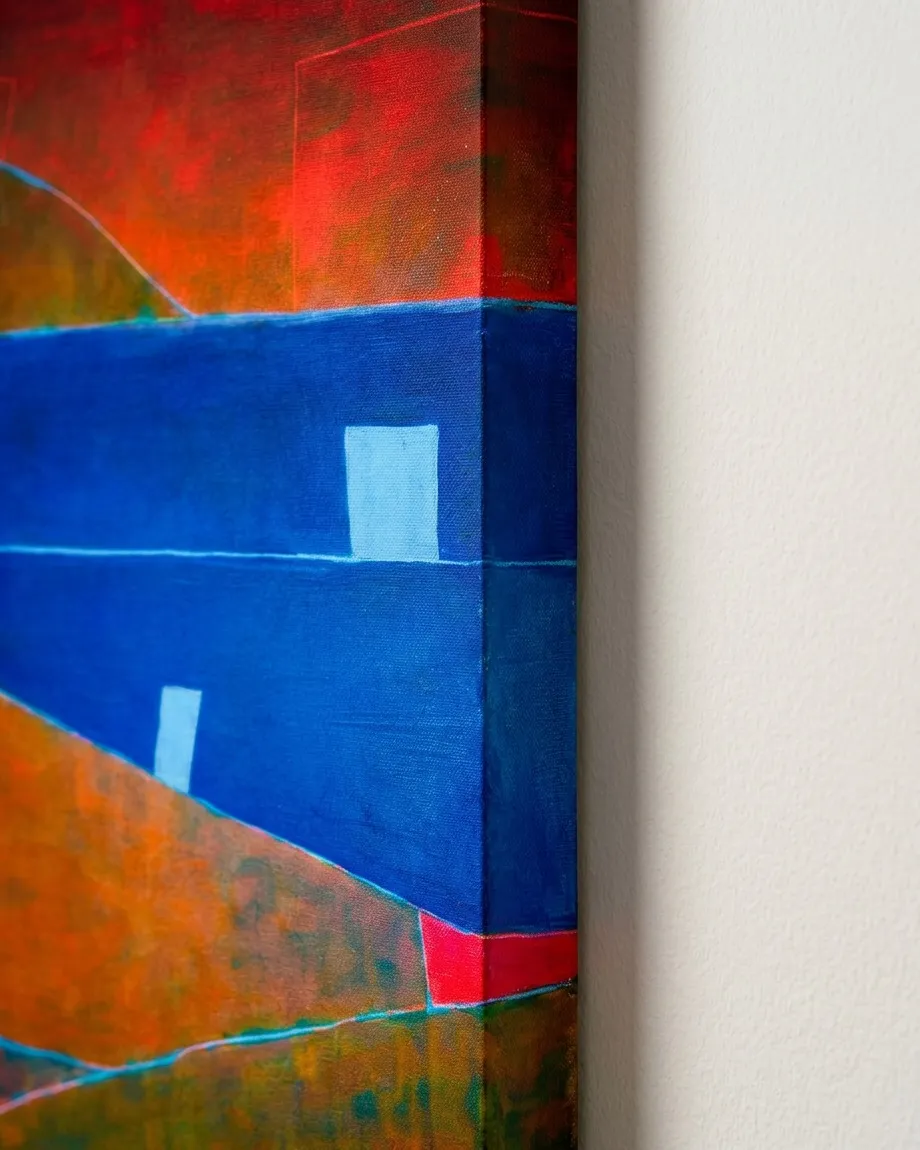
Detail of CLIVUS by Maurizio Valch | Texture and Incised Lines
From a distance, CLIVUS is undecided about whether it is offering a territory or denying it. The large blue horizontal seems to slash through the field like a low wall, a shoreless lagoon, or an expanse that has passed over the slopes and forced them to fall silent. Above, the reds grow denser; below, ochres, oranges, and greens tilt as if trying to slide out of the picture plane. Yet no single area behaves entirely as ground. The diagonals offer an initial orientation and immediately take it back: what appeared to be a hillside might be the face of a volume; what appeared to be background might step forward to become an obstacle.
Ailton Krenak is an Indigenous Brazilian thinker and activist who matters here because he reminds us that the earth is not a silent resource arranged for the gaze. Under this insistence, the ochre areas cease to be available land. They do not wait to be traversed, parcelled out, or turned into a pleasing view. Even the blue band resists serving as a horizon: it is too close, too compact, too horizontal to reassure. It seems to say that the eye can wander across it, but not necessarily possess it.
The first test consists of measuring it. How much does that blue actually occupy? From a distance, it could be calculated as an intermediate band, a surface separating top and bottom. But on descending toward it, measurement loses its rule. The blue seems to widen. Breath grows short when following the slopes: the ochres push downward, the upper red tenses upward, and the blue stops the movement in its tracks. It is not a clean border, because fine lines—almost luminous—graze it, run along it, contradict it. One of them seems to cross underneath; another clings to the edge like a thread that refuses to obey.
I approach the blue and do not find a tranquil expanse: I find a distance that changes as I look at it. I feel that the edge forces me to stop, but also that something in it asks for continuity. I cannot decide if the color opens, closes, or remains waiting. When a light shape appears within that mass, I doubt its size and my own distance from it. I want the limit to hold the image, but I perceive that the limit can also retreat.
Then the question is not whether the blue represents water. The question is what kind of body could cross it without imposing a function upon it. A human body seems too heavy: it would have to bring along its steps, its weight, the habit of assuming that every surface allows one to get somewhere else. A current might perhaps enter, though the blue shows no movement; it maintains a stillness that is not passivity. A memory might pass through: it leaves no trace, but it changes the color of the area it traverses. A child, on the other hand, might try a less reasonable and more precise solution: they would walk on a thin line, not on the blue, as if the line were a bridge and the entire field were what remains below.
Then a childish but not insignificant question arises: why does the upper cyan piece not fall into the blue if the blue seems much larger than it? The question alters the scale. There is no longer a band and two light rectangles: there is something tiny that has managed to sustain itself in an immensity without any visible support. Or perhaps it is not supported: perhaps it is traversing the blue with a slowness so extreme that it appears motionless.
Further down, another cyan shape appears near the orange slope. It has the improbable gesture of something that refuses to become a house, a sign, a window, a boat, or a game piece. It seems to make an absurd and heroic effort to stand upright on an incline that has not been granted to it. The upper shape might be a closed door, a measurement without numbers, an opening onto a non-existent room. The lower one might be a distress signal, a displaced token, a geometric creature that has lost its group. If they are called buildings, they immediately seem too lonely; if they are called windows, it is not clear who is looking from the other side.
Hassan Fathy was an Egyptian architect attentive to how a building can respond to climate, nearby materials, and the dignity of daily life. Before these small shapes, the gaze immediately searches for what could find shelter, what wall could breathe, what edge could offer support without casting out the newcomer. The orange slope seems to propose a floor, and the red peaking out in the lower right corner seems a possible base, a firm piece on which to begin something. But the blue band ruins the calculation: it does not let us know whether that base is in front, behind, on top, or about to disappear.
Here the two insistences collide. One does not want the territory to be reduced to a reserve of building sites; the other does not accept that every inhospitable surface must remain uninhabitable. One asks to listen to the autonomy of the blue; the other feels around to see if, without conquering it, some refuge might be built alongside it. Yet the painting complicates both. The upper cyan shape is too straight, too still, too separate from the slanting lands: it disconcerts any trust in a living continuity among all fields. But at the same time, none of those shapes manage to consolidate themselves as architecture. They lack weight; they have too much vulnerability. They seem to depend on a bluish line that is almost erased.
At first, I wanted the small shapes to obey the distance and the blue band to retain its power of interruption. Now I cannot say they continue to obey. I see that one of those light pieces has become more stubborn than the rest: it indicates neither an entrance nor an exit, but it forces everything around it to change scale. When I look at it, the blue stops being a central zone and becomes something that I, too, do not fully know.
Returning to the starting point, the slopes no longer seem to advance toward the blue band to be stopped. Rather, they seem to have been forced to coexist with it. The upper red crowns nothing; it presses. The lower ochre does not descend toward a resolution; it piles up against a limit. The luminous lines, once discrete, appear as trials for passage: they do not defeat the blue, but neither do they grant it a monopoly on separation.
The band can be named, but each name arrives late. It can be called a plane, a cut, a wall, a body, a distance, an impossible drink. None succeed in fixing it. Perhaps it can be inhabited not by entering it, but by learning to pause at its edge without turning it into property. Perhaps it can be measured only when the small cyan pieces disrupt the scale. Perhaps it can be crossed with the gaze, but not without the gaze returning modified.
There remains, toward the meeting of the blue and the lower zone, a fine line that grazes the edge as if hesitant to continue. It is not quite a path, a crack, or a seam. Beside it, the small lower cyan shape remains tilted, too light to hold an answer and too present to disappear.
- Original artwork
- CLIVUS
- Actual dimensions
- 31.5 × 51.2 in / 80 × 130 cm
- Presentation
- Digital contextual visualization
Context references
close up abstract painting · oil acrylic texture details · incised lines abstract painting · clivus artwork maurizio valch · blue and red color field
About this visualization
This visualization places the artwork within an architectural context to help collectors and viewers imagine its presence in a real space. It is an interpretive reference, not an exact reproduction: the original work remains the sole authority for scale, color, surface and material presence.