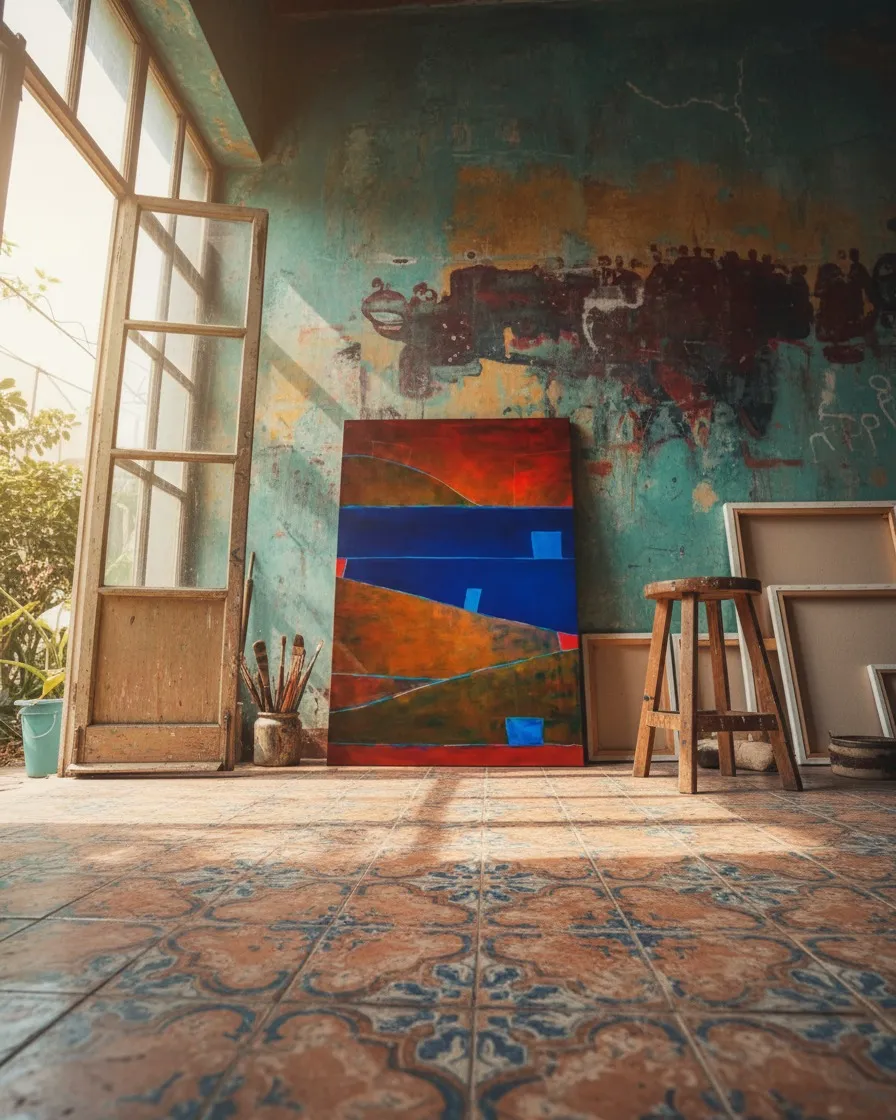
Context study / CLIVUS
CLIVUS Painting on Studio Floor | Maurizio Valch
When standing in front of CLIVUS, resting directly on the worn tiles of the studio floor, the painting manifests with the material gravity of a free-standing monolith that renounces the protection of a hanging wall. The work's composition is organized through a series of chromatic slopes and inclines that guide the eye in a controlled descent: from the dense upper crimson band, charged with an almost geological vibration, to the intermediate ochre slopes that slide toward the center before being interrupted by a dense block of deep blue. In this topography of descent, the notion of helplessness becomes visible in the behavior of the small, lighter blue geometric squares; these abstract niches or blocks seem to slide or hang suspended over slopes that disobey the law of the level, floating without a firm anchor, unprotected before the inevitable internal gravity of the pictorial plane and exposed to the drift of the surrounding color.
When I confront the surface of this canvas, I understand the plane not as a passive receiver of pigments, but as a dense crust that I must physically intervene upon through force. The fine white lines that delimit the slopes and contain the blocks of color are not marks added with a docile brush; they are the result of a process of subtraction and scraping where I make direct incisions into the overlapping layers of oil and acrylic. In this violent yet measured gesture, I seek a form of permanence: sculpting the pictorial matter so that the support retains the physical trace of my passage and of the material's resistance, turning the canvas into a skin that remembers the effort of its own formation. It is a constant tension between my impulse to impose a geometric order and the acceptance that the accumulated density has its own drying time, its own roughness, and a tectonic will that I can only guide through these incised marks.
The observer's gaze shifts inevitably toward the violent chromatic transition that splits the canvas in half, where a concentrated indigo blue acts as a retaining dam or a static river that abruptly interrupts the descent of the upper slopes. It is at this precise boundary where wonder emerges, stripped of any lightness and understood here as the tense astonishment at the appearance of an elemental, raw order in the midst of the fracture. Wonder reveals itself in the ability of this cold block to sustain the visual weight of the hot reds and earthy ochres that press upon it from above and below. It is a purely brutalist experience: witnessing how a surface battered by the palette knife and wounded by incised lines manages to establish such a resolute, silent, and monumental balance, transforming the instability of the fall into a monument to stillness.
By pulling my stretchers away from the protective security of traditional hangers and leaving them resting on the floor, I accept that my painting must inhabit the threshold of the elements, devoid of frames that isolate it from real space. In this position, the painting becomes a vulnerable body exposed to the variable light entering through the window and to the physical irregularity of the environment, a decision that deepens my experience of helplessness. By renouncing the certainties of academic presentation, I allow the work to assume its own tactile edge, where the boundaries between the three-dimensional space of the studio and the flat space of representation blur. Helplessness transitions from a compositional concept into a real physical condition: the painting is supported by its own weight, brushing the earth, exposed to the dust and wear of the outside world, assuming its fragility as part of its own material truth.
Finally, the visual descent through CLIVUS culminates in the light blue block resting at the base of the canvas, almost submerged in the last red band, while the upper horizon of the work tilts definitively. Contemplating the entirety of the piece in its current placement, any urgency of ascent weakens; the slopes and steps suggested by the incised lines do not lead to any passable summit nor demand a heroic effort of self-surpassing, but rather invite us to accept the stillness of the stratum. At this point of confluence, the permanence of the chromatic matter and the helplessness of the inclined lines resolve into the wonder of a gaze that no longer fears gravity: sliding and falling are revealed not as accidents or losses, but as the indispensable conditions for the painting's presence to settle with absolute firmness on the floor of the world.
- Original artwork
- CLIVUS
- Actual dimensions
- 31.5 × 51.2 in / 80 × 130 cm
- Presentation
- Digital contextual visualization
Context references
painting leaning on floor studio · rustic art studio decor · original abstract painting maurizio valch · clivus painting situs series · brutalist wall art
About this visualization
This visualization places the artwork within an architectural context to help collectors and viewers imagine its presence in a real space. It is an interpretive reference, not an exact reproduction: the original work remains the sole authority for scale, color, surface and material presence.