Context study / CLIVUS
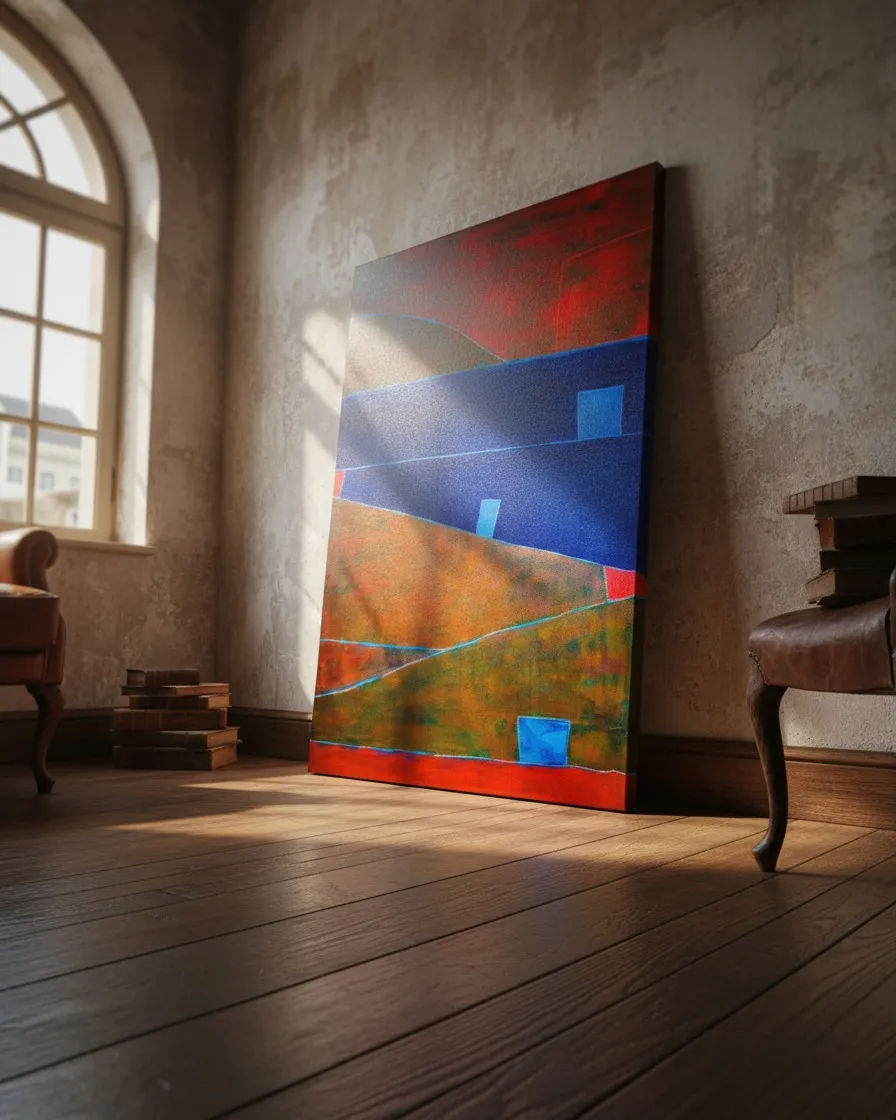
CLIVUS in Classic Living Room with Natural Light | Maurizio Valch
Protocol for crossing a slope that is still water
From afar, CLIVUS offers an immediate stability: a broad blue strip runs through the center, seeming to hold the painting like a level line. The eye quickly accepts this agreement. Above is a darkened red zone, below earthy fields where ocre, green, and black mingle like surfaces that have received different pressures. Between both regions, the blue seems to arrest everything. It could be a river seen in profile, a dam with no visible shores, a screen stretched over uneven ground. But one only has to linger a moment for that horizontal to begin to fail.
It is not that the band tilts clearly; it is the surrounding land that refuses to obey it. The upper zone descends toward it with a gentle curve and a red pressure that seems to build up behind the blue. The lower part does not rest: it rises, breaks, and falls again through diagonals that find no single direction. The blue, then, ceases to be a base. It behaves like an immobile thing surrounded by something sliding. Or like a hollow so firm that it forces everything else to move.
The first trap is there: the central strip seems to measure the painting, but perhaps it is the strip itself that needs to be measured. The upper red does not simply sit on top; it approaches like a ceiling that is too low. The lower field, with its ocre warmth and green glazes, does not simply lie beneath; it seems to push upward, as if wanting to reclaim the space occupied by the blue. The distance between the two edges of the band does not read the same everywhere. At times it feels wide and navigable; at times, compressed, almost closed by the slopes.
**Jorge Oteiza** thought of the void as a force capable of tensing space. Here one might suspect that the blue does not fill the center, but rather withdraws it: a subtraction of terrain, a place where gravity loses its footing. But that suspicion never quite settles. The strip is not a clean absence. It has visual density, a dark pressure, a surface that seems to advance and recede at once. It does not fall entirely silent.
I feel that the boundary is not drawn to separate two zones, but to make each distrust its place. When a strip like this appears, I cannot decide whether I am looking inward or if something is coming toward me. Balance is not about keeping the parts still: it is about allowing a line to seem firm while everything around it threatens to shift position. Then the form ceases to be an answer and begins to breathe like a distance.
As one descends toward the small turquoise figure located within the large band, stability becomes even less reliable. It is a quadrilateral, yes, but it does not quite become a window, a sign, a door, or a piece placed on a plane. Its blue is lighter, sharper, less deep than the blue surrounding it. For this reason, it does not merge with it: it remains suspended in an area that should receive it and yet expels it. It seems small only as long as the eye retains the scale of the painting. As soon as one gets closer, the scale breaks. It could be an immense opening seen from afar, a sheet that has detached, a body arrested mid-fall.
Then a question arises that admits no elegance: why does that small blue not fall if the earth below is sliding? The question shifts the entire strip. It can no longer be calm water, because it sustains something. It can no longer be a secure wall, because the small quadrilateral does not seem fixed to it. It can no longer be merely a surface, because the eye begins to search behind, beneath, on the other side. The turquoise rectangle ceases to be a decorative detail and acquires weight: it forces us to imagine a gravity that does not align with the painting's vertical.
Another small blue appears lower down, tilted, in the territory where ocres and greens push against each other through oblique lines. There it seems to have let itself be carried by the slope, though it does not finish falling either. A third one, close to the bottom edge, has a different presence: it behaves almost like a resting object, but the red border surrounding it denies it a clear base. All three introduce a geometry that does not quite belong to the landscape and yet does not belong to a recognizable architecture either. They are too concrete to dissolve into the earth, too unstable to order the scene.
**Yasujirō Ozu** turned quiet distances and immobile objects into sensory events. Under that attention, CLIVUS no longer appears as a single image but as a succession of silent planes. First, the high edge of the blue approaches the red. Then, a thin line crosses the band and alters its depth. Next, the small turquoise quadrilateral interrupts that depth without announcing anything. Finally, the lower diagonal forces us to turn back and verify that the supposed ground has moved while the eye was looking at something else.
The tilt does not happen all at once. It has delay. A bluish line in the lower zone seems to accompany a slope, but it could also be the edge of a wall-less construction. The red, at both ends, behaves as a closure that fails to close. The green does not open into a recognizable nature: it remains trapped between temperatures, like a dampness compressed by layers that have not finished sedimenting. The black, instead of providing depth, narrows certain areas and brings them closer. Nothing offers itself as a stable stage.
The force of withdrawing, concentrating, and falling silent seeks to clear the blue strip; the patience of the quiet planes, instead, returns everything that remains on its sides: the friction of a diagonal, the deviation of an edge, the wait of a rectangle that has not yet decided whether to float or rest. One intelligence wants to empty the center so that the tension is sharper. The other forces us to attend to what takes time to become visible within that tension. But the painting resists both operations. The blue does not let itself be completely emptied, and the margins do not accept becoming mere context.
Now the work may look like a sectioned construction: a blue wall between two sliding floors. Later it looks like a geological cut where layers have lost their order. Then it looks like a map without scale, crossed by a strip that corresponds to no known river. It can also hint at a tilted table on which three blue pieces have remained, although no shadow quite confirms this possibility. Each reading alters the previous one, but none succeeds in expelling it. The landscape persists within the architecture; the architecture filters into the cut; the map becomes too physical to be read from above.
There is an area I can no longer claim as known, even though it remains before me. The blue strip seemed like a clear decision at the start, a way to contain the slope, but now it also seems like an interruption that has begun to decide on its own. I do not know if the small blues enter, exit, or resist. Their scale changes without permission: one instant they are almost nothing, and the next they force the entire painting to seem too large for the gaze.
Upon returning to the whole, the body no longer positions itself before a vertical surface with the same confidence. The gaze climbs the lower slope like one looking for a place to plant their foot; it stops at the tilted turquoise rectangle; it crosses the central strip without knowing if it is crossing it or remaining suspended in it; it returns to the upper red and discovers that there is no ceiling there either. Distances have changed measure. Eighty centimeters of width can contain a lateral fall; one hundred and thirty in height can behave like a space too low to stand in.
The blue band continues to look horizontal, but it no longer looks motionless. Its lower edge, barely deflected by the rise of the ocre zone, allows the small turquoise near the bottom to seem supported by a ground that, in reality, continues to slide to the left.
- Original artwork
- CLIVUS
- Actual dimensions
- 31.5 × 51.2 in / 80 × 130 cm
- Presentation
- Digital contextual visualization
Context references
large classic living room painting · vintage living room decor with art · minimalist abstract painting maurizio valch · original painting living room wooden floor · situs territorial abstraction
About this visualization
This visualization places the artwork within an architectural context to help collectors and viewers imagine its presence in a real space. It is an interpretive reference, not an exact reproduction: the original work remains the sole authority for scale, color, surface and material presence.