Context study / CLIVUS
CLIVUS in Detail - Texture and Edge of the Work by Maurizio Valch
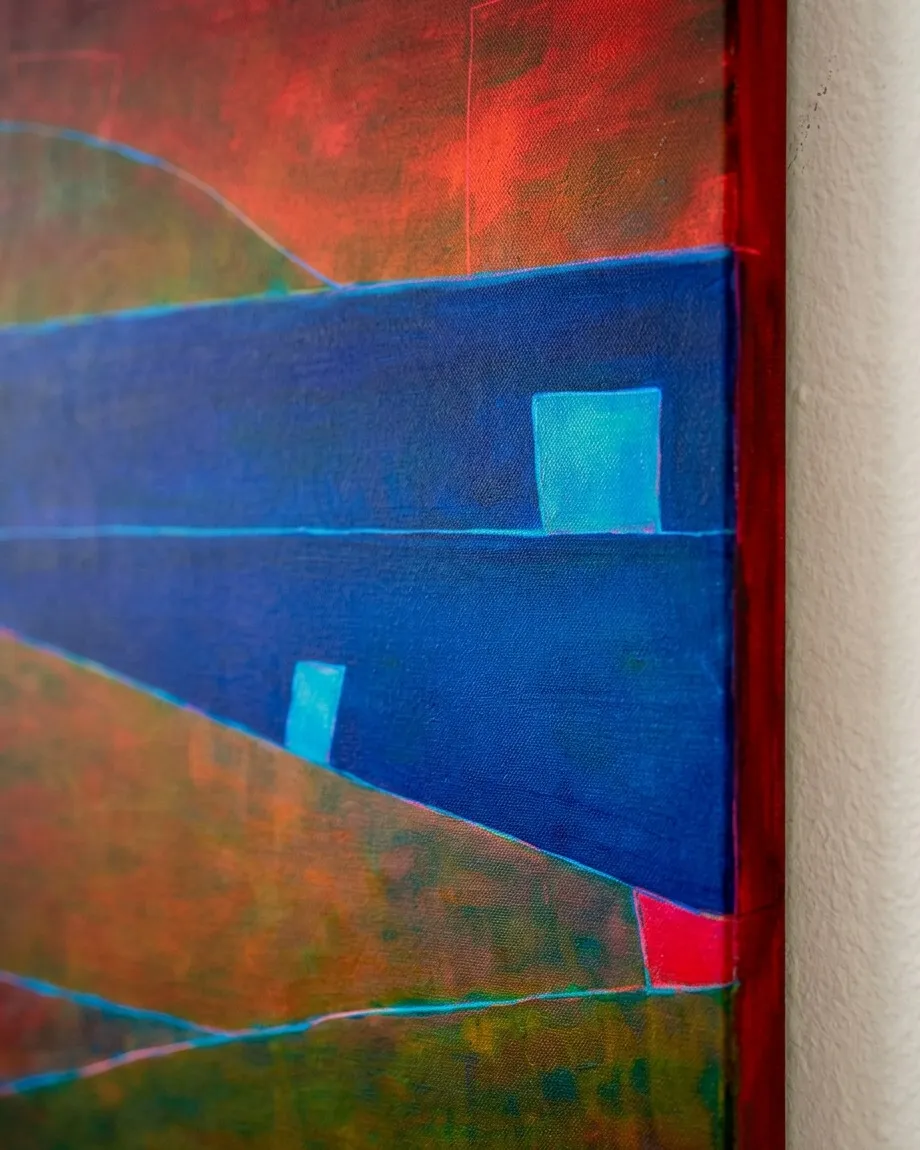
Wrapping the corner of the stretcher, allowing the crimson color to saturate the edge of the three-centimeter canvas and die against the white plane of the wall reveals that the painting does not simulate a window, but rather behaves like a body. On this visible edge of CLIVUS, where the accumulated layers of oil and acrylic are physically interrupted, the author's biography sedimentates without needing to recount a single event. There are no dates, names, or explicit geographies written on this support; what is offered to the gaze is a geological record of pressures, scrapings, and frictions where lived time is transformed into material thickness.
Many times I have been tempted to explain my travels, the long distances on bicycle, the moves, or the fatigue accumulated after walking the paths of the north, as if the truth of those years depended on an orderly chronicle. However, in the studio I discover that linear thought yields to matter: my steps do not become illustrated slopes, but rather the actual inclination of an ocher plane descending under the weight of a red sky. Each time I decide to cover an area that was previously luminous or allow the palette knife to drag the pigment to the physical limit of the canvas, I am inscribing a wound that does not seek to be understood as a confession, but experienced as a force.
This renunciation of anecdote brings Valch's practice close to the material sensibility of Antoni Tàpies, for whom the surface of the painting functioned as a wall or a skin exposed to the wear of time. The thin white incisions cutting through the central blue of the work do not describe the contour of an object or trace a walkable route; they operate as passing marks, scars that interrupt the continuity of color to reveal the hidden substrate. By suppressing the narrative of concrete events, the painting frees itself from the tyranny of the psychological document and opens a space where the limit becomes purely somatic, allowing memory to manifest as a structure of tensions and not as an inventory of recollections.
Those two light blue blocks that I have placed on the slopes of the painting are not symbols of happy moments or extraordinary revelations either; they are simply weights, counterweights that my hand needed to settle to find balance amid the decline. I know there is a self that constantly seeks to turn every small experience into a great feat or a definitive explanation of who I am, but when working I prefer the honesty of the bare pictorial fact. Letting a wedge of bright pink resist the pressure at the bottom edge of the canvas is a practical decision, a way of sustaining the structure without resorting to a theory that justifies my presence before it.
Observed from the side, suspended in the stillness of a silent room, the painting reveals its true dimension as a three-dimensional threshold that shares the scale of our body. The viewer who approaches this tactile edge does not seek to decipher the intimate secrets of another's life, but instead encounters the vibration of a matter that has been inhabited and exposed to the open air of creation. The non-narrative autobiography is fulfilled here: not in the reconstruction of a foreign past, but in the capacity of this eroded plane to return the weight of our own gaze before the mystery of the unfinished.
- Original artwork
- CLIVUS
- Actual dimensions
- 31.5 × 51.2 in / 80 × 130 cm
- Presentation
- Digital contextual visualization
Context references
close up oil and acrylic texture · painted edges on three centimeter stretcher · details of material abstract painting · palette knife and scraping marks on canvas · three dimensional thickness of artwork
About this visualization
This visualization places the artwork within an architectural context to help collectors and viewers imagine its presence in a real space. It is an interpretive reference, not an exact reproduction: the original work remains the sole authority for scale, color, surface and material presence.