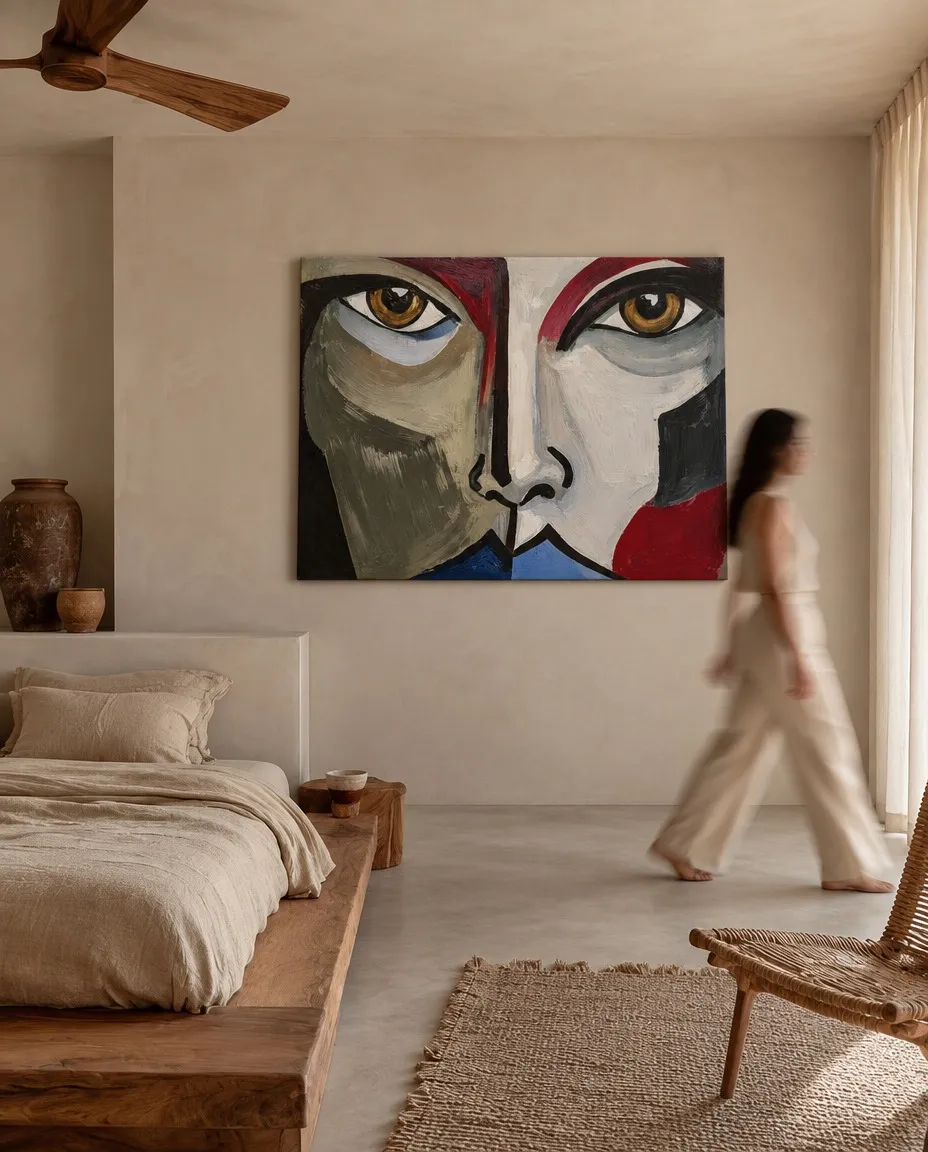
Context study / ASPECTUS
ASPECTUS in a contemporary bedroom | Maurizio Valch
Encountering ASPECTUS first involves experiencing the physical intimidation of its monumental scale—210 × 160 centimetres—a dimension that turns the canvas into a wall of psychological containment and strips the viewer of their customary superiority before the flat plane. The face here is not a physiological representation, but a telluric architecture divided by a deep vertical incision that fractures the axis of the nose and separates the surface into two radically opposing chromatic continents: on the left, a territory of cool earth tones, olive greens, lead greys, and blacks that evoke the density of wet rock; on the right, a block of thick whites and a crimson plane that acts like an eyelid of fire or a burning boundary. This relentless frontality directly recalls prehistoric masks from the ancient Mediterranean, artefacts in which the human sought to fix an immutable presence against the chaos of nature. It is within this tension that the theory of Swiss psychiatrist Carl Gustav Jung, whose study of psychic archetypes illuminates the irresolvable conflict between the outward mask of the Persona and the dark layers of the Shadow, becomes meaningful. We may then ask whether this painting behaves as an archetypal portrait of the collective soul or, instead, as the cartography of an irreparable inner fracture in which the unity of being has been definitively suspended.
When I stand before this large-format support, the process becomes a hand-to-hand struggle with untamed matter, a contest in which acrylic and oil are not merely vehicles for colour, but sediments that I drag across the weave of the canvas with palette knives and heavy brushes. I seek to give the painting the resistance of rock or crust, so that each stroke reveals the stratification of time and the erosion of physical gesture. The vertical fracture that cuts the face into two halves was not born as a prior design in my sketchbook, but as a necessary wound during its making—a ventilation channel through which this great earthen head could breathe beneath the pressure of accumulated paint. For me, this dividing boundary materialises a geographical and mental frontier separating two states of my own memory, accumulated over years spent before the Mediterranean landscape: on one side, the damp shadow and silence of dark-stone cliffs and coastal caves; on the other, the incandescence of blinding white sun and the vibration of red pulsing beneath clay skin.
This dialectic of formal tensions finds a profound echo in the contrast between the thought of Georgian mystic George Gurdjieff, who proposed that the ordinary human being inhabits a state of automated mechanicalness and deep sleep, and the philosophy of Indian thinker Osho, who advocated dissolving structural dogmas in favour of a chaotic, free vitality. The stony symmetry governing the composition of ASPECTUS evokes, in Gurdjieff’s sense, the fixity of the “machine man”: a being trapped in the rigidity of a defensive mask, repeating external patterns beneath armour of inert pigment. Yet at the lower edge of the canvas, the abrupt emergence of indigo blue and saturated red introduces a current of untamed force that challenges this apparent paralysis, aligning with Osho’s vision of vital energy striving to overflow every moral or formal containment. The golden eyes, rendered with the concision of ancient Iberian ex-votos, sustain a gaze that does not belong to ordinary psychology, raising the question of whether we are before the portrait of a fossilised ancestral automatism or the precise instant of self-remembering, in which consciousness suddenly awakens as it contemplates its own limits.
When I set out to create the gaze in ASPECTUS, my purpose was not to capture a conventional human emotion, nor the trace of sadness or joy that might limit the painting’s universality, but to erect two structures of ochre and gold that function as empty temples. Those golden pupils are wells of suspended time, sockets that return the gaze neutrally, without making moral judgements, acting simply as mirrors of a mineral presence that precedes language. In the stillness of my studio in Nerja, as the evening light recedes from the canvas more than two metres high, a dense silence arises in which I am certain that this face was not created by my hands, but unearthed from an archaic temporal stratum. As I hold that motionless gaze, I feel that the painting existed long before I dared to trace its outline, and that my work has consisted only in removing the crust of matter to allow it to emerge.
Returning to the pure materiality of the painted surface, we see how the composition rests on a chromatic base of indigo blue and dense red, a support that holds the giant chin and anchors the immense head to the physical plane of the floor, while a neutral, stripped-back background isolates the figure to avoid any narrative distraction. The force of ASPECTUS lies precisely in its renunciation of anecdote and in its insistence on the sheer presence of painting as a geological fact. The fate of this divided face remains suspended before the eyes of the viewer as an open question about the nature of inner experience. One may ask whether the vertical crack that fractures its features will ultimately bring about the structure’s definitive collapse, or whether it is instead the only fissure through which the light of consciousness can penetrate the opaque density of matter and bring the stone to life.
- Original artwork
- ASPECTUS
- Actual dimensions
- 82.7 × 63 in / 210 × 160 cm
- Presentation
- Digital contextual visualization
Context references
ASPECTUS Maurizio Valch · abstract painting for bedroom · wall art with abstract face · large-scale contemporary bedroom art · painting with amber eyes red and blue · minimalist décor with figurative art · divided face painting · Maurizio Valch FACIES series
About this visualization
This visualization places the artwork within an architectural context to help collectors and viewers imagine its presence in a real space. It is an interpretive reference, not an exact reproduction: the original work remains the sole authority for scale, color, surface and material presence.