Context study / ASPECTUS
ASPECTUS — monumental abstract face | Maurizio Valch
1. The gaze as a space of reception (visual “listening”)
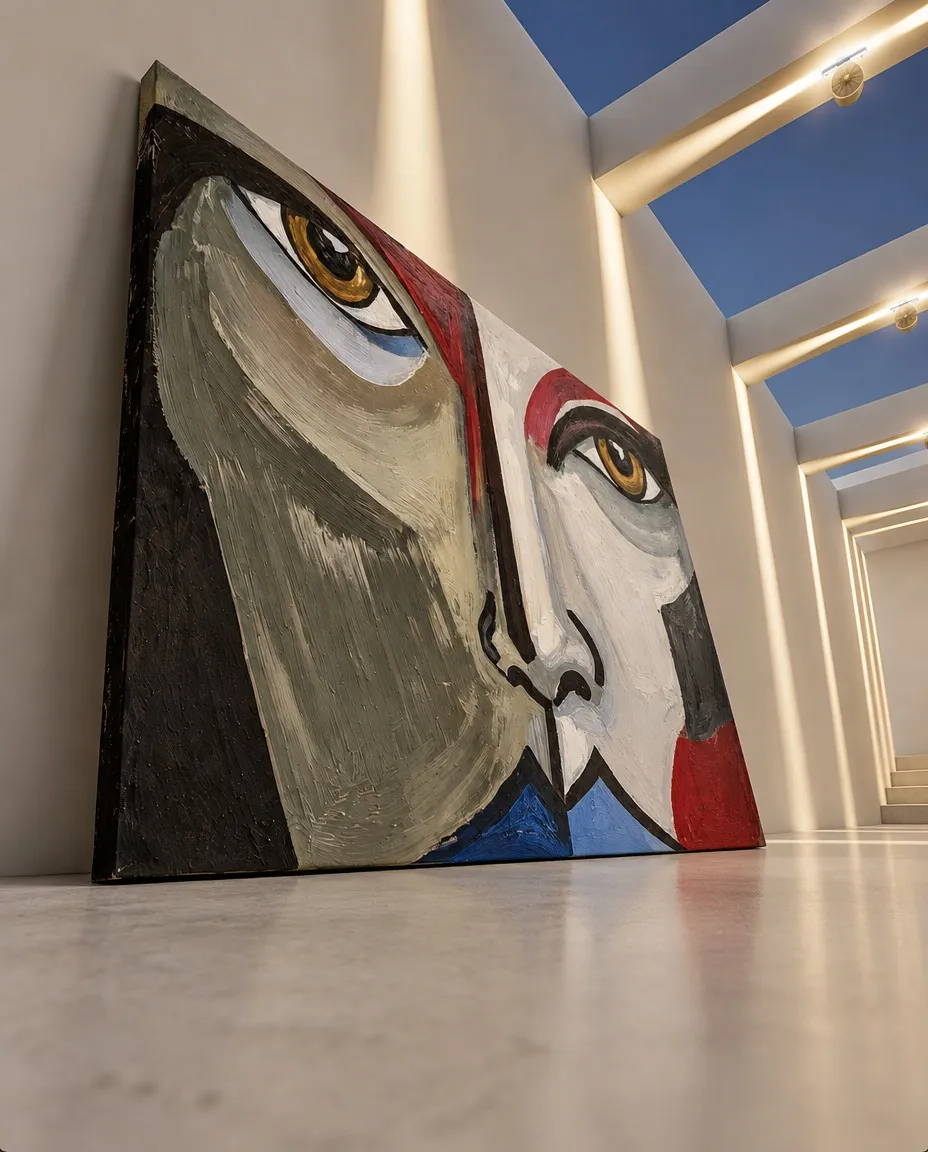
The imposing physical presence of “ASPECTUS”, a work measuring 210 × 160 cm whose dimensions command the vertical plane, is articulated through two monumental, almond-shaped golden eyes that govern the upper third of the composition. Far from serving as a mere passive focal point, this gaze immediately establishes itself as a territory of silent listening. The face is fragmented by a thick, brutalist vertical line that divides its features into two asymmetrical halves, giving it an almost architectural solidity, like a totem carved from stone. Yet despite the geometric coarseness of the eyebrows and the severity of the nose bridge, this portrait does not impose an inquisitorial violence upon the viewer; on the contrary, its scale and the schematic treatment of its features open up a receptive threshold. It is matter itself—the thickness of the stroke, the roughness of the surface—that offers itself as a resonating chamber in which the viewer’s silence is received, transforming the act of looking into a profound, shared attention.
2. The artist’s voice: A process of transition (Maurizio Valch on “letting go”)
When I confronted the vastness of this canvas in order to shape “ASPECTUS,” I understood that the process had to be an act of complete letting go. I had spent long periods working on my abstract landscape series, where matter was organized through incisions, geological planes, and palette-knife marks across the surface; making the transition to human physiognomy required me to relinquish the comfort of pure abstraction. I had to abandon minute control over the canvas and allow the face to emerge almost accidentally, like an orography rising from the accumulation of pigment. As I defined those heavy, emphatic black eyebrows and drew the lowered eyelids, I felt that the memory of the earth I had previously painted was concentrating in these physical features, transforming what had once been an open horizon into a bodily boundary that now looked back at me, claiming its own existential autonomy.
3. The pigment thermometer (the “heat” of division)
The violent chromatic contrast that structures the work functions as a thermal register in which heat acts as a deforming force. The left half of the face withdraws into a restrained range of bluish greys, olives, and cool earth tones, while the right half ignites with a dense, impasto crimson that crowns the forehead and spills across the cheek. This heat is not merely a visual quality, but a tactile energy held within the accumulation of oil and acrylic. The density of the impasto, particularly evident in the protrusion of the bridge of the nose, reveals the striations of matter that have captured the force of the painter’s physical gesture. In this way, the thermal contrast divides the face into two states of matter: a zone of cooling and stony containment on the left, and a volcanic, impassioned flow on the right that distorts classical proportions in favour of material expressiveness.
4. The artist’s voice: Matter and encounter (Maurizio Valch on the work’s base)
In the lower area of the painting, where black lines reduce the mouth to a schematic slit, I chose to introduce that wedge of cobalt blue and deep indigo, directly contrasting the heat of the crimson above. For me, working through this transition was not about illustrating a decipherable psychology or emotion, but about constructing a body exposed to the elements of light and gravity. As I scraped, built up, and polished the pigment until the surface took on the rough texture of leather or weathered skin, I realised that the painting did not end at the three centimetres of its stretcher depth. This cool blue and the density of the base serve as an anchor that extends the work toward the ground beneath our feet; a reminder that painting is, above all, a tactile barrier seeking to touch the reality of the person who looks at it through the letting go of mere academic representation.
5. The collapse of distance (transpersonal synthesis)
Before the imposing scale of “ASPECTUS,” the analytical distance that usually protects the viewer from the work ultimately dissolves. At this point of contact—a true tactile edge—a shedding of one’s own identity takes place: the letting go of the observer’s intellectual defences allows the dense heat of the crimson and the weight of the earth tones to enter their sensibility, healing the coldness of the distant gaze. Looking at this fragmented face thus becomes a silent, reciprocal listening, in which painted matter and the viewer’s consciousness are revealed as a single substance. The face painted by Maurizio Valch ceases to be a represented “other” and becomes the mirror of a shared territory, where volume, colour, and space come together to celebrate the mystery of pure presence.
- Original artwork
- ASPECTUS
- Actual dimensions
- 82.7 × 63 in / 210 × 160 cm
- Presentation
- Digital contextual visualization
Context references
ASPECTUS Maurizio Valch · monumental abstract face painting · contemporary fragmented face art · large-scale painting with amber eyes · material painting in red and blue · wall art for a contemporary hallway · vertical abstract figurative painting · Maurizio Valch FACIES series
About this visualization
This visualization places the artwork within an architectural context to help collectors and viewers imagine its presence in a real space. It is an interpretive reference, not an exact reproduction: the original work remains the sole authority for scale, color, surface and material presence.