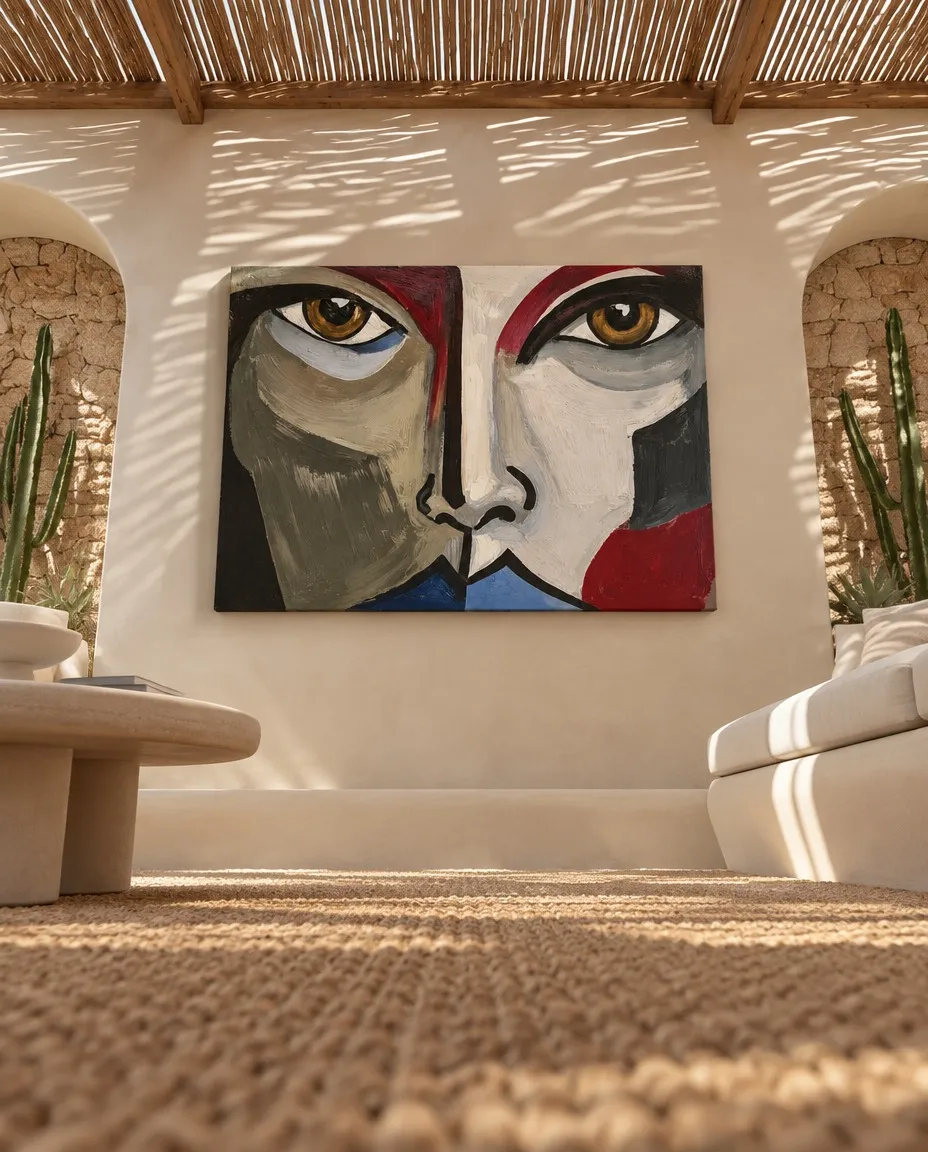
Context study / ASPECTUS
ASPECTUS, monumental face | Maurizio Valch
The imposing surface of "ASPECTUS" stands before us as a formal retaining wall, dominated by a vertical fissure that cleaves the face into two asymmetrical yet inseparable hemispheres. This division immediately introduces the notion of the Double, a recurring motif in explorations of otherness that shapes our inner experience. To understand the formal tension sustaining this structure, it is essential to turn to the thought of Carl Gustav Jung (the Swiss psychiatrist who investigated how the human psyche is organised through polarities and archetypes inhabiting the collective unconscious), who proposed that the mind is structured around inescapable dialectical tensions. In this monumental face, the right half—of dirty white and pale greys, framed by crimson red—does not wage a moral battle against the left half, dominated by olive tones, leaden greys, and blue sinking into black. Instead, both areas embody the forced coexistence of the Persona—that adaptive, visible mask we show the outside world—and the Shadow, those relegated and unintegrated aspects dwelling in the background of consciousness. The image’s almost totemic frontality eliminates any impulse towards anecdotal portraiture, establishing a hieratic presence that compels us to confront the constitutive polarity of our own mental architecture.
When I approached the canvas of "ASPECTUS" as part of my research for the FACIES series, I never intended to illustrate a map of the mind or deliberately translate concepts from psychology; the origin of this face is strictly tectonic and visceral. For me, that sharp vertical division is no more than the natural continuation of the cracks, incisions, and territorial partitions I make across abstract landscapes in earlier series such as STRATA or LIMINA. I work the painted matter in search of its utmost physical resistance, building dense layers of oil and acrylic that I then cut, drag, and sculpt with a metal palette knife. That central partition, dark and severe, is the result of a physical gesture, a trench raised in the painting to delimit two independent chromatic and textured territories. I do not paint a human physiognomy in the traditional sense, but construct a façade, a Brutalist structure in which eyebrows, nose, and chin function as beams, buttresses, and load-bearing walls in a building carved directly into the dense paste of matter.
The two enormous almond-shaped eyes, in a golden ochre tone, crown the composition and act as the work’s true dynamic axis, directly addressing us with a confrontation born of their stillness. In sustaining this face-to-face encounter, we may invoke the theories of G. I. Gurdjieff (a mystic and investigator of human behaviour who proposed that human beings live in a state of automatism and sleep from which they can awaken only through a shock of directed attention), whose system insists on the need for an external impact to emerge from everyday inertia. The fixed, unblinking gaze of "ASPECTUS" functions precisely as that shock of directed attention: it suspends the automatic course of our everyday thoughts and returns to us our own fragmented image. By offering no accommodating gaze, the painting becomes a severe mirror that interrupts our psychological automatism, compelling the viewer to turn inward in an instant of “self-remembering,” when daily dispersion freezes and gives way to the harsh certainty of our own inner division.
As I applied the golden impasto to the sockets of these two monumental eyes in the silence of the studio, I experienced the unsettling sensation that the work was looking back at me, assuming a sovereignty beyond my control as a painter. Those eyes quickly became the centre of gravity in the workspace; every brushstroke I added around them seemed governed by their unfathomable gaze, which tenaciously resisted dissolving into the pure abstraction I usually pursue. I wanted the imposing scale of this canvas, two metres ten high by one metre sixty wide, to operate not as a mere two-dimensional surface viewed from a comfortable distance, but as a genuine architectural threshold. My purpose with "ASPECTUS" was to establish an inhabitable territory, a physical boundary enveloping the body of whoever stands before it and forcing them to sustain a silent, unavoidable dialogue with a presence that embodies the weight and density of all that we leave unspoken.
Ultimately, this monumental effigy activates an ancient archaeological resonance that reconnects us with the most remote layers of Europe’s visual memory. In "ASPECTUS" there is a direct inheritance from Etruscan votive masks, from the uncompromising hieratic quality of Romanesque frescoes in the Pyrenees, and from those first human forms ancient makers carved directly into Mediterranean limestone to bear witness to their existence. The achievement of the work lies in allowing our contemporary identity—usually fragmented, dispersed, and subjected to the incessant noise of speed—to find a precarious yet monumental order on the canvas. At the end of the visual encounter, the painting does not seek to resolve our psychic division surgically or offer easy answers; instead, it defines the fracture, gives our internal contradiction a firm frame, and turns our divided face into an inhabitable, resistant territory against the external chaos.
- Original artwork
- ASPECTUS
- Actual dimensions
- 82.7 × 63 in / 210 × 160 cm
- Presentation
- Digital contextual visualization
Context references
ASPECTUS Maurizio Valch · 210 x 160 cm painting · monumental contemporary face painting · wall art for a Mediterranean interior · abstract figurative painting with amber eyes · large red blue grey and green painting · fragmented frontal face in contemporary painting
About this visualization
This visualization places the artwork within an architectural context to help collectors and viewers imagine its presence in a real space. It is an interpretive reference, not an exact reproduction: the original work remains the sole authority for scale, color, surface and material presence.