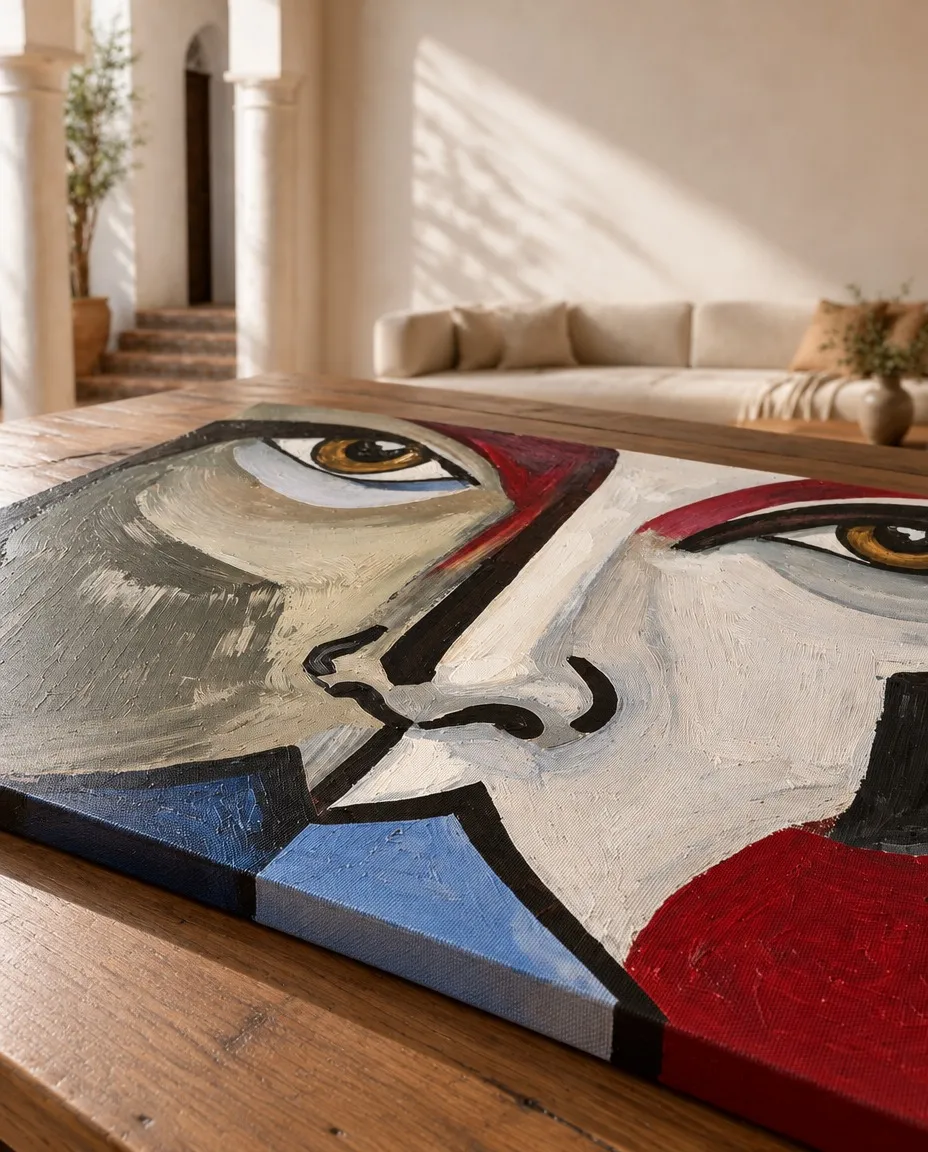
Context study / ASPECTUS
ASPECTUS detail | Material painting by Maurizio Valch
Standing before ASPECTUS, the imposing 210 × 160 centimetre canvas from my twenty-fifth series, the viewer is confronted by a presence that exceeds the limits of the purely pictorial to become a spatial and tactile event. The emergence of this monumental face in the work of an artist whose trajectory has persistently explored geological abstraction and stripped-back landscape gives rise to a genuine sense of wonder. This is not, however, a docile or merely decorative dazzlement, but the overwhelming astonishment produced by a colossal physiognomy that seems sculpted directly from the depths of matter. A sharp, almost heraldic vertical cut fractures the composition into two asymmetrical halves, at once unifying and dividing this archetypal face. From this fracture, two enormous almond-shaped eyes of earthy, hypnotic ochre fix their gaze on the viewer, undoing every possibility of aesthetic distance; no longer are we looking at the painting, but rather the painting, from its cyclopean scale, questions us and returns to us the weight of looking.
When confronting this support on a totemic scale, my purpose was not psychological portraiture, but the physical embodiment of a boundary through the untamed density of oil paint. I dragged the palette knife and loaded brush, allowing paint to accumulate in rough ridges and visible strata that shape the cheeks and forehead as if I were modelling a geological relief rather than a human face. Through this process of accumulating and removing matter, I traced the severe vertical line that breaks the nose and splits the physiognomy in two. For me, this fissure introduces the vibration of exposure: a material exposure in which the mask of identity inevitably fractures. This exposure should not be read as lament or as a weakness of form, but as the absolute vulnerability of a being exposed to the elements of existence; a structural crack through which the face renounces ideal symmetry and gives itself, naked and wounded by paint, to the space around it.
The chromatic architecture of ASPECTUS functions as the tectonic support for this existential tension, distributing forces through a restricted palette of monumental power. On the left, a greenish-grey penumbra, worked with dense bidirectional brushstrokes, evokes the dampness of stone or the shadow of a gorge; on the right, a rough, impure whiteness introduces a blinding light that, far from ethereal, has the consistency of plaster or chalk. This polarity is framed by violent masses of crimson red that crown and close the canvas at its edges, while at the base of the chin, a geometric wedge of cobalt blue acts as a keystone holding the whole together. It is precisely this almost Brutalist rigour in the arrangement of colour that gives the work its quality of permanence. The face does not seem to inhabit chronological time, but rises with the mineral solidity of an ancestral monolith, a temple of pigment suspended in an eternal present whose impassive eyes suggest that they have watched the world pass from an immemorial origin.
Those familiar with my earlier work, such as the STRATA or PRIMORDIUM series, will recall that my enduring preoccupation has been the inscription of time upon the earth, silent horizons, and incisions in the support. In ASPECTUS, I sought to condense all that territorial and tectonic memory in this being’s gaze; the eyes no longer look upon an external landscape, but contain within their own ochre the sedimentation of a thousand forgotten landscapes. The permanence I once sought in geological strata and the wonder of form’s appearance are now concentrated in the abyss of these eye sockets. While painting, I understood that the canvas had ceased to be a window and become a rough skin, a rugged relief in which the viewer and I myself are equally exposed. This is creative exposure: the boldness of someone excavating the density of oil paint in search of an origin, a first root revealed only when we abandon the illusion of depth and accept the unadorned truth of resistant matter.
Finally, ASPECTUS consolidates before our eyes as a genuine tactile shore, a pictorial membrane of extraordinary force in which the boundaries between the viewer’s space and the interior of the work irreversibly dissolve. As we sustain the fixed, monumental gaze of the canvas, the three notions that articulate the experience are wholly transformed. Permanence loses its mineral rigidity to reveal itself as the organic force of that which resists wear and oblivion. Exposure sheds its tragic charge to become the radical honesty of a fracture that does not conceal its seams, but makes the crack its principal expressive virtue. And wonder, stripped of all illusionistic artifice, becomes the intimate astonishment of discovering that, in confronting this colossal face, we are not contemplating a stranger but looking into the deepest and least explored strata of our own collective memory.
- Original artwork
- ASPECTUS
- Actual dimensions
- 82.7 × 63 in / 210 × 160 cm
- Presentation
- Digital contextual visualization
Context references
contemporary material painting detail · ASPECTUS Maurizio Valch detail · abstract face painting texture · painting with dense brushstrokes and relief · fragmented face painting with amber eyes · painted surface with central division · textured contemporary figurative art
About this visualization
This visualization places the artwork within an architectural context to help collectors and viewers imagine its presence in a real space. It is an interpretive reference, not an exact reproduction: the original work remains the sole authority for scale, color, surface and material presence.