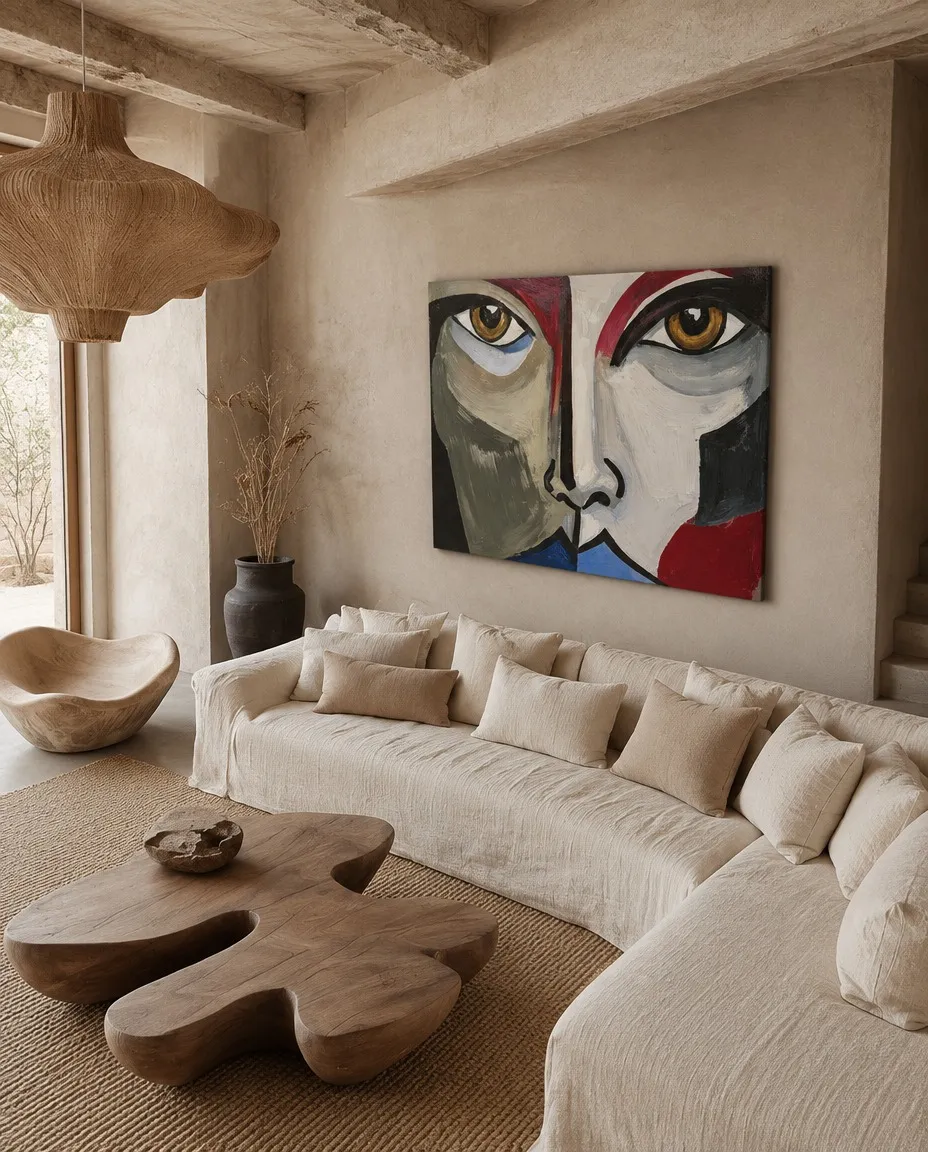
Context study / ASPECTUS
ASPECTUS in a warm living room | Maurizio Valch
ASPECTUS: moving the chair closer
From a certain distance, ASPECTUS presents itself as a monumental mask: 210 × 160 cm of frontal face, too close to be merely a face and too still to be called a presence. The two golden eyes fix the space before the gaze has time to arrange it. The nose descends like an axis that seems to promise order. The barely closed mouth holds something of a suspended agreement.
But the promise breaks almost immediately. On the left, the face seems crossed by a lower, earthier light, held among dark greens, dense greys, and areas that appear to have aged at a different speed. On the right, white, pale grey, and red do not lighten the image; they make it more exposed, as though that half were too close to an unforgiving illumination. They are not two faces pasted together; that would be easier. They are two ways of inhabiting the same face without ever quite sharing the same time.
The nose does not divide cleanly. It is a boundary unsure whether it is a bridge, a wound, a fold, or a wall. The left eye seems to reach it from a room with less air. The right seems to look out from an area where everything has already been seen too many times. Between them, the vertical line does not join: it compels us to persist.
I never quite see a face when a face seems to demand a single identity. I am interested in discomforting proximity, in that moment when a face ceases to be recognisable and begins to resist even the person who has looked at it for a long time. When I return to a completed work, I find that the image has retained a will that does not coincide with mine: it does not easily come together, it refuses to be calmed by an explanation.
Sitting too close
Peter Brook, the theatre director who made empty space, bodily presence, and the audience’s attention decisive theatrical material, helps us notice when an image makes us take a seat.
Here, no comfortable theatre seat remains. The frontality of ASPECTUS removes the usual margin between the viewer and what is viewed. This face does not occupy the background of a wall: it moves forward until the viewer’s space becomes its own stage. There is not enough distance to contemplate it without involving some part of the body: the shoulders, the breath, the involuntary tilt of the head as the gaze tries to choose one eye.
Brook might imagine each eye as a performer arriving on stage with a different text. The left eye speaks from a greenish, earthen density, as though it knew a weariness that preceded the scene. The right eye, edged by sharper lights and shadows, seems to sustain another urgency: not an identifiable emotion, but an attention that will not be postponed.
Both share golden irises, yet they do not produce the same gaze. The concentrated gold does not unify them; it makes them more uncomfortably comparable. Each iris draws us in like a small lamp lit in a different room. The left pupil seems to sink into waiting. The right seems to stop short, with the obstinacy of someone who has already heard an explanation given too quickly and does not intend to give it credit.
In this scene, the nose becomes a curtain too narrow to separate the actors and too rigid to let them cross. It is also an edge: the place where the eye stumbles and must decide which side to remain on. Brook would want to know where the gaze sits. On the left, beside the darker material. On the right, before the white and red that seem unwilling to settle. Or directly before the nasal axis, in the least secure place: the one from which both eyes can be seen at once.
Then a small, impossible-to-dismiss question appears: can one half of a face fall asleep while the other remains on watch?
The mouth does not answer. It barely closes, but not with the firmness of a secret being kept. It seems instead occupied with holding the tension between the two sides, without knowing which version of the face it should pronounce. Beneath it, the blue area introduces a note that corrects nothing. The blue neither cools nor reassures; it opens a low interruption, like a pocket of air that entered too late.
Listening to what cannot be heard
Olivier Messiaen, the composer who heard the world as an architecture of rhythms, colours, silences, and wonder, allows us to attend to this face as though its stillness had duration.
Messiaen would not so quickly accept the human scene Brook places before the painting. Where Brook sees two performers caught in extreme proximity, Messiaen perceives rhythms that need neither actor, intention, nor audience. The black edging the eyelids does not function as dramatic shadow: it cuts time. It is a band of suspension. It makes each eye seem to arrive late at its own opening.
The unblinking gaze might last seven slow pulses and one suddenly brief one. The first four would remain held in the left iris, where the gold seems to gather without expanding. The next two would travel along the bridge of the nose, stumbling over the black curve that forms beside it. The final pulse would not end in the other eye: it would fall beneath the mouth, into that reduced area of blue that seems like a pause placed out of order.
For Brook, the red on the right might be the sign of an entrance, an impossible costume, the arrival of a character who has not yet recognised itself. Messiaen complicates that reading. The red does not enter: it interrupts. It does not possess the duration of a human appearance, but that of an impact that continues to occur after it has been seen. Nor does the white on the right offer silence. The heaviest silence appears, perhaps, in the pale space that descends between the eyes and narrows towards the nose: an area that seems to emit nothing and yet compels us to hear everything else.
The dark green of the left cheek does not accompany the grey; the grey does not accompany the white; the blue does not complete the red. The colours form neighbourhoods, not equivalences. They approach without becoming familiar. The surface seems to accumulate different directions, densities, and speeds: some areas reach the eye as a motionless mass, while others pass with the speed of a correction that failed to erase itself. Nothing allows us to determine how this variation was made; only the optical experience remains of a face whose times do not coincide.
I feel my breathing change before this painting, not because the face appears to breathe, but because its stillness forces the air to be measured differently. I return to the eyes and find that I still do not know which of the two saw me first. I return to the mouth in search of a truce and discover that it remains occupied by something I cannot name: perhaps not a withheld word, but the interval between two gazes that never manage to meet.
Returning without reassembling
Brook insists that the painting requires shared presence: someone must expose themselves before that face for the scene to take place. Messiaen makes another demand: the image continues to arrange its rhythms even when no one stands before it, when the viewer withdraws, when the room is empty. One seeks to bring the face towards the body; the other seeks to detach it from all immediate psychology.
The disagreement is not resolved. It produces a third form of attention: looking without forcing the face to become a character, and listening without reducing it to harmony. The whole face then reappears, but no longer as an innocent unity. The division between left and right does not separate two clear identities; it keeps a misalignment open. The eyes appear to share an architecture, but not necessarily a horizon. The nose seems to join them, but also prevents them from explaining themselves to one another. The mouth seems to belong to both, although neither eye appears to have told it what it knows.
From a distance, ASPECTUS becomes a mask again. Up close, it ceases to be one: it is a surface that distributes attention and returns it altered. The eye cannot rest on the pale half without feeling the gravity of the greenish half; it cannot linger in the darkness without receiving the claim of white, red, and gold. A minimal difference remains active between the pupils, a distance that resists translation and may be the true centre of the face.
Look first at the left eye and then at the right; before stepping away, silently consider whether both were looking in the same direction.
- Original artwork
- ASPECTUS
- Actual dimensions
- 82.7 × 63 in / 210 × 160 cm
- Presentation
- Digital contextual visualization
Context references
ASPECTUS Maurizio Valch · large painting for an earth-tone living room · abstract face painting for a living room · contemporary art for a Mediterranean interior · painting with golden eyes and red tones · contemporary figurative wall art · fragmented face in painting
About this visualization
This visualization places the artwork within an architectural context to help collectors and viewers imagine its presence in a real space. It is an interpretive reference, not an exact reproduction: the original work remains the sole authority for scale, color, surface and material presence.