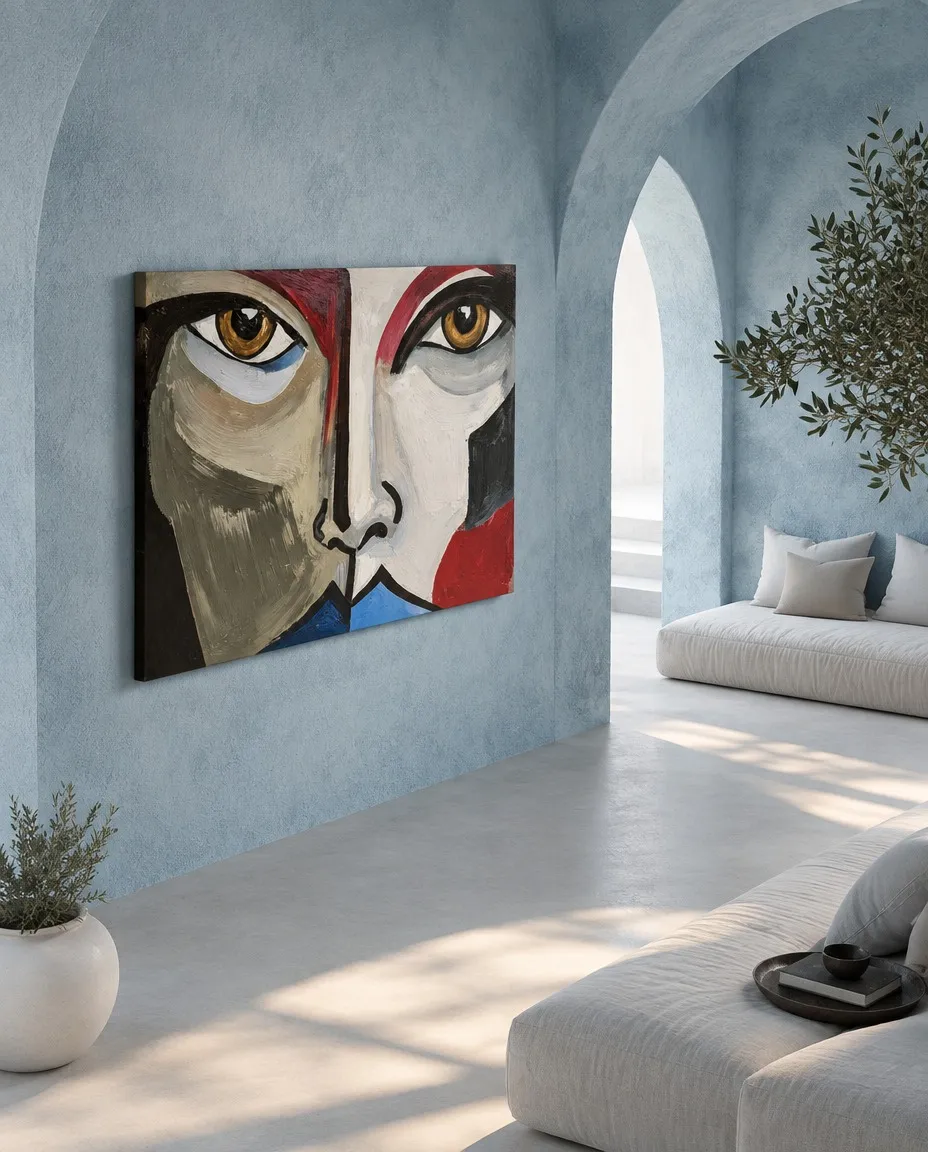
Context study / ASPECTUS
ASPECTUS by Maurizio Valch | Fragmented Face Painting
The monumentality of ASPECTUS enters the restraint of this space of Mediterranean arches not as a decorative piece, but as a presence that alters the architecture's order. At two metres wide, the large format demands an immediate pause: the viewer's gaze is caught by those enormous amber eyes, which make no attempt to tell a story or represent a familiar myth. By stripping the image of halos, crowns, or any attribute of conventional religious iconography, the painting recovers an elemental, almost liturgical force that lies solely in its material weight and conflicted symmetry. There is no invitation here to mystical devotion, but to a direct confrontation with a face which, in its incorruptible fixity, seems to have outlasted time.
When I faced this canvas, I wanted scale not to serve as spectacle, but to construct an insurmountable limit for the eye. I did not want to paint a portrait, but a wall that would return the gaze with the same physical density with which I accumulated oil and acrylic on the canvas. In drawing the central incision, that dry cut that divides the physiognomy into two halves, I was not seeking to illustrate a psychological theory of duality, but to register a physical event: a wound in the material that interrupts the continuity of the plane. In the silence of my studio, as I dragged the palette knife to shape the earth-toned cheek against the severity of the crimson arc, I felt that this rite of addition and scraping was not trying to explain anything outside itself, but to approach a suspended space where language yields to the sheer presence of what is there, standing and silent.
The formal tension between the shadowed half and the icy pallor on the right resolves into a broken symmetry, an unstable threshold where opposing forces coexist while refusing to merge. In ancient thought, the numinous did not manifest itself through perfect harmony, but through the mystery that inspired fear and reverence, through the fracture in which human fragility was revealed. The lower blocks of dense blue and muted red act as tectonic forces pressing upon the face, suggesting that the apparent stillness of the gaze rests on latent conflict. Lacking a doctrinal framework to translate this tension, the work transfers responsibility to the viewer, turning the blue-grey wall into the stripped-down wall of a temple where the only possible revelation is one's own state of alertness before the indecipherable.
Looking now at the work installed beneath light entering through the arches and falling obliquely across the rough textures of the canvas, I find that the painting has gained an autonomy that no longer belongs to me. Those ochre eyes, conceived as corporeal volumes rather than transparent windows, seem to sustain a vigilance that exceeds any intention I may have had in painting them. I wonder whether that moment in which the gaze of the painting and that of the person who pauses before it meet in the void is not, at heart, the true meaning of my search: a suspension of psychological time, a silence that does not impose itself by force, but arrives when the mind exhausts its explanations and is compelled to remain at the tactile edge of what simply is.
The fixity of ASPECTUS connects with the memory of Mycenaean funerary masks or severe Iberian reliefs carved in stone—objects that did not seek to portray an individual's identity, but to fix an unalterable presence against the passage of eras. By relinquishing anecdote and realistic representation, Maurizio Valch's painting becomes an approach to the ineffable through the geography of the human face. There are no promises of salvation in this large divided surface, yet its stone-like stillness and material honesty contain an invitation to set interpretation aside. The painting ceases to be an image and becomes a broken mirror in which transcendence is sought not in some distant beyond, but in the capacity to hold one's gaze before the impassable fissure of one's own being.
- Original artwork
- ASPECTUS
- Actual dimensions
- 82.7 × 63 in / 210 × 160 cm
- Presentation
- Digital contextual visualization
Context references
ASPECTUS Maurizio Valch · contemporary fragmented face painting · large painting with amber eyes · wall art for a Mediterranean interior · large-scale abstract figurative painting · contemporary artwork for a living room with arches · divided face painting in red blue and green
About this visualization
This visualization places the artwork within an architectural context to help collectors and viewers imagine its presence in a real space. It is an interpretive reference, not an exact reproduction: the original work remains the sole authority for scale, color, surface and material presence.