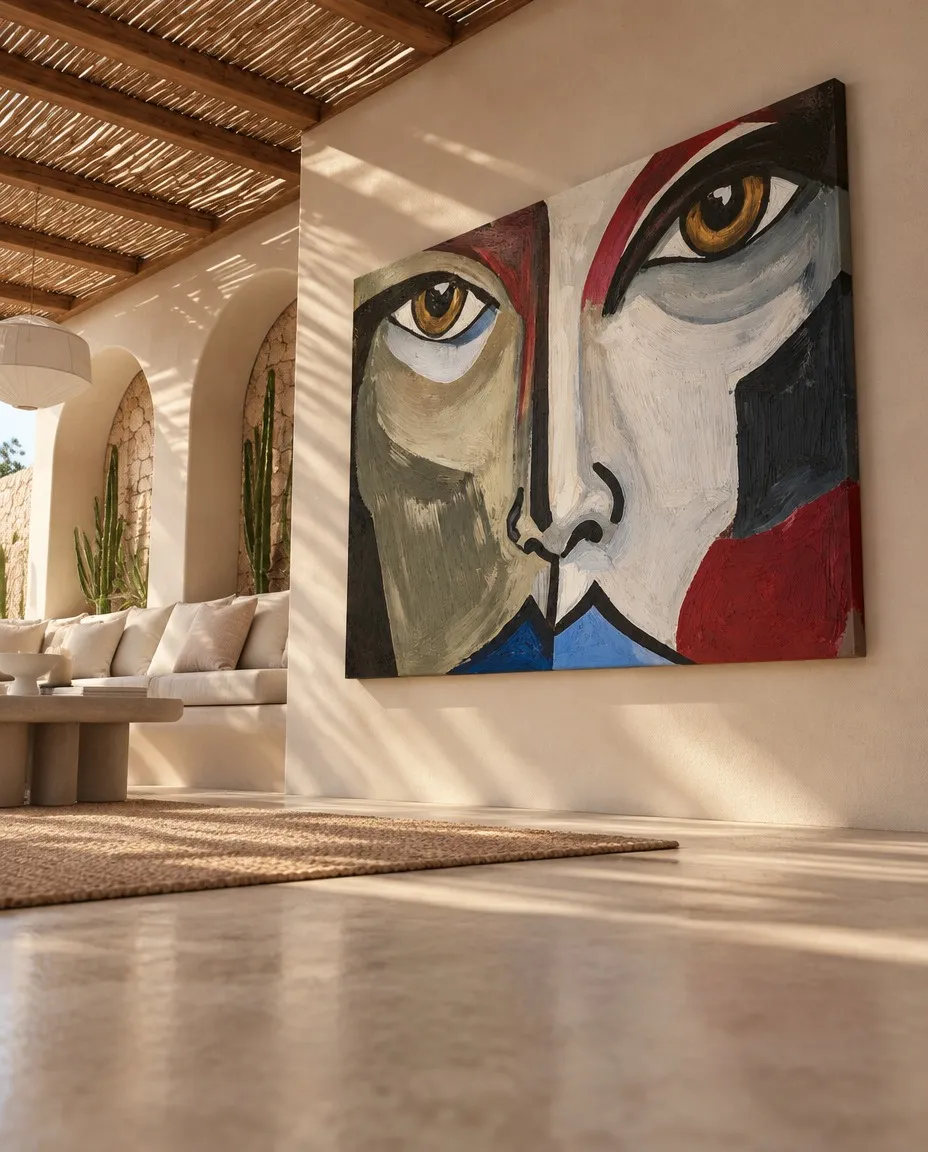
Context study / ASPECTUS
ASPECTUS in a Mediterranean Dining Room | Maurizio Valch
From a distance, ASPECTUS does not present itself as a portrait: it occupies the wall like a façade brought too close, as though it had moved forward until it stood level with the viewer. Its 210 centimetres of width offer not a scene to enter, but a presence from which it is difficult to step back. The face does not seem positioned before the viewer; it seems to have already caught them within its field. The unease does not arise from a recognisable expression, but from a disproportion: those golden eyes are on a scale that does not quite belong to a face, and the face, in turn, is on a scale that does not quite belong to a body. Before asking what it feels, the viewer notices that they are being measured. Perhaps the two eyes arrived here after spending a minute in different worlds. Perhaps each brings news that the other does not yet know how to hear.
The left eye holds the gaze first, not because of its calmness, but because its surroundings seem to linger. There are muted greens, dense greys, a matter of shadows that does not quite recede behind the eyelid. Yet it would be hasty to call it earth, night, memory, or sadness. That area might be the aspect of something that has breathed beneath a surface and learned not to reveal itself whole. The white of the eye does not illuminate: it receives the pressure of what surrounds it. Its gold does not gleam like an ornament; it seems a substance seen from within a cavity. What kind of ground might lie beneath that pupil, if it were not a ground that could be named? What visual memory can reside in an eye that does not ask to be deciphered, but held without haste?
Then the other eye interrupts. It does not arrive as an answer or the reverse of that territory; it arrives to unsettle the names that had just seemed useful. The pallor on the right is not relief from shadow, and the red does not complete a chromatic drama. It cuts, yes, but it also displaces. The dark area of the cheek seems to have invaded a place where clarity was expected, while the red band occupies an expanse that could be skin, cloth, wound, mask, or simply a fact of painting that does not wish to represent anything beyond itself. The right eye does not correct the left: it deprives it of the right to be a coherent region. If the first seemed to hold a dense breath, the second asks whether that breath was not already a hasty construction by the viewer.
Between them there is no line that can be reduced to an explanation. There is a vertical seam, dark and unstable, descending from the forehead, edging the nose, and approaching the mouth without fully asserting what it joins. At times it appears to be the shadow required for the face to exist; at others, an opening through which the face ceases to belong to itself. It does not divide two finished halves; rather, it produces the suspicion that neither had been a half before meeting the other. Here the gaze loses one certainty—that of facing an available identity—and acquires a more difficult question: what if the face is made by that which cannot be fused within it?
I cannot make this face into a single thing. When I try to gather it together, one gaze moves ahead of me and the other falls behind; when I follow one, the other returns a distance I cannot erase. The painting retains a resistance I cannot master: it refuses to become a unity, yet it also resists being divided without something on each side continuing to pulse in the other. I feel that the seam is not only in the face; it also appears between my desire to order and the gaze the work refuses to grant me.
It is worth making a brief, almost discreet test. Imagine covering the greenish half—not to interpret it as absent, but to notice what happens to the air when the right eye remains alone before the body. Then cover the other half. The change may not be conceptual. Perhaps the gaze quickens, perhaps breathing becomes shorter, perhaps a different proximity emerges, as though someone were standing before the viewer in another way. Neither part explains the whole. But the whole does not soften the resistance of either part: even as it brings them together, it retains the disagreement between their presences.
Ailton Krenak, the Brazilian Indigenous thinker and activist who has imagined ways of living less separate from the Earth, rivers, and all that the modern world treats as mute matter, enters this disagreement. Before this face, his suspicion would not fall on which side tells the truth. He would suspect the very demand to make the face legible by cutting it into manageable zones: one half for shadow, another for light; one for the rough, another for the cutting; one for what is admitted as feeling, another for what is presumed to be understood. Perhaps the painting does not look out from an individual identity enclosed in skin, but from a wider condition, in which a gaze may be traversed by materials, climates, presences, and times that do not fit within a person's name. The seam, then, would not be only interior: it could be the place where the human habit of separating encounters its limit.
But the experiment grows more unsettling when Erwin Schrödinger appears, the physicist who made visible the strangeness of a world in which something may not be exhausted by a single state while no one can fully observe it. His intervention does not allow uncertainty to become a comfortable metaphor. While attention settles on one eye, the other does not disappear: it remains at the edge of vision, out of focus but active, altering what one believes one is seeing. Can this face sustain two affective states at once without that simultaneity needing correction? The left eye may convey an impossible piece of news: “something is looking at you from a place where form has not yet decided to be a face.” The right may bring another: “what you call form was already changing as you looked at it.” Neither message arrives pure; each contaminates the hearing of the other.
Krenak objects that the problem cannot remain an abstract exercise in attention: an uncertainty detached from the bodies and conditions that compel certain bodies to be divided, classified, or silenced risks becoming a luxury. Schrödinger replies, without resolving that objection, that uncertainty also takes place in the retina, in the nape of the neck, in the slight effort of holding two non-coinciding points of focus. It is not only a narratable wound; it is an optical and bodily experience. Their friction produces not reconciliation but a discipline of looking: attending to two presences without amputating one in order to understand the other, allowing the peripheral eye to keep disturbing the central eye.
A child might ask: why do those eyes hold gold when the mouth seems to be clenching a stone? The question alters the painting because it seeks neither symbols nor diagnoses. It brings out the disproportion between the unsettling richness of the pupils and that small mouth, almost closed around something that cannot be said. Perhaps it is not a stone. Perhaps it is what remains of the news that neither eye can deliver without losing it. The mouth does not seem to keep a complete secret; it seems to contain the effort not to release an objection too soon. There the face ceases to be a field of two gazes and becomes a mechanism of retention: it sees more than it can utter.
Now the painting no longer answers to my intention. The mouth and eyes have formed a question that continues working when I stop looking at them: I do not know which of them is watching me, nor whether the other is looking at something behind me. What once might have seemed a face has detached itself from my will and returns a presence I cannot possess. I can return to it, but I cannot force it to come together in order to reassure me.
On returning to the eyes, they no longer appear as organs or emblems. They are two places from which the viewer may not be the same. One seems to look at the person who arrives laden with names; the other, at the person who does not yet know how they have been seen. The seam remains between them, becoming neither solution nor condemnation. And as the gaze turns away, a small but persistent physical suspicion remains: one of those eyes has just shifted slightly—not on the canvas, but in the place from which it returns the world's gaze.
- Original artwork
- ASPECTUS
- Actual dimensions
- 82.7 × 63 in / 210 × 160 cm
- Presentation
- Digital contextual visualization
Context references
ASPECTUS Maurizio Valch · contemporary monumental face painting · large painting for Mediterranean dining room · wall art with golden eyes · red blue and green abstract figurative painting · horizontal artwork for a large wall
About this visualization
This visualization places the artwork within an architectural context to help collectors and viewers imagine its presence in a real space. It is an interpretive reference, not an exact reproduction: the original work remains the sole authority for scale, color, surface and material presence.