Context study / ASPECTUS
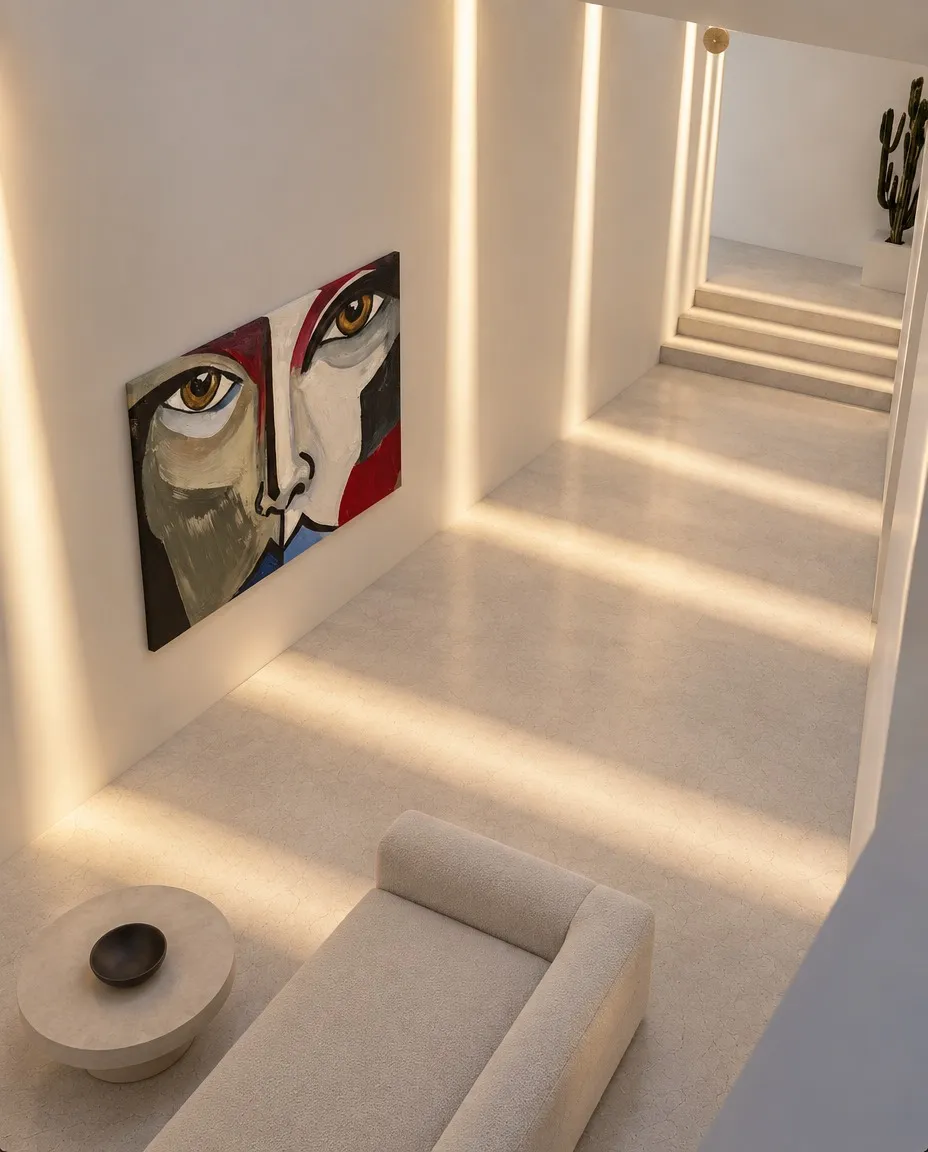
ASPECTUS in a Minimalist Foyer | Maurizio Valch
ASPECTUS, an imposing 210 × 160 cm work from the FACIES series, asserts itself in space not as a conventional portrait but as an architectural structure of human physiognomy. The canvas is disrupted by a bold vertical black axis that fragments the face into two asymmetrical halves, opening an unbridgeable trench between a dense left band of earthy, greyish tones and a right half dominated by icy, impastoed white. This facial wall, bounded by fields of saturated crimson red and indigo blue at the base, cancels any attempt at immediate psychological reading and offers instead a totemic presence. The two oversized, fixed eyes, with golden pupils that catch the light in a compelling way, act as magnetic centres that suspend the viewer’s sense of time. The work’s frontality immediately evokes an archaeology of the gaze, in which the face ceases to express contemporary subjectivity and becomes an eroded geological relief, a stratum of lime and pigment emerging from the memory of European territory.
Before this large-format stretcher, I understand painting as a constructive action in which the canvas is not a passive support but a physical boundary that I must fracture and order with the palette knife. As I accumulate oil paint across the surface, I deliberately seek the friction of matter; I am not interested in smooth colour transitions, but in the collision between the density of grey that carries shadow and the coldness of white that arrests light on the right side of the face. The thick central black line is not a contour stroke but a structural incision, a necessary crack dividing thought and form, preventing the face from unifying into the falsehood of a harmony that does not exist. In this process of partitioning and chromatic tension, where crimson and blue determine the weight of the base, the two golden eyes emerged not as a figurative choice but as two autonomous thresholds that watch over my own pulse and demand that I halt the material accumulation at the exact point where the painting begins to look back.
This formal division of the face in ASPECTUS invites a rigorous conceptual examination of duplicity and the structure of human consciousness. In observing this inner boundary that divides the physiognomy, it is difficult not to invoke Carl Gustav Jung, the renowned Swiss psychiatrist who mapped the tensions of the collective psyche, in order to question the work through his notions of the Persona and the Shadow. Here, the whitish half does not necessarily function as the social mask that conceals the abyss; rather, both parts coexist in a brutalist parity that exposes the subject’s constitutive duality without moral hierarchies. Added to this friction is the perspective of G. I. Gurdjieff, the influential Armenian thinker who devoted his teaching to the awakening of human self-awareness, prompting us to question the quality of this monumental gaze: these circular, symmetrical pupils, suspended within a two-dimensional plane, may be read as the paralysis of the individual’s everyday mechanical existence—looking without seeing—or as the violent flash of self-remembering, a moment of lucidity that breaks the inertia of automatism through the fixity of its own pictorial presence.
For me, this FACIES is a passage connecting the present to the formal ruins of the Mediterranean, a territory where archaic cultures carved stone to confront gods and death with the same frontality that I now seek in the studio. In working on these monumental features, I do not pursue the physiognomy of a particular individual, but the echo of Iberian masks, the synthetic lines of Cycladic figures and the firmness of Palaeolithic incisions that resist time beneath the earth’s crust. Painting this face is an exercise in excavation, in which I remove layers of forgetting so that a collective memory we share unconsciously may surface: a mask that seeks not to conceal anything, but to return to the surface the hardness of a common origin, paying homage to the severity of forms that preceded us and that continue to inhabit the subsoil of our gaze.
The experience of ASPECTUS dispenses with decorative exits in order to compel a final face-to-face encounter between the viewer and the painted surface. The lateral blocks of crimson and blue act as buttresses, preventing the face from dissolving into the room’s background and establishing the painting as a two-dimensional monument to material resistance. A deconstructive reading of the work brings us to a point of no return, where theories of the fragmented self and the inheritance of archaic cultures of southern Europe merge into a single physical presence. The painting offers no conciliatory answers and permits no passive contemplation; instead, it leaves us before the severity of its own golden gaze. In the end, one fundamental question remains suspended: does this two-dimensional gaze belong to a stone ancestor watching us from the depths of human history, or does it function as an implacable mirror that returns our own fragmented image, demanding that we emerge from lethargy and automatism to sustain the gaze of our own duality?
- Original artwork
- ASPECTUS
- Actual dimensions
- 82.7 × 63 in / 210 × 160 cm
- Presentation
- Digital contextual visualization
Context references
ASPECTUS Maurizio Valch · horizontal abstract face painting · wall art for a minimalist foyer · contemporary painting with large eyes · abstract figurative painting for an entrance hall · FACIES fragmented face artwork
About this visualization
This visualization places the artwork within an architectural context to help collectors and viewers imagine its presence in a real space. It is an interpretive reference, not an exact reproduction: the original work remains the sole authority for scale, color, surface and material presence.