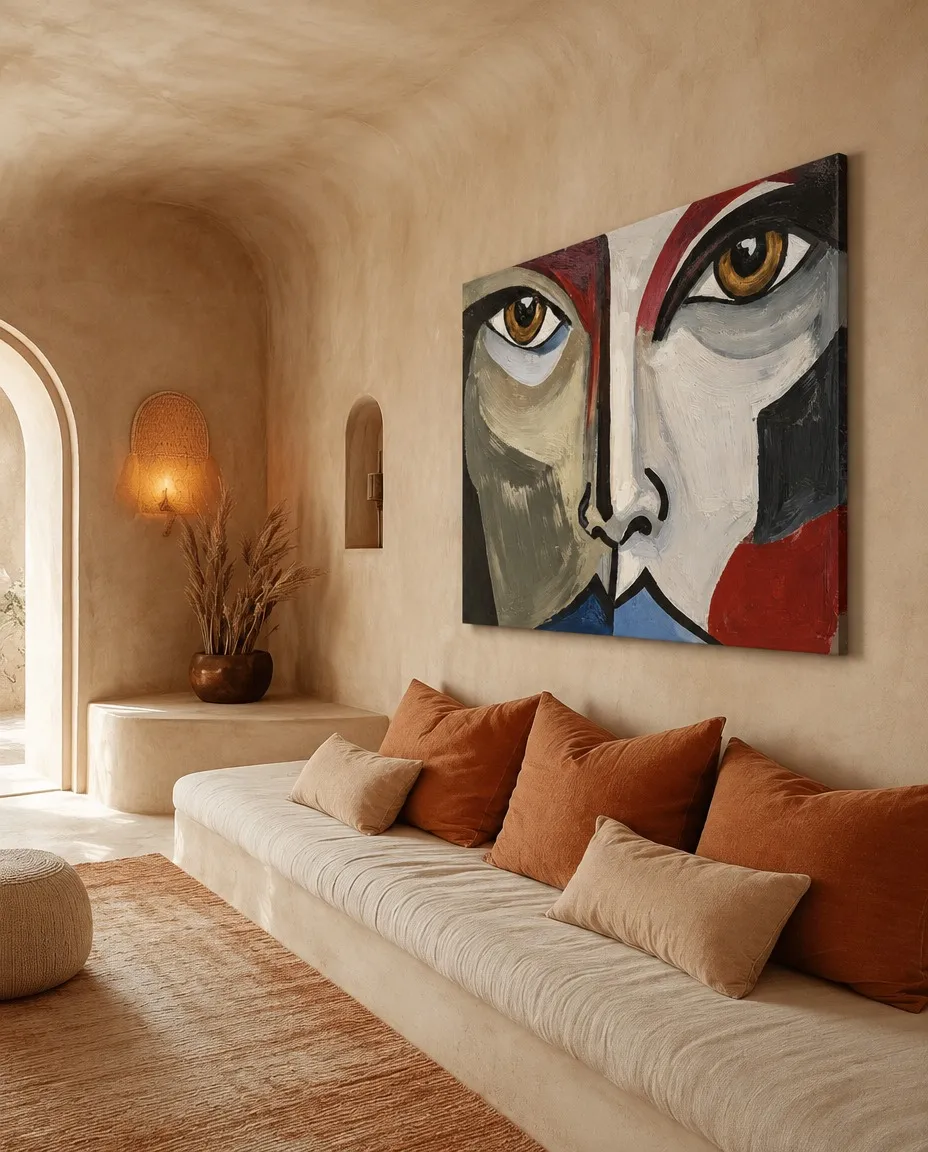
Context study / ASPECTUS
ASPECTUS in an Arched Interior | Maurizio Valch
The monumental scale of ASPECTUS, set within this space of organic walls and warm tones, transforms contemplation into a physical face-to-face encounter with no room for distraction. The painting does not tell a story of pain or explain the origin of its fracture; it simply stands as a presence that sustains a state of concentrated tension. By dispensing with anecdotal devices, the image becomes a pure emotional block, a visual structure in which conflict does not unfold over time through narrative but remains suspended, condensed in the severity of a face that returns our gaze with mineral fixity.
When I faced the canvas to open this vertical scar, I was not thinking of illustrating a theory of duality or portraying inner disorder. I wanted the pictorial material—the opaque density of oil paint, the resistance of acrylic—to physically register the pressure of a wound that does not seek to close. As I drove the palette knife into the centre of the face, the gesture was not descriptive but a tectonic intervention on the surface: a dry cut that exposes the strata of paint and arrests the flow of form. For me, the face is a territory where emotion is not explained in words, but accumulates in the thickness of matter and in the weight of every superimposed layer.
The work’s temperature is contested by two atmospheres that collide without blending: the organic density of the greens and earth tones on the left opposes the cold pallor and crimson arc on the right. This chromatic arrangement does not function as a symbolic code for the viewer to decipher, but as a direct sensory impact that precedes any intellectual interpretation. The lower blocks of dense blue and opaque red press upward, exerting a constant pressure that threatens the apparent stillness of the upper face. It is this containment of opposing forces that gives the painting its vibrant character; emotion is not narrated but held within the structure of the work itself.
I shaped these large ochre eyes so that they would not function as the usual lyrical window onto a sentimental interior, but as corporeal volumes that halt the contemplative drift of those who stand before them. In this quiet space, where light brushes the texture of both wall and canvas, I am interested in this stripped-back confrontation: an encounter in which the painting’s gaze feels as real and weighty as the viewer’s own body. There is no invitation to comfort here, nor a journey of reconciliation; there is only the fixity of an instant that resists translation by the noise of thought.
Ultimately, ASPECTUS acts as a fractured mirror that returns to the viewer the certainty of their own fragmentation. By rejecting the softness of conventional portraiture, the work connects with the solidity of ancient Iberian reliefs or stone masks that observe the passage of time with incorruptible indifference. The central fissure that divides the face is not an accident to be repaired, but the indispensable condition upon which this monumental presence is built. To sustain one’s gaze before this imposing canvas is to accept that emotion does not need to justify itself through a story in order to occupy, with all its weight, the space we inhabit.
- Original artwork
- ASPECTUS
- Actual dimensions
- 82.7 × 63 in / 210 × 160 cm
- Presentation
- Digital contextual visualization
Context references
ASPECTUS Maurizio Valch · contemporary frontal face painting · large abstract face painting · wall art for a living room with arches · painting with ochre eyes and crimson background · contemporary painting for a Mediterranean interior
About this visualization
This visualization places the artwork within an architectural context to help collectors and viewers imagine its presence in a real space. It is an interpretive reference, not an exact reproduction: the original work remains the sole authority for scale, color, surface and material presence.