Context study / ASPECTUS
ASPECTUS in a Mediterranean Living Room | Maurizio Valch
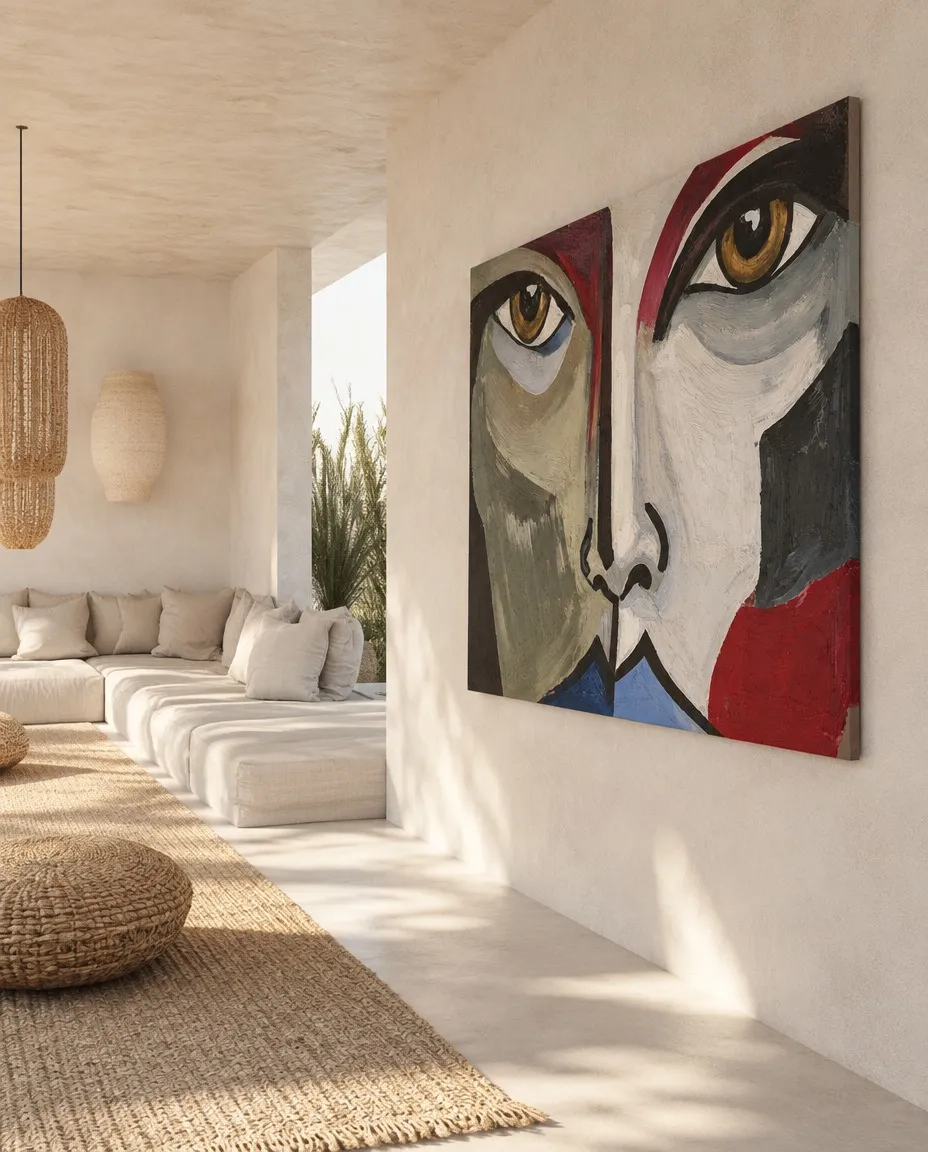
The physical monumentality of ASPECTUS, realised on a 210 × 160 cm canvas, asserts itself in space not as a mere representation of human physiognomy, but as a material territory from which the face emerges out of abstraction. Here, the face does not seek the pleasing effect of traditional mimesis; it stands as a tactile, emphatic architecture, a map of tensions in which paint takes on the volume of rock. The idea of protection is articulated through this defensive configuration of the canvas: the accumulated density of oil and acrylic, together with the blocks of crimson and opaque black that frame and compress the forehead, act as a physical armour. This crust of thick pigment shelters an inwardness sensed as dense and inaccessible—a wall that does not isolate but preserves the integrity of the depicted subject against external dispersal. The work’s surface thus becomes a threshold where the face protects itself through the weight of its own matter and the firmness of its frontal structure.
When confronting this large-format support, I had to sustain a direct dialogue with the momentum of my previous series, those in which silent horizons, monoliths and geological incisions entirely dominated the surface. Moving towards facial figuration required a profound degree of trust: the trust to let coarse strokes, dense impasto and palette-knife marks leave behind the coldness of mineral geography and begin sculpting human features. I did not seek to refine the gesture, but to trust that the rawness of the material would reveal the structure of character. In this process of construction, the point of greatest tension was drawing the bold black line that cuts through the central axis of the composition, abruptly dividing the nose and the meeting point of the lips. I trusted that this vertical fracture, rather than breaking the unity of the head, would act as an inner spine—a nerve that holds both halves together and gives the face its true architectural gravity.
From an analytical perspective, the canvas reveals itself as split by a radical chromatic asymmetry that questions the limits of identity. On the left, an atmosphere of earth tones, smoke greys and deeply muted olive greens prevails, recalling wet stone or the earth’s crust; on the right, by contrast, a clean bone white breaks through, bounded by a dense, vibrant block of crimson, while at the base both sides converge in a precise blue triangle. The concept of belonging emerges precisely through this apparent formal contradiction: to which of these two realities does the face truly belong? The work proposes that belonging does not mean homogeneity or the suppression of difference, but the coexistence of two physically dissimilar territories that choose to share the same ground and support one another beneath a single gaze. It is the constructive tension between the shadowed block and the luminous plane that unifies the pictorial space, showing that identity is inhabited through the integration of its fractures.
In the gaze of ASPECTUS, I concentrated all the tension of my practice, shaping two large ovals in a golden-brown hue that stare steadily, without blinking. I did not conceive these eyes as open windows onto a confession, nor as a passive invitation to the viewer’s empathy, but as a tactile boundary that halts intrusion. Like the “closed boxes” I have reflected upon in my studio writings, these pupils guard an inviolable enclave, protecting a secret that painting has no obligation to decipher. I chose to paint the symmetry of these two golden gems amid the apparent chaos of surrounding brushstrokes and textures in order to establish a rigorous pact of trust and belonging with anyone who pauses before the canvas. The viewer must understand that they do not possess the work by decoding it; the work belongs to them only if they can sustain its gaze, accepting the enigma of its silence without trying to violate its reserve.
In the final reception of ASPECTUS, the concepts of belonging, protection and trust converge decisively on the canvas surface, transforming it into what might be called a “tactile shore.” This space of friction does not function as a distant projection screen, but as a plane of physical confrontation in which the viewer discovers themselves reflected in—and questioned by—the monumental scale of the painted face. By suspending the desire for clinical analysis or formal classification, a pact of mutual trust is established: the viewer relinquishes intellectual distance and, in return, the work allows them to approach its protective shelter. In this way, the depicted face and the real face that contemplates it cease to be separate entities and come to belong, at least for the brief and intense duration of contemplation, to the same stratum of shared silence, where painting and gaze merge into a single physical presence.
- Original artwork
- ASPECTUS
- Actual dimensions
- 82.7 × 63 in / 210 × 160 cm
- Presentation
- Digital contextual visualization
Context references
ASPECTUS Maurizio Valch · contemporary fragmented face painting · abstract face painting with golden eyes · figurative wall art for a Mediterranean living room · large painting with red blue white and green · Maurizio Valch FACIES series artwork
About this visualization
This visualization places the artwork within an architectural context to help collectors and viewers imagine its presence in a real space. It is an interpretive reference, not an exact reproduction: the original work remains the sole authority for scale, color, surface and material presence.