Context study / ASPECTUS
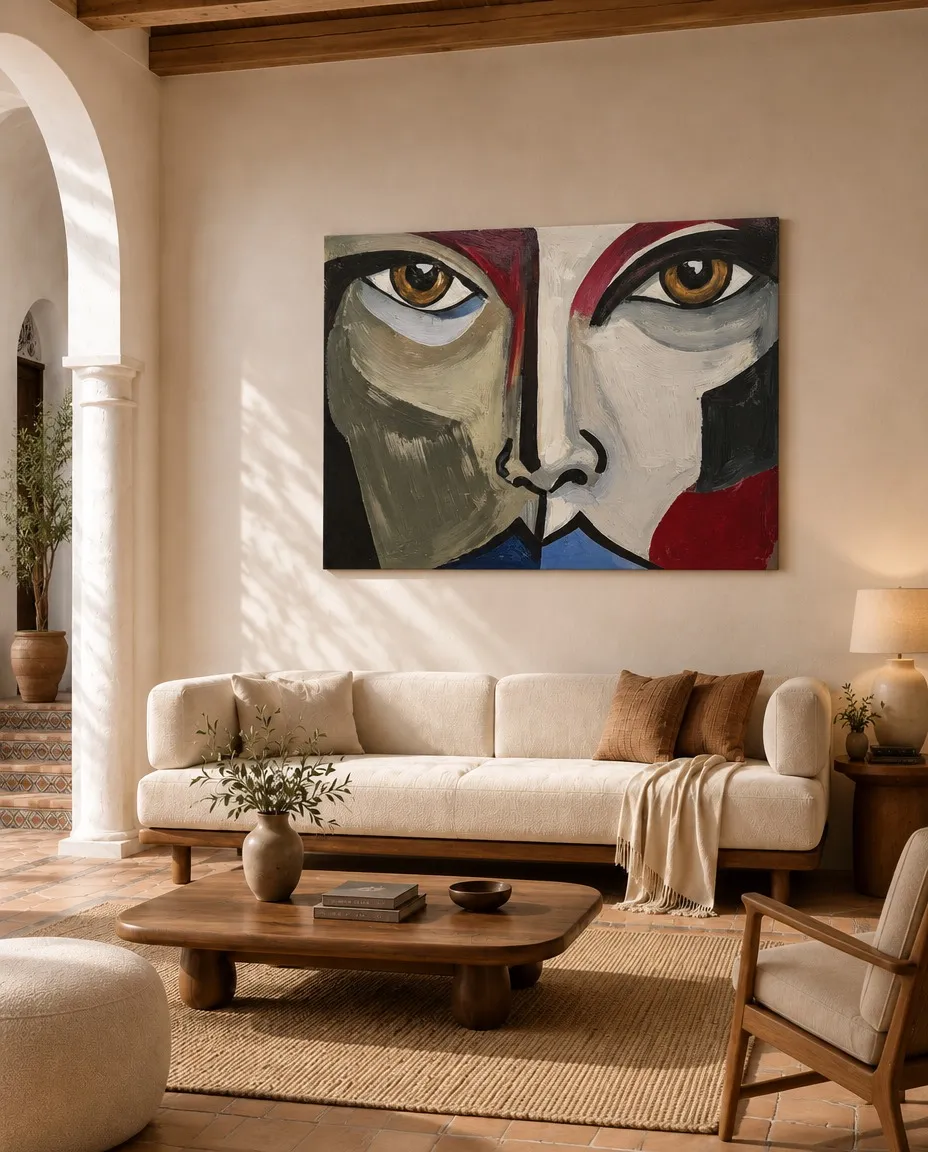
ASPECTUS by Maurizio Valch in a Mediterranean Living Room
The scale of ASPECTUS is measured not only in centimetres, but in the force with which it interrupts the room’s emptiness. In this space of clean walls and tempered light, the two-metre-wide painting behaves like a geological presence, a compact mass that does not decorate the wall but replaces it. Whoever sits on the sofa does not contemplate a picture; they live alongside a structure that watches them. Far from conveying order, the symmetry of the two-sided face imposes the fixity of an ancient monolith, one of those stone masks that did not seek to record an individual’s expression but to consolidate an unbridgeable boundary against time.
When I faced the canvas, I did not seek to draw a face, but to dig into matter until I found its resistance. Not a single stroke on this surface aims to be agreeable or descriptive; the palette knife drags pigment as one might shift sediments of damp earth, accumulating layers of oil and acrylic so that the painting takes on the weight of a wall. The violent scar dividing the physiognomy into two symmetrical yet conflicting halves is not a line added in passing: it is a physical incision, a dry cut that penetrates the strata of colour and remains there as the trace of a fracture refusing to heal. I do not paint to illustrate an idea, but to raise a territory where form appears and resists under its own pressure.
That vertical seam fracturing the gaze refers to a mute tension, an internal line of battle where two systems of thought contend for control of the space without ever merging. The marble-like pallor of the right side collides with the shadowed, earthy tones of the left, suggesting a profound psychological division, akin to the invisible boundaries we draw every day to preserve a coherent identity. This is not a portrait; it is a cartography of fragmentation. The central scar functions as an unstable threshold, a muscular barrier that the painting itself maintains to prevent both facets from recognising one another and dissolving the fiction of the self that contains them.
I know well that the mind is expert at producing complex theories to justify its own noise, but these severe ochre eyes I designed allow no such intellectual escape. I painted them with an almost sculptural density, seeking for them to return the gaze with the same material force with which they were placed upon the canvas. Sometimes, while cleaning brushes in the studio, I wonder whether this watchful fixity is the rigid mask we put on to survive the demands of our surroundings, or the exact instant in which consciousness abruptly wakes from its own automatism and finds itself trapped within its own functioning. In the end, no verbal answer can sustain that gaze; only the fixity of the plain fact remains.
At the base of the composition, compact blocks of indigo blue and muted crimson exert a muffled pressure, a tectonic thrust that threatens to crack the rigidity of the upper features. The silence emanating from this monumental confrontation is not peaceful; it holds the gravity of things on the verge of an inevitable transformation. Like a walker who stops before an abrupt relief in the desert, the viewer exposed to ASPECTUS in this silent room finds not a window onto another’s interiority, but a broken mirror returning the image of their own inevitable division.
- Original artwork
- ASPECTUS
- Actual dimensions
- 82.7 × 63 in / 210 × 160 cm
- Presentation
- Digital contextual visualization
Context references
ASPECTUS Maurizio Valch in living room · large painting above sofa · contemporary art for a Mediterranean living room · abstract face painting in living room · large-scale painting for living room wall · living room décor with contemporary painting
About this visualization
This visualization places the artwork within an architectural context to help collectors and viewers imagine its presence in a real space. It is an interpretive reference, not an exact reproduction: the original work remains the sole authority for scale, color, surface and material presence.