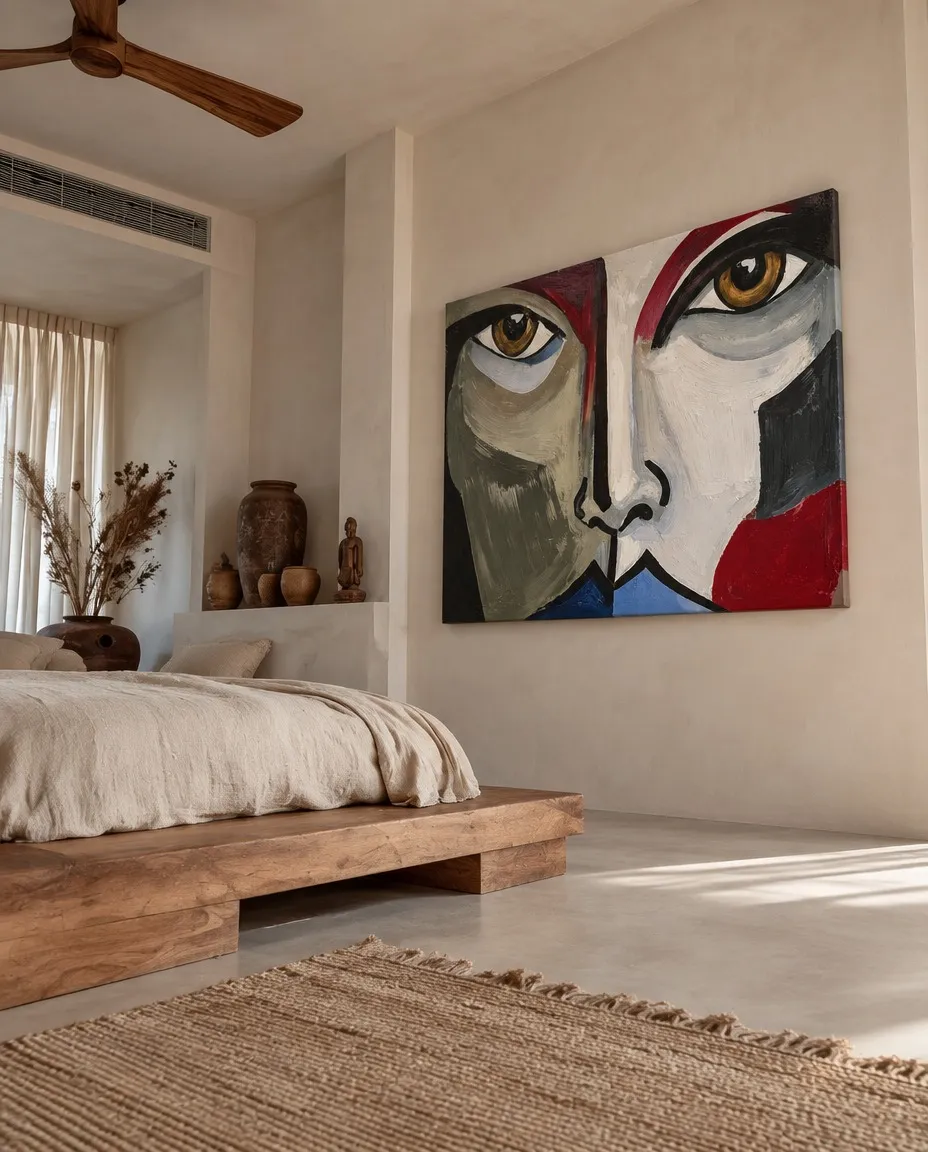
Context study / ASPECTUS
ASPECTUS by Maurizio Valch in a Mediterranean Bedroom
Score for a face that cannot decide which way to look
ASPECTUS does not offer up a face all at once. First one eye appears; then the other makes you return. The gaze tries to step back, to assemble the nose, cheeks, mouth and outline, but something brings it back to that pair of golden irises: two small centres of heat embedded in a cold, dark, dense expanse. They do not illuminate the face. They complicate it. They resemble two metals left too long near the fire, two tiny lamps that do not know for whom they are lit.
The eye on the left arrives with a greenish, grey, almost sedimented slowness. Beneath it, the surface seems to bear weight; the black does not entirely fall away, and the blue below does not quite cool the face. A gravity pulls downward and yet the iris remains alert, as though it had heard a sound that has not yet reached the rest of the face. Ludwig van Beethoven, a composer who made tension, interruption and insistence into a way of thinking in sound.
The eye then ceases to be an eye and takes on the behaviour of a sustained note. Not an imaginary note floating around the painting, but a pressure: gold insists against muted greens, the dark edge insists against the white approaching from the other side, the form returns to itself without remaining identical. The second eye replies but does not accompany it. It enters a little late or a little early; which does not matter. Its gold seems sharper, more exposed among cold whites, blacks and greys. There is no agreement between the two: one face tries to sustain a single note while each half listens to different music.
The vertical seam unsettles that listening. It runs down from between the brows, across the nose and to the mouth, yet it does not function as a reliable border. At times it seems a wound hastily closed; at times a hinge; at times the exact place where one side has seeped into the other. It does not separate two people. Nor does it manage to unite them. The left eye borrows the tension of the right; the right receives something of the left’s heaviness. The line does not split: it transmits.
I recognise in this face a hesitation I cannot force to stop. I wanted to see how two presences could occupy the same place without coinciding, and the face began to resist every agreement I wished to impose on it. I feel the separation as a physical pressure, almost as if the nose had to sustain two breaths that cannot find the same rhythm. When I look at the two eyes together, I do not find a synthesis; I find an insistence that makes me return to them.
A child’s question then enters without asking permission: “If both eyes are on the same face, why does one seem to have arrived before the other?” The scene changes. It is no longer about two spatial halves, but two times caught in the same plane. The greyish green seems to have waited; the red seems to have burst in. The white seems neither young nor old, but has the impatience of something just discovered. The black, by contrast, takes no side: it settles into both areas like a guest who knows too many doors.
Ludwig van Beethoven cannot resolve this delay. The dissonance remains without moving towards an arrival. The visual motif returns—two golds, a nose, a line, a mouth—and each return changes the pressure without offering respite. There is no hidden musical resolution in the face. There is repetition with friction. A sustained note that begins to resemble a question, and a question that hardens until it resembles matter.
Here arises the suspicion that perhaps too much interiority has been demanded of the face. Marcel Duchamp, an artist who shifted art towards the question of when and how a thing changes when seen differently.
The suspicion does not deny the eyes; it relieves them of an obligation. Perhaps they do not have to reveal a soul, a secret or a character. Perhaps they are mechanisms of return. Whoever looks wants to decide quickly: this half is sad, that one furious; this is the real one, that one a mask; this red accuses, that green is silent. But every decision produces a different face. The central seam becomes complicit in that production: the more one tries to settle it into a coherent identity, the more visible become the viewer’s hands distributing emotions, ages, guilt and temperaments.
The face, with a somewhat cruel patience, lets this happen. Then it ruins the result.
Because the mouth is there. Small, taut, barely open like a black interruption between planes that do not quite settle into place. Until then, the eyes seemed to dominate everything: they were heat, vigilance, threat, weariness, lamp. The mouth retrospectively alters their command. It does not speak. Nor does it entirely fall silent. It seems to contain the effort not to choose a side, as though closing the lips a little more might prevent the face from becoming two faces. There is something almost comic in this economy: two enormous eyes, two incompatible climates, a nose occupying the centre with severity, and a mouth that seems to say: please, do not make so much noise.
But it makes noise. The intense red does not end within its own half; it presses towards the centre. The blue below does not provide rest; it rises with silent coldness towards the mouth. The blacks provide contour, certainly, yet they also open gaps through which expression escapes. The visible matter retains the sense of having passed through several decisions, of having changed direction without entirely erasing the earlier course. It does not confess a process: it preserves the memory of a struggle without narrating it.
The seam no longer seems merely a separation. It becomes the place where the two eyes accept that they belong to the same face without managing to look at the same thing. Here, the will to find a secret unity begins to fail; so too does the temptation to reduce the fracture to a clever idea. There is too much weight in the painting, too much presence in those golds, too much friction between white, green, red, blue and black for the face to be only a paradox. It remains an artefact, yes, but one that returns warmth.
I now discover that this face also looks at me from a zone I do not control. I do not possess it when I try to explain it, nor does it disappear when I stop looking for an answer. Sometimes I think the two eyes sustain an opposition; at other times I feel they are two ways of watching over my need to resolve it. I do not need them to coincide in order to recognise their closeness. The painting has learned to preserve something I do not know how to claim as my own.
Return to the golden irises and look at them without following the nose first: let the red reach the right one, the blue support the left, the black bring them closer, and observe how the central line prevents either one from shining alone.
- Original artwork
- ASPECTUS
- Actual dimensions
- 82.7 × 63 in / 210 × 160 cm
- Presentation
- Digital contextual visualization
Context references
ASPECTUS Maurizio Valch in bedroom · large painting above bed · contemporary art for a Mediterranean bedroom · abstract face painting in bedroom · large-scale painting on light wall · bedroom décor with contemporary art
About this visualization
This visualization places the artwork within an architectural context to help collectors and viewers imagine its presence in a real space. It is an interpretive reference, not an exact reproduction: the original work remains the sole authority for scale, color, surface and material presence.