Context study / ASCENSUS
ASCENSUS in a Classic and Elegant Interior | Maurizio Valch
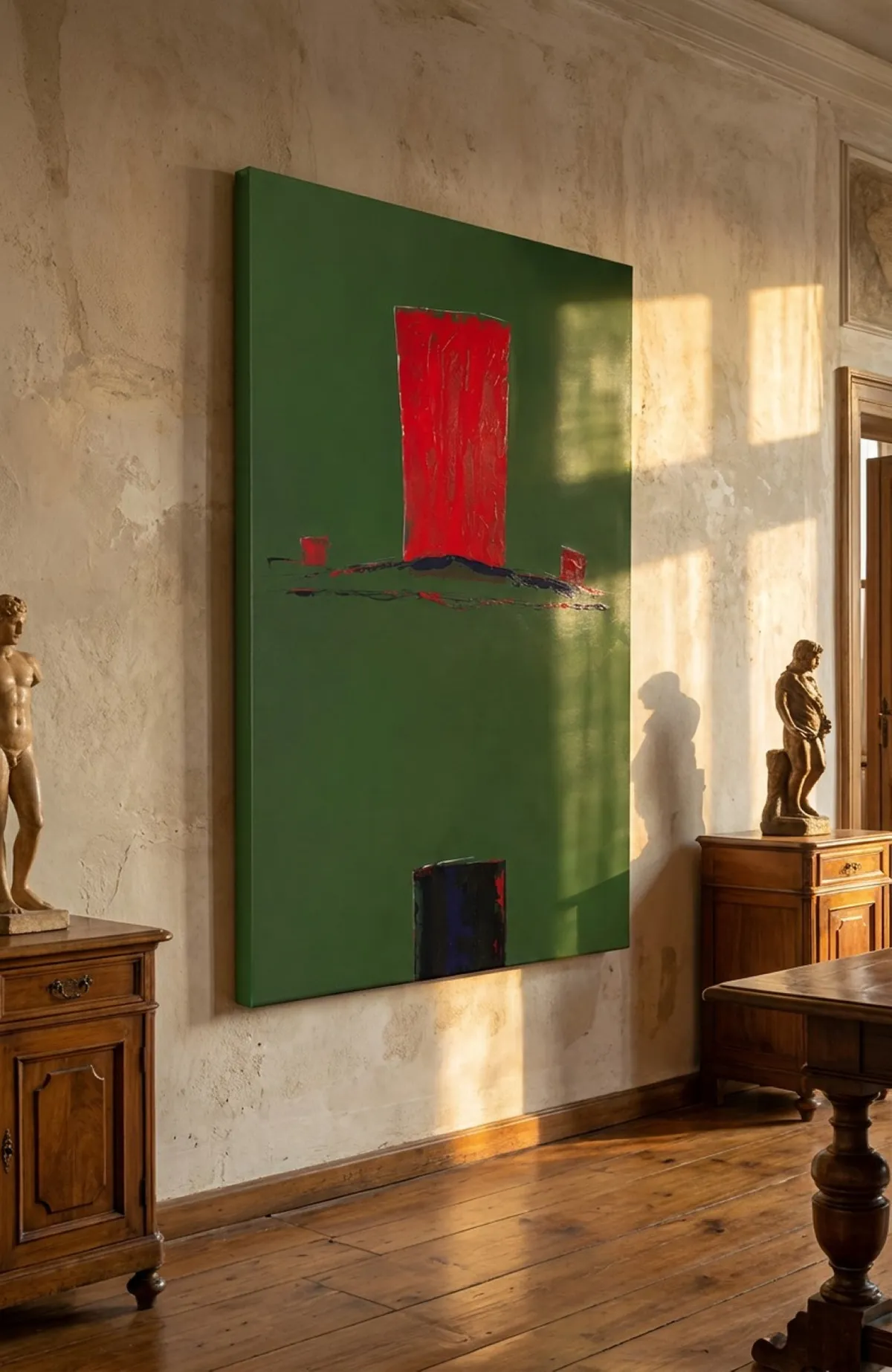
"ASCENSUS" unfolds before the gaze not as a two-dimensional representation, but as a topography of chromatic and tectonic tensions. A dense and silent forest-green plane, saturated with an almost forest-like or geological vibration, constitutes the primordial territory of the work; it does not act as a passive background or a neutral void, but as an atmosphere of physical density that presses upon the shapes. In this grave, vegetal space coexist three distinct strata that organize the gaze vertically: a dark block, of an almost nocturnal indigo and imperfect edges, emerging from the lower limit of the canvas like an obtuse root or a subterranean threshold; a horizontal fracture line tearing through the center, a dark horizon where scratches of an underlying red can be discerned; and finally, a large crimson monolith that rises with force in the upper portion, flanked on its sides by two small red blocks—two watchmen measuring the scale of the space and consolidating the order of the plane.
I remember the density of the paint on the canvas laid horizontally on the studio floor, the actual weight of the green pigment that sought a thickness capable of resisting the onslaught of the other colors. I did not want that background to be an aerial atmosphere, but a resistance, an almost organic mass holding the destiny of the black and the vibration of the red with gravity. The dark block below did not arise from symmetrical planning, but from a physical need for anchorage: a thick stroke that emerged almost at the end of the process to restore gravity to the canvas, a mark driven into the bottom edge acting as an iron counterweight. As I dragged the brush loaded with indigo and black across the base, I felt how the material claimed its own roots, a necessary zone of sinking so that the plane would not float adrift and would find its center of gravity in the very ground of the painting.
This vertical arrangement of pictorial matter establishes a direct dialogue with the inner friction of the individual, raising a question about the very nature of human ascent. Observing the work through the perspective of G. I. Gurdjieff, the dark, imperfect block at the base refers to that original mechanical state, the state of deep sleep and automatism in which daily existence unfolds when devoid of intention; the transition toward the upper crimson monolith then becomes the conquest of an awake attention, a "self-remembering" that is only possible through the conscious effort that breaks the inertia of the middle horizon. Concurrently, this structure resonates with the process of individuation theorized by Carl Gustav Jung. Ascent is not a purifying abandonment of the lower matter, but an integration of the Shadow: that dark, formless block lying below is the indispensable foundation for the Self, embodied in the imposing red mass above, to acquire its true scale, its light, and its sense of wholeness, revealing that the Self cannot stand without first reclaiming that which has remained buried.
To trace that horizontal fracture dividing the canvas, I had to wound the green plane with a wide palette knife, letting the background red seep through the black like a trace of cold fire. I was not looking for a pure line, but a boundary eroded by the rubbing of the tool, a material tear testing the separation of the two worlds. When I undertook the central block, I deliberately avoided clean geometry; I preferred the vibration of an imperfect presence, worn down by the friction of accumulated and then scraped pigment, revealing the layers of its own physical growth. The two small lateral red blocks appeared almost by instinct, as necessary satellites to measure the distance and sustain the violent verticality of the central monolith, two visual support points preventing that large crimson mass from collapsing under its own weight and signaling, on their small scale, that all effort of elevation requires a tense and vigilant balance on the sides.
By dispensing with complacent discourses on elevation or disembodied mysticism, Valch's proposal imposes itself through its tectonic character and material rigor. The transit suggested by the work is not an ascent free of conflict, but an arduous effort, a physical struggle of form to separate itself from the density of the background and sustain itself in its own verticality on an unstable horizon. Standing before this structure is to confront the real distance of a threshold where masses of color do not describe a path mapped out in advance, but instead construct their own specific weight and their resistance to the void. ASCENSUS is thus consolidated as a space of pause and examination, a painting that refuses to illustrate a doctrine to, instead, erect before the viewer the thickness of matter and the gravity necessary to sustain all searches for lucidity.
- Original artwork
- ASCENSUS
- Actual dimensions
- 31.5 × 47.2 in / 80 × 120 cm
- Presentation
- Digital contextual visualization
Context references
abstract painting for stately living room · contemporary art in classic interior · large vertical dining room painting · elegant decoration with abstract art · interior design ideas with green painting
About this visualization
This visualization places the artwork within an architectural context to help collectors and viewers imagine its presence in a real space. It is an interpretive reference, not an exact reproduction: the original work remains the sole authority for scale, color, surface and material presence.