Context study / ASCENSUS
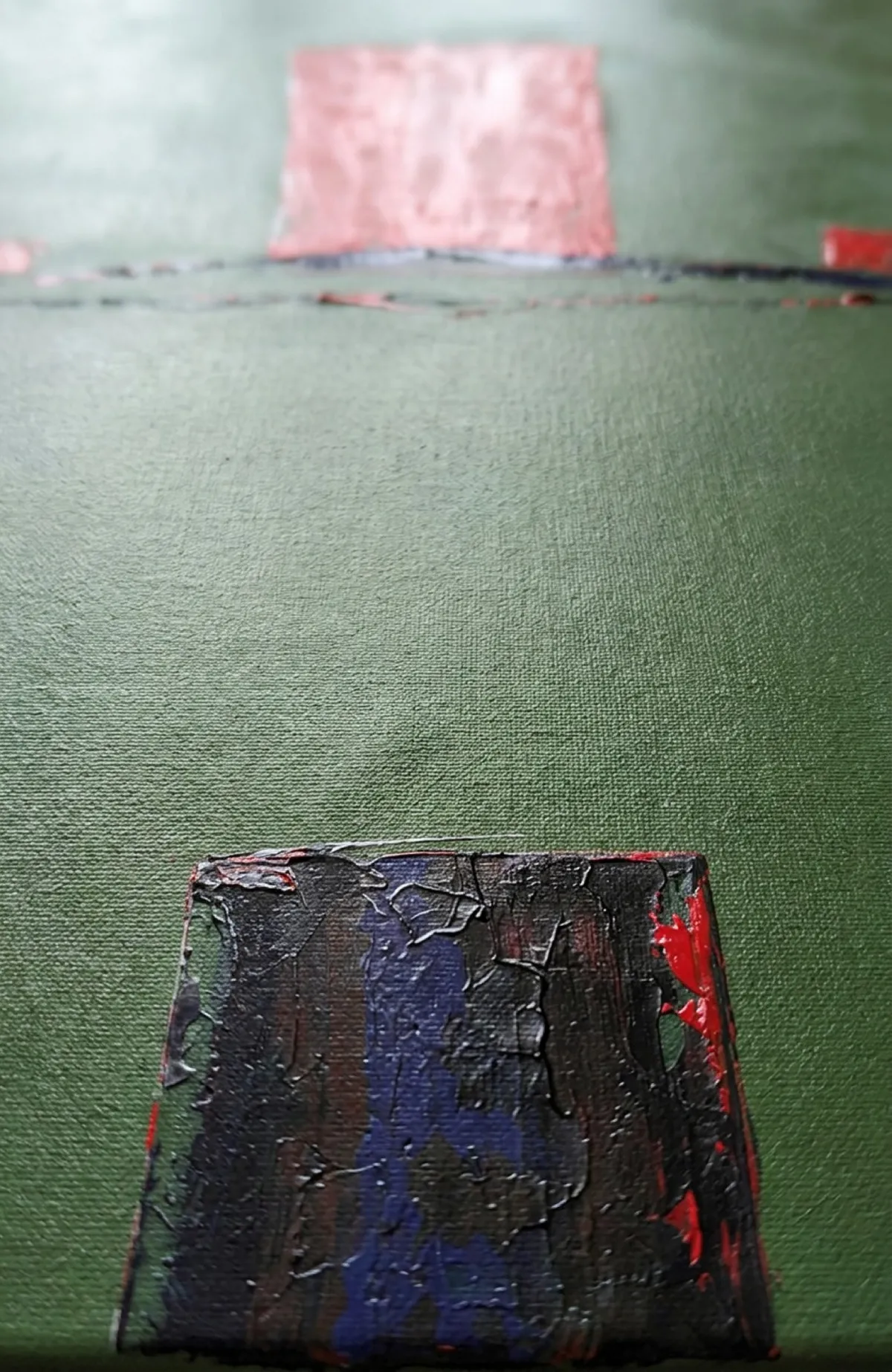
Detail of Texture and Matter in ASCENSUS | Maurizio Valch
Unnumbered File: Communication between a late block and a height that does not respond
Message found in the lower zone.
The dark block does not seem to have settled: it seems to have arrived. It occupies the bottom edge like an object that has stopped after too long a journey, with its bands of muted blue, black, brown, and tiny touches of red. There is no wall to support it. Nor a frame to quietly turn it into a door. It has the compact presence of something that belonged somewhere else and yet remains here, alone, almost touching the edge of the painting.
Its message does not rise yet. It remains stuck to its own density.
Above, far away, the red structure retains a strange frontality. It does not advance toward the viewer, nor does it fully withdraw. It is on the line, or behind it, or has been stopped by it. On either side, two smaller red remnants seem to have fallen from the same sentence. They are not reassuring companions: they could be expelled particles, two punctuation marks, two miscalculations.
Between both enclosures extends the green.
Not a background.
Not a empty distance.
The physical time it takes for a question to leave a surface, cross a wait, lose part of its shape, and arrive turned into something else.
Estimated delay: indeterminate.
The green zone has a long, almost excessive breath. The eye tries to cross it quickly and cannot. It slips, sinks into its visible weave, looks up again, returns down. During this journey, the dark block stops being merely heavy and the red structure stops being merely high. They become two extremes of a conversation that does not share a calendar.
In a note without an addressee, the voice of Maurizio Valch appears before the central band manages to explain itself:
I do not know if the distance is between the shapes or within the gaze. The block below becomes close to me because of its weight, but at the same time it seems to have remained out of reach; the red shape, on the other hand, is up there and seems to touch a zone I cannot measure. When I try to bring them closer, the green grows. When I leave them apart, the line between them begins to insist as if it had retained something.
The horizontal line does not let itself be called a horizon without protesting. It curves, breaks, accumulates tiny thicknesses, darker zones, red and black signals. It has something of a ground because it receives the upper structure; something of a wound because it does not remain clean; something of a customs post because everything passing through it loses clarity.
Customs Interception:
> Message sent from below: "Is there room for me up there?"
> Message received above: "There is a dark vibration beneath the field."
The answer is not false. It is worse: it is insufficient.
Maryam Mirzakhani was a mathematician who imagined complex paths and helps here not to confuse a visible distance with a possible path.
Her report does not accept the direct crossing. Going from the lower block to the red shape in a straight line would be to naively traverse the green, like someone crossing a plain pretending it has no climate, thickness, or delay. She proposes another route: starting from the left edge of the block, detouring toward an almost imperceptible undulation of the horizontal band, traversing it without quite touching the red structure, and returning through the field, now converted into a different line.
Under this reading, the painting does not contain two shapes separated by space: it contains a surface that forces a detour.
The briefest path is not the shortest.
There is an uncomfortable precision in that idea. The horizontal line seems almost straight, but it is not; and its minimal deviation reorganizes the entire painting. If it were a clean division, the red structure could settle above and the block below. But its irregularity means neither possesses a definitive position. The red height seems to rest on an unstable border. The dark block seems to have been deposited after the border closed.
The mathematician then records an anomaly: the larger the green space appears, the less it functions as a measurable distance. The sensory separation grows and shrinks depending on where one looks. From the center of the dark block, the red structure is almost out of the world. From one of the lateral red remnants, however, a very recent fall seems to have occurred below.
Question submitted by a childlike gaze, without stamp or specialist:
Why does the red building at the top have two little red pieces so it doesn't feel lonely, and the block below had to travel with no one?
The question disrupts the file. It forces us to look at the two small red pieces at the ends of the line not as subordinate details, but as a distribution of companionship. Above, there is a figure and its residues. Below, there is a figure concentrating within itself its losses, its edges, its retained colors. The composition does not distribute isolation fairly. And perhaps that is why it is unsettling.
Rainer Maria Rilke was a poet attentive to the strange intimacy of things and helps here to listen to what the shapes keep silent before being translated.
His objection arrives written on the reverse of the calculation: the dark block is not below. It is arriving late.
Its position must not be measured alone; its delay must be attended to. It is at the lower edge because it has not yet reached the moment of the red structure. That construction, up there, already seems installed in a scene that has taken place. The block, by contrast, retains the condition of an object that has just interrupted the field. It does not ask to ascend. It does not even seem to know that a height exists to which it could address itself.
The observation corrects the geometry, but does not destroy it. It makes it more exact.
Mirzakhani would have to admit that a trajectory does not simply join two contemporary points. It can join two times that have fallen out of sync. A curve on this surface would not be the displacement of the block toward the tower: it would be the duration of its arrival. The green then stops being an interval and becomes a kind of extended delay.
Rilke, in turn, must accept a less comfortable correction. The silence of the block is not enough. Its strangeness has structure. Its edges do not dissolve into a general emotion: they delimit a low, compact volume, with a presence that resists being swept away by the landscape. The poetry of delay needs a measure, even if that measure fails. There is something almost humorous in it: the block seems solemn, but it also seems obstinate, like a suitcase refusing to coincide with the train.
Perceptive Test.
Cover with your hand, for a few seconds, the upper red construction and its two small remnants. The green is no longer a wait: it becomes an extension that the dark block could be closing, sustaining, or even producing. Now cover the lower block. The red shape loses its antagonist and stops appearing elevated; it is left exposed, somewhat helpless, almost too frontal on the band. The test reveals a real tension: each construction does not complete the other, but rather prevents it from becoming a stable image.
New transmission, distorted when crossing customs:
> From above: "I remain."
> On the line: "I seem."
> Below: "I have arrived."
None of the phrases coincide with the previous one.
After the routes and silences have altered their methods, the voice of Maurizio Valch re-enters the file:
I thought that distance could sustain the separation between the two shapes, but now I see that it also mixes them in a way I do not control. The red construction does not finish staying above and the dark block does not finish staying below. If one arrives late, perhaps the other was waiting too soon. The line does not unite them, but neither does it allow them to forget each other.
The horizontal band keeps the rest of that communication. It does not deliver the complete message to either side. Near it, the red construction remains red, frontal, high; but it can no longer quietly occupy its height. The dark block remains below, densely set apart; but it has stopped being a piece fallen out of place. Between them, the green continues to extend with the patience of something that was not empty.
In the lower part, where the block almost touches the edge, remains information that has not crossed customs. Above, the red construction does not receive it.
- Original artwork
- ASCENSUS
- Actual dimensions
- 31.5 × 47.2 in / 80 × 120 cm
- Presentation
- Digital contextual visualization
Context references
oil paint close-up · vertical canvas texture · abstract painting details · black and blue painting block · contemporary material art
About this visualization
This visualization places the artwork within an architectural context to help collectors and viewers imagine its presence in a real space. It is an interpretive reference, not an exact reproduction: the original work remains the sole authority for scale, color, surface and material presence.