Context study / ASCENSUS
ASCENSUS on the Art Studio Easel | Maurizio Valch
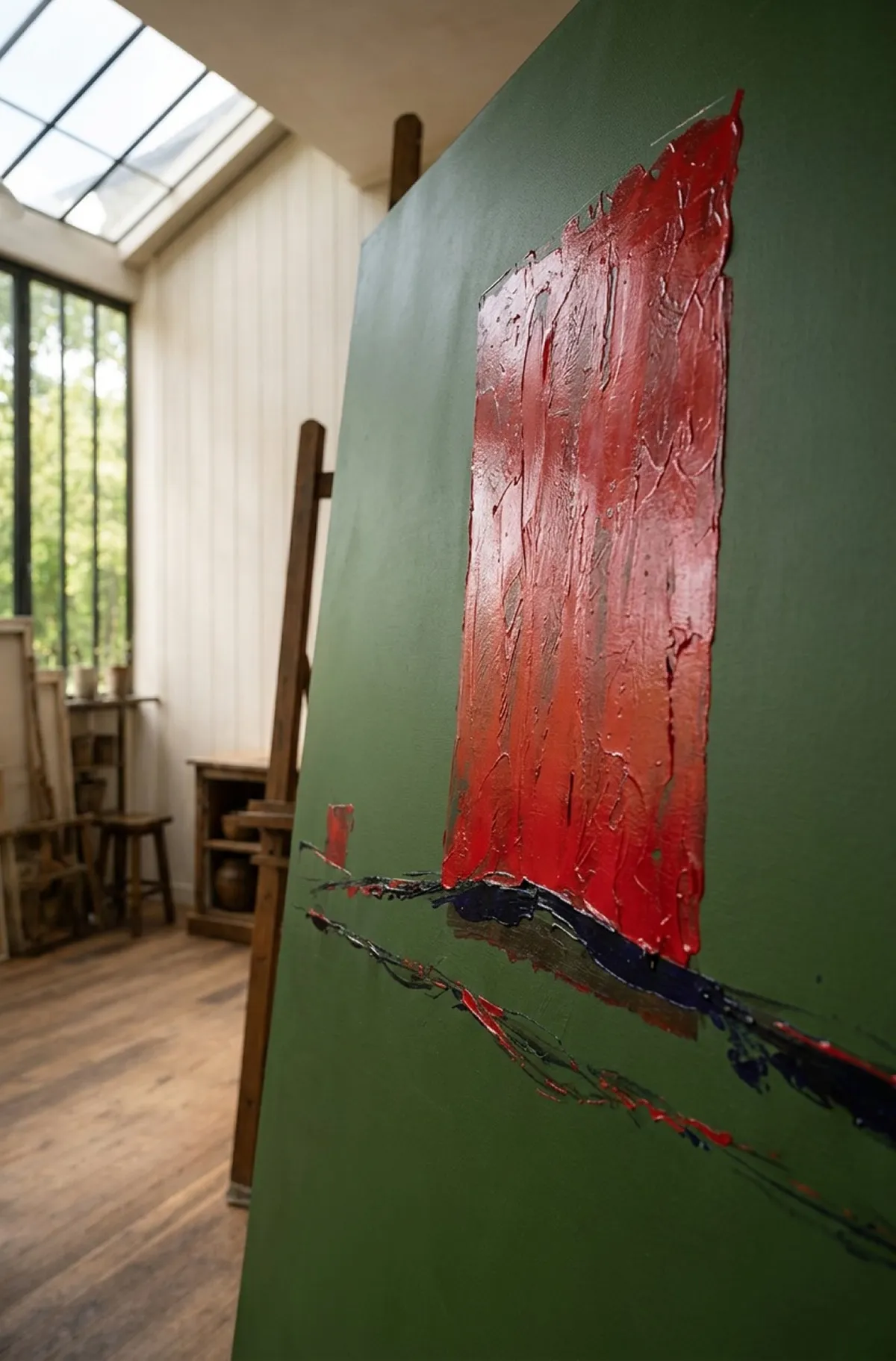
When confronting the imposing green surface of ASCENSUS, we are confronted by a spatial polarity of a contained but resounding violence. At the lower edge of the canvas, a dark, almost black block sits boxed in, serving as a chromatic and tectonic anchor. Just above this foundation, resting on a densely textured horizon line, rises the large crimson monolith, flanked on both sides by two small red witnesses that establish its scale. Here, depth is articulated not through an illusory three-dimensional perspective or a classic vanishing point, but as pure vertical distance. It is the physical gap that separates the dense weight of the lower stratum from the upper red sanctuary; an abyss where the green void acts as the stage for effort and resistance.
When I confront the canvas in the studio, I seek for color to be not a mere passive container, but an active territory of generosity. This green that covers most of the surface is not a flat background; it is a ground offered to support the weight of the densest impasto, a firm plane that resists and, at the same time, enhances the vibration of the red that expands over it. When applying the oil paint, I try to define the shapes without suffocating their outlines. I allow the material to breathe at its edges, keeping the boundaries rough, rugged, and open, so that the painting does not close in on itself, but remains in a state of constant physical availability.
The core of the composition is located in that middle horizontal band, the exact threshold where the large crimson block sinks its roots. We are not facing a peaceful transition; the incised traces and incised marks of dark pigment that structure this base reveal a communion arising from friction and tectonic resistance. There is no soft harmony here, but a raw encounter where the horizontal supporting plane and the vertical thrust of the monolith support each other through mutual pressure. The two small lateral red blocks function as sentinels of this tense bond, balancing the lateral forces and ensuring that the union between ascent and anchorage does not collapse.
With ASCENSUS, I decided to definitively detach myself from the literal representation of the ladders that starred in my previous series. I understood that true ascent does not require a symbol or a figurative rung, but a tension that must be resolved in the very density of the oil paint. My search for depth has become more honest and austere: I no longer seek to accumulate layers indefinitely, but to intervene in the existing material, introducing incisions into the matter to scrape, wound, and reveal the support. It is a raw and direct communion with the limits of the canvas, where each scratch is a physical attempt to unveil what lies beneath the surface, making the act of painting an exercise in constructive honesty.
Taking a step back from this 120 x 80 cm canvas, the physical scale of the work imposes itself with a monumental presence that overflows its own metric dimensions. The visual journey, which inevitably ascends from the dark base to the textured crimson summit, synthesizes the three pillars of the proposal: the generosity of the green plane supporting the composition, the depth of the void mediating between the extremes, and the final communion of the tectonic forces balancing before our eyes. In ASCENSUS, it becomes clear that ascending is not an incorporeal flight detached from the ground, but the physical act of finding and sustaining its true tension.
- Original artwork
- ASCENSUS
- Actual dimensions
- 31.5 × 47.2 in / 80 × 120 cm
- Presentation
- Digital contextual visualization
Context references
green and red abstract painting · artworks in studio · textured oil painting · large vertical painting · wooden easel with painting
About this visualization
This visualization places the artwork within an architectural context to help collectors and viewers imagine its presence in a real space. It is an interpretive reference, not an exact reproduction: the original work remains the sole authority for scale, color, surface and material presence.