Context study / ASCENSUS
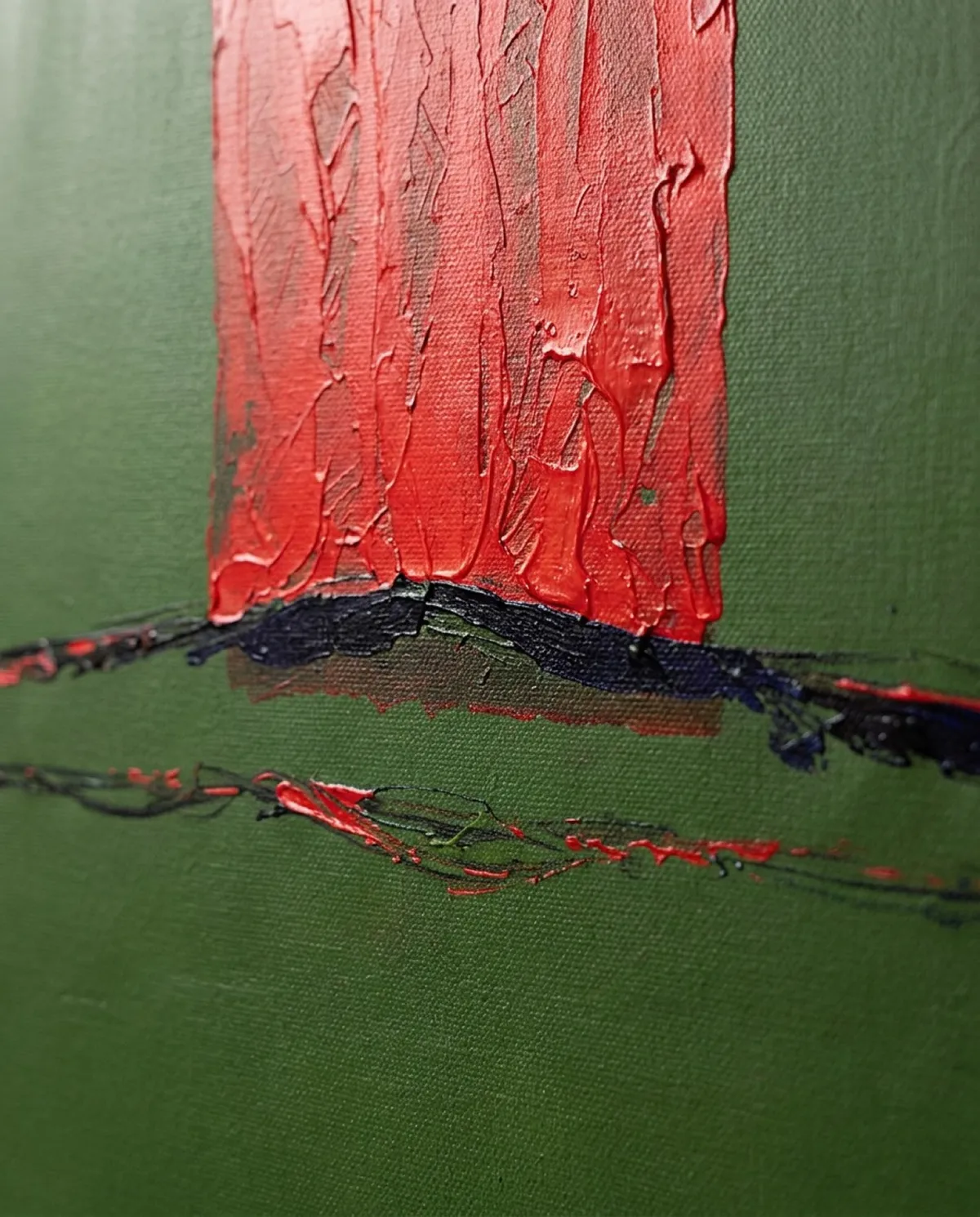
Macro Detail of Oil and Support of ASCENSUS | STRATA Series
The green plane of ASCENSUS, observed from a proximity that reveals the coarse weave of the canvas, behaves as an architecture of silence. There are no temples, crosses, or time-honored symbols on this surface; the approach to a dimension exceeding the purely material is resolved here through a drastic ordering of physical forces. Focusing the eye on the relief, the gaze encounters a crimson block that rises, dense and rough, suspended over a horizontal wound of black pigment. This structural sobriety, captured in the side view that accentuates the three-dimensionality of the matter, strips the space of any illustrative intent, forcing the body to position itself before an absolute limit—a threshold where the motionless begins to suggest transition.
When I scrape the paint and open that dark line in the center of the canvas, I do not seek to draw a passable horizon, but to record the friction of weight against the possibility of elevation. In previous series, I often resorted to the scale of small ladders to guide the eye, but in this green plane, I understood that transition does not require a visible scaffold. I am interested in the moment when a mass of accumulated color, applied with the force of the palette knife, sustains itself in the void through its own internal tension. It is a daily negotiation in the studio: letting go of the noise of thought and agreed-upon explanations to allow a block of crimson matter to simply be a nucleus of resistance rising above the ground.
In this physical confrontation, the painting evokes a stillness akin to the asceticism of Arvo Pärt, where the interval between two notes sustains the entirety of the structure. The olive immensity enveloping the forms does not function as an inert vacuum, but as a field of resonance where each mass of pigment retains its gravity. This stripping away of decorative elements redirects the observer's attention toward the experience of the limit itself: the lower vertical block is anchored with the opacity of indigo, while the upper shape seems to break free from terrestrial inertia. It is precisely this unresolved tension between the weight that binds us and the impulse to rise that fosters an experience of contemplation, a moment of pause where the invisible gains presence through the density of the oil.
I often find that memory attempts to immediately occupy the painted space with logical justifications or stories about the human condition. However, when facing the verticality of this canvas, I seek to silence that conceptual inertia. The true effort lies in holding the gaze on the green void without the urgency to classify it, accepting that the seam dividing the plane is both a boundary and a portal. Ultimately, painting this suspended monolith is my way of measuring distance from the origin—an inquiry where the silence of the mind allows matter to speak for itself.
The physical closeness revealed by this presentation of the painting—where the lateral light glides over the ridges of the red pigment and the rusticity of the support—dismantles the intellectual distance we typically impose on art. The viewer does not stand before a discourse to be decoded, but before a tactile shore pulsing with its own chromatic breath. By renouncing narrative, the work opens a space where chronological time stops, inviting one to inhabit an expanded present. On that threshold of pure matter and suspended gravity, the painting ceases to be an object of visual consumption to become a place of permanence, a refuge where the stillness of the canvas restores to the observer the awareness of their own verticality.
- Original artwork
- ASCENSUS
- Actual dimensions
- 31.5 × 47.2 in / 80 × 120 cm
- Presentation
- Digital contextual visualization
Context references
details of abstract painting canvas · red and green paint texture · contemporary art up close · painting technique details · material painting details
About this visualization
This visualization places the artwork within an architectural context to help collectors and viewers imagine its presence in a real space. It is an interpretive reference, not an exact reproduction: the original work remains the sole authority for scale, color, surface and material presence.