Context study / ASCENSUS
Abstract Painting ASCENSUS Hung on Wood Wall | Maurizio Valch
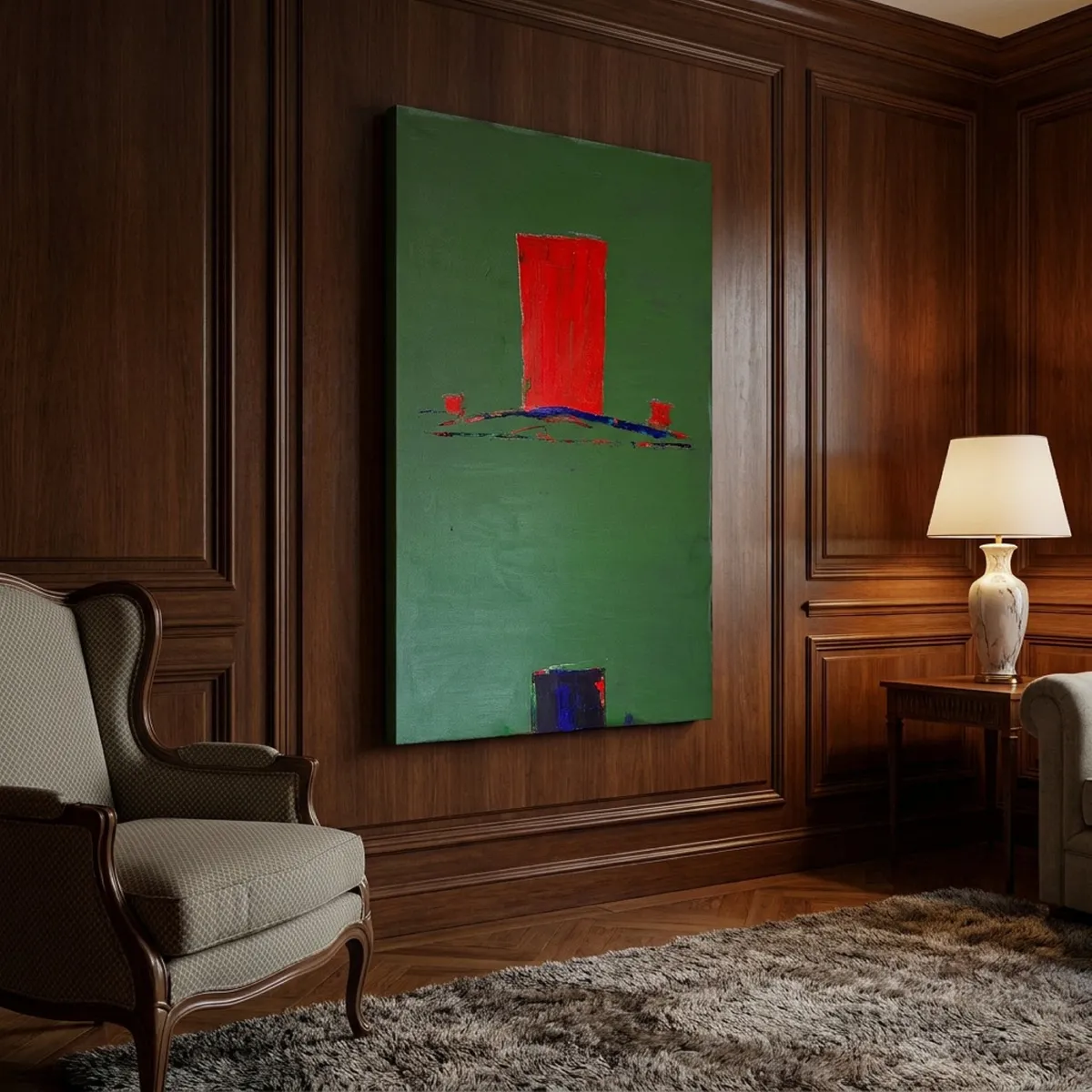
ASCENSUS does not begin at the top. It forces the gaze downward first to the bottom edge, to that dark, barely discernible rectangle that nevertheless holds the tension of the entire surface. It offers no secure entry: it resembles a closed box, an opening emptied of its interior, a presence positioned too low to be viewed comfortably. One must lean toward it. It almost touches the edge of the canvas. There, the green is not a serene expanse: it is heavy. It surrounds the dark shape as if holding it captive in a cavity of thick air.
Blaise Pascal was the thinker and mathematician who understood that vacuum, pressure, and uncertainty can alter the existence of both body and mind. Confronted with this small lower shape, his impulse would be to measure: to calculate the distance to the red vertical suspended far above, to establish a proportion between them, to determine if one might be a reduced scale of the other. But the green renders calculation doubtful. It does not function as a clean interval, but as a pressure intervening between the two rectangles. The body senses this distance before it can count it. To ascend with one's eyes from below is not to gain height: it is to traverse an area where one cannot tell whether it is empty or pushing back.
Looking at the finished work, the green still resists being placed behind anything. I wanted there to be distance, but now the distance seems to look back on its own. The lower shape remains close to me; the upper one has withdrawn without leaving. Between the two, I find an expanse I cannot call background, yet cannot fully cross.
The question begins to form without settling: what kind of ascent needs to keep a door at the bottom, even after raising a red tower in the air? Perhaps there is no tower, nor any door. Perhaps the red vertical is a body that has lost its ground; perhaps the dark shape is its remnant, its deposit, a version too small to partake in the height. What is certain is that the two verticals do not recognize each other. One occupies the edge like something that has not yet entered; the other dominates the upper half as if it had arrived from a space whose rules do not match those below.
Between them, an irregular horizontal band appears. It is not a line that imposes order; it wavers, opens up, is stained with blue and red, resembling a small patch of raised ground or a table seen from too far away. The two red fragments flanking the large upper shape do not help to fix the scene. They could be supports, witnesses, lateral signals, or simple interruptions preventing the eye from traveling smoothly along the band. The horizontal calls for a pause. There, the ascent ceases to be vertical and becomes lateral: to advance slightly to the left, to retreat, to seek an edge that never fully defines itself.
Michel Foucault was the philosopher who learned to discover how spaces, limits, and gazes organize what a person can do, say, or become. The horizontal band would seem to him less of a distance than a threshold: a division distributing permissions, heights, and exclusions. Below, one waits; above, one occupies a position. The red shape would not have to be a tower or a door: it could be the spatial rule deciding what can rise and what must remain on the lower edge. Pascal attempted to measure a separation; Foucault suspects that to measure it is already to obey it.
But the painting resists this obedience. The band does not possess the firmness of a norm; it is scarred by deviations, minor accumulations, and self-contradicting lines. The great red shape does not stand cleanly enough to become an institution. It seems too irregular, too exposed, even slightly clumsy to command anyone. Foucault might think that an institution has been built that is too small to house a person and too unstable to police them. Pascal, meanwhile, discovers something that the scheme of permissions fails to capture: the vulnerability of standing before an incalculable height, a height that alters one's breathing without offering a number.
Then, a child's question disarms both readings: Does the door below look at the tower?
The question redirects attention to the dark rectangle. It is no longer just what waits to be overcome. It may be looking upward. It may be holding onto the upper image, as if the enormous red depended on that tiny darkness to avoid detaching from the canvas. If the door looks, it also measures; if it looks, perhaps it is not a door. The scale is momentarily inverted: the lower shape seems to possess the patience of one observing a figure that is too large, struggling to remain aloft.
I do not feel that the upper part has conquered the lower. I see that one needs the other, even if they cannot share size or place. The line between them does not seem like a definitive border, for it also moves when I look at it. I would like to accept an explanation, but the painting retains a resistance that forces me back to the edge, to that small dark rectangle that does not ascend and, yet, never stops sustaining the height.
Above, the red remains undecided. Its vertical mass has something of a signal, a standing door, a figure that has just been interrupted. It does not culminate the journey: it complicates it. The green surrounding it does not celebrate or absorb it; it keeps it suspended in a distance that remains physical, almost tactile. Below the band, on the bottom edge, the dark shape remains open just enough for the gaze to enter there once more, while the irregular line preserves between itself and the red a zone that no one has managed to conquer.
- Original artwork
- ASCENSUS
- Actual dimensions
- 31.5 × 47.2 in / 80 × 120 cm
- Presentation
- Digital contextual visualization
Context references
decorate study with abstract art · green and red living room painting · original minimalist abstract art · maurizio valch strata painting · large format abstract paintings
About this visualization
This visualization places the artwork within an architectural context to help collectors and viewers imagine its presence in a real space. It is an interpretive reference, not an exact reproduction: the original work remains the sole authority for scale, color, surface and material presence.