Context study / ASCENSUS
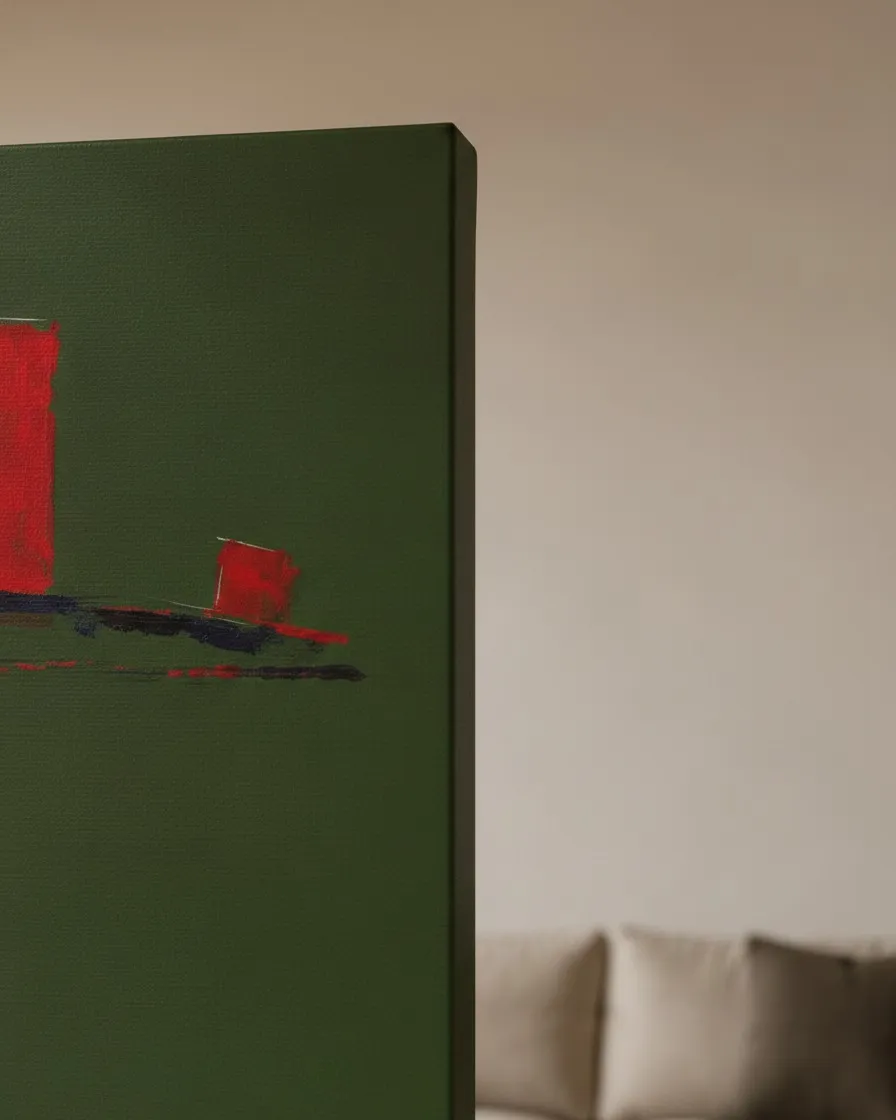
Side Edge View of ASCENSUS by Maurizio Valch - Border Perspective
The side cut of the canvas, exposed in the tempered gloom of a room where the furniture fades into neutral tones, shifts attention from the center of the image to its pure physical consistency. There is no anecdote, staged drama, or explicit confession in the sobriety of ASCENSUS. The huge mass of olive green that dominates the surface functions as a self-sufficient emotional temperature, a dense atmosphere that renounces explaining its motives to present itself as a raw fact. Like the silence that settles after an impact, this color does not narrate the wound; it contains its specific weight, transforming the painting into a concentrated block of awareness that confronts the viewer without offering the comfort of a justifying story.
I often search for the limit where words surrender and painting assumes the responsibility of sustaining the invisible. When I was preparing the background of this work, I was not thinking of constructing a metaphor about effort or loss, but of finding a tone that could house the heaviness of those days when the mind becomes saturated with useless explanations. The green is not a stage; it is the silence that remains when one finally understands their own noise. When plunging the palette knife and dragging the thick crimson over the central seam, I was not trying to illustrate an interior conflict, but to fix a physical presence that vibrated with the same stillness and isolation with which one feels a certainty that cannot yet be formulated.
The condensation of this state dispenses with any illustrative dynamism. The dramatic tension in ASCENSUS is reduced to the neighboring relationship between the suspended red monolith and the dark base anchoring it from the bottom edge. There are no threads binding them, nor ladders to facilitate the passage, barely a line of harsh scraping that interrupts the monotony of the green plane. This structural economy evokes the principle of the interval in Arvo Pärt's musical scores, where the expressive charge is not found in the development of a complex melody, but in the contained vibration of silence between two isolated sounds. Emotion does not unfold in time; it petrifies in space.
I recognize in my own history the constant temptation to turn every difficulty into a heroic exploit, a narrative of fall and redemption that justifies suffering. However, in the studio, I learn to distrust that mental architecture. By painting the bottom black block, heavy and immovable, I force myself to look at inertia without the veil of psychological theory. The painting demands that I lay down the character of the seeker; there is no epic journey happening on the canvas, but the simple coexistence of what falls and what resists. The painting is finished when thought stops adding explanations and surrenders to the material evidence of form.
The physical proximity of the artwork in this presentation, where the stretcher bars acquire the relief of a sculpture breaking into the living space, consolidates its status as a tactile edge. The crimson surface and clean edges do not decorate the wall; they interrogate it through their silent gravity. By renouncing verbal translation, the image keeps its mystery intact, inviting the viewer to abandon the analytical drive. There is no need to decipher the monolith to experience the pressure it exerts on the green plane; it is enough to hold one's gaze before that suspended mass to recognize that the true landscape always occurs on the other side of words.
- Original artwork
- ASCENSUS
- Actual dimensions
- 31.5 × 47.2 in / 80 × 120 cm
- Presentation
- Digital contextual visualization
Context references
painted canvas edge · original painting stretcher bar depth · acrylic and oil texture · minimalist green and red painting · abstract painting technical details
About this visualization
This visualization places the artwork within an architectural context to help collectors and viewers imagine its presence in a real space. It is an interpretive reference, not an exact reproduction: the original work remains the sole authority for scale, color, surface and material presence.