Context study / ASCENSUS
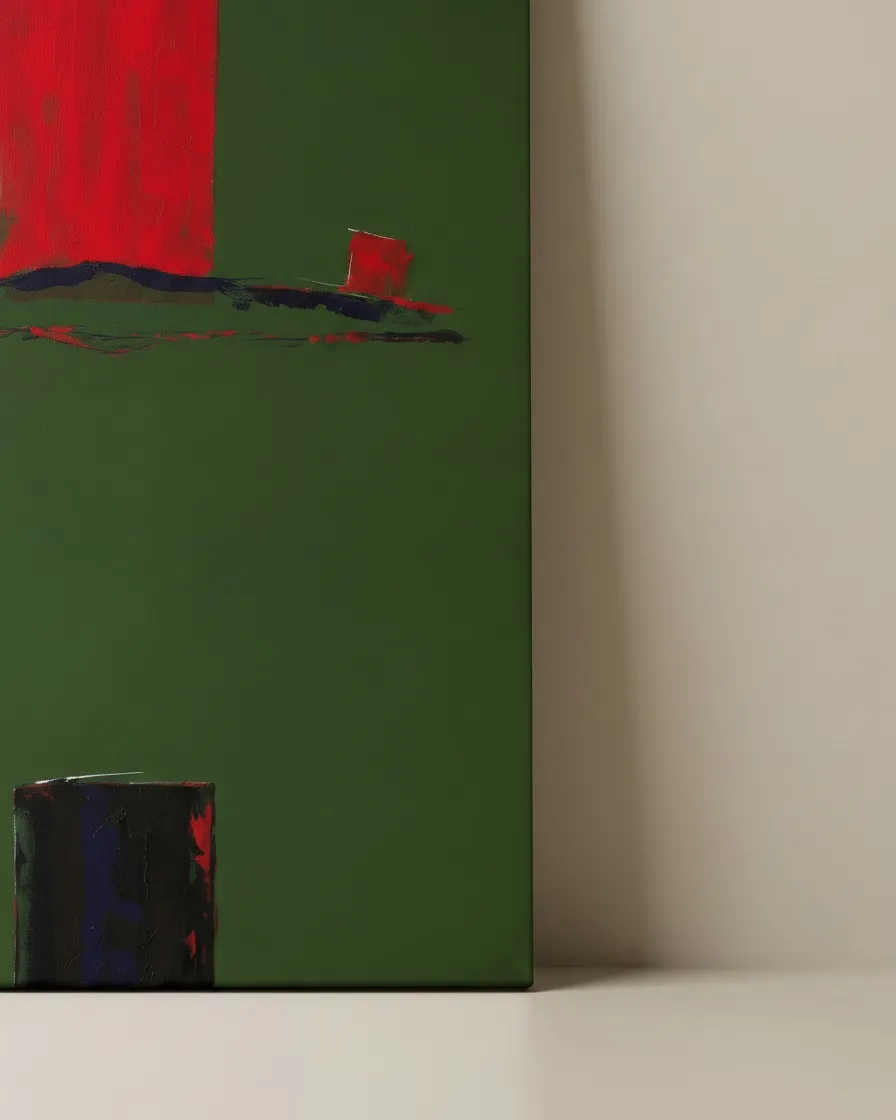
Details and Texture of ASCENSUS, Painting by Maurizio Valch
A dense, silent green field dominates the 120 x 80-centimeter canvas, functioning not as a neutral backdrop but as a protective skin that borders on absolute confinement. Within this vast vegetal territory, the massive crimson mass at the top asserts itself with a burning vibration, raising a question about its true condition: is it sheltered by the surrounding immensity, or does it remain captive in forced isolation? Belonging in this space is not harmoniously resolved; it is the abrupt insertion of a warm color into a cold, quiet plain. At the same time, the marked verticality of the artwork forces the viewer to experience a heavy gravity in the lower block and a strange suspension at the top, turning the green void into an abyss that must be crossed with the gaze.
I know the physical resistance of this three-centimeter-thick stretcher well; its three-dimensional presence in the studio constantly reminds me that painting is a craft of real weights and volumes. In tracing the thin dark line that supports the large crimson block above, I relied on a purely material trust: the certainty that the pulse and density of the pigment would suffice to hold that enormous floating mass over such a thin layer. Applying the color, scraping the surface, and defining the lower block with the palette knife was an exercise in physical containment where every gesture sought an anchor. For me, trust lies in that assumed risk, in the decision to let the paint hold itself despite the physical distance and the void separating the bottom from the top.
Lingering on the middle section of the canvas reveals that the apparent uniformity of the green is interrupted by a tectonic scar, a dark, rough line upon which sits the crimson monolith flanked by a small satellite block. This horizontal axis functions as the boundary where belonging is negotiated: these red forms do not grow organically from the surface but seem to have temporarily established themselves there, like a camp forced upon a crust of foreign rock. The paint in this area abandons its flatness to become a rugged relief, a boundary where the material offers resistance and the frayed edges reveal the paint’s struggle to cling to the surface.
For me, belonging is a constant dispute between what I have inherited and what I have had to conquer with my own hands on the canvas. Looking at the heavy, dark base at the bottom of the canvas, I recognize a downward pull, an ancient, familiar stratum acting as a biographical anchor, while the red block at the top represents that territory conquered in the heights through the effort of oil. Painting is my way of mapping survival, of opening cracks and applying layers that serve as shelter from the elements. Now that the finished work rests on the studio floor, I understand that belonging to a place is never a state of rest, but this constant tension between the gravity holding us down and the physical impulse pushing us to ascend.
Naming this painting ASCENSUS reveals that the movement upward is devoid of any lightness; the ascent demands the physical effort of bridging the green distance separating both masses. In this trajectory, trust is transformed into the gravity maintaining the balance of forms, protection is embodied in the horizontal crust halting the fall of the upper block, and belonging is revealed as the decision to remain suspended between two opposing densities. The painting closes with the muted vibration of the crimson cut against the green wall, a material friction suspended in space and in the memory of the eye.
- Original artwork
- ASCENSUS
- Actual dimensions
- 31.5 × 47.2 in / 80 × 120 cm
- Presentation
- Digital contextual visualization
Context references
abstract oil brushstroke details · textured abstract canvas relief · original artwork maurizio valch · paintings with incised marks and palette knife
About this visualization
This visualization places the artwork within an architectural context to help collectors and viewers imagine its presence in a real space. It is an interpretive reference, not an exact reproduction: the original work remains the sole authority for scale, color, surface and material presence.