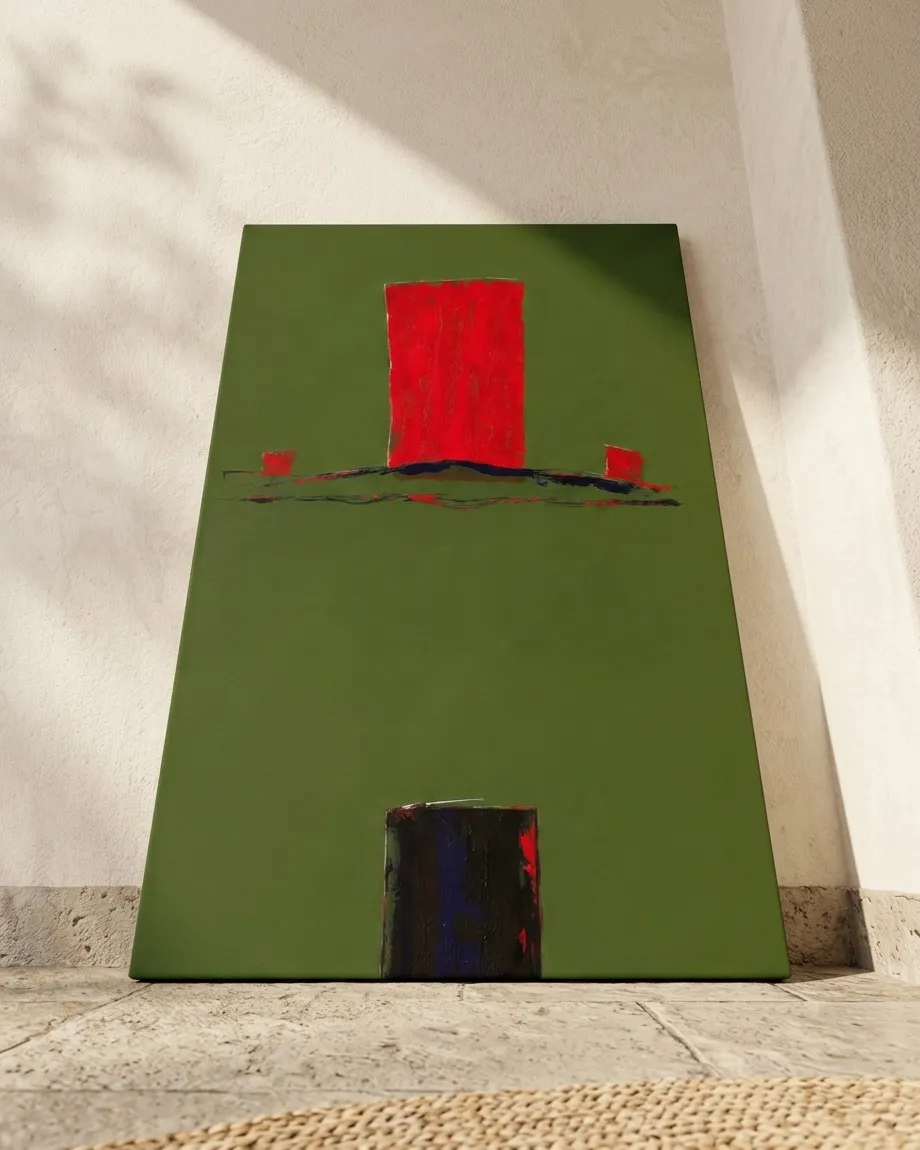
Context study / ASCENSUS
ASCENSUS by Maurizio Valch on a Natural Stone Terrace
To contemplate "ASCENSUS" is to enter a space governed by an almost geological calm, where the pictorial plane is not a mere background but an absolute territory. A dense field of olive green, silent and expansive, envelops the gaze before subjecting it to a strict gravitational partition. In the lower third, a dark block, almost black, traversed by glazes of an abyssal blue and subtle reddish glints, acts as a blind anchor, a telluric base claiming its right of gravity. Facing this basal mass, a rough, horizontal line of dense, dark pigment unfolds like a geographic scar holding three glowing red volumes: a central monolith and two smaller guardians flanking its symmetry. Between the dense lower base and the floating irruption of the upper blocks, the green becomes an active void, a distance that not only separates, but irreparably tensions the relationship between terrestrial weight and the possibility of elevation.
When I face the canvas, I do not seek to illustrate a metaphysical idea; I am interested in the physical resistance of the medium, the actual friction of oil and acrylic under the edge of the palette knife. That olive green is not a symbol of nature, but a surface I accumulated layer after layer to build a thick silence, a chromatic wall where each subsequent gesture had to force its way through. Dragging the red against that background, I felt the violent vibration of two temperatures in conflict; erecting that central block was an exercise in material insistence, an attempt to consolidate a presence that refused to dissolve. The incision crossing the middle plane is not a decorative element, but an actual cleft in the surface of the territory, a wound in the painting that physically marks where the inertia of the support ends and the formal tension of that which seeks to hold itself up begins.
This articulation of forces finds a deep echo in the ideas of G. I. Gurdjieff regarding the automatism of human existence and the urgency of a conscious effort to break daily lethargy. For Gurdjieff, ordinary life takes place in a sleeping horizontality, a mechanical flow that can only be interrupted by a "conscious shock," an act of will that restores our presence. In "ASCENSUS," the dark line cutting across the canvas functions as that horizontal inertia of sleep, while the central red block stands as the physical manifestation of "self-remembering," an abrupt verticality that breaks in to reclaim consciousness. This philosophy of awakening is translated here into a structural tension where matter seems to struggle to free itself from its own automatic laws. To the sides, the two small satellite blocks act as silent guardians or witnesses of this fracture, reminding us that any attempt to awaken does not occur in a vacuum, but under the close watch of the forces regulating the balance of the system.
Naming this work Ascensus, I am struck by the suspicion that painting is, by definition, an art of insurmountable immobility and that any pretense of ascent is nothing more than a beautiful physical impossibility. Looking at the finished painting, I wonder if that red block is actually ascending or if it has remained perpetually trapped, suspended between the gravity of the lower block and the immutable immensity of the upper green. There is no real movement on the canvas, only the representation of an extreme difficulty, a threshold that might well be an impassable border. That dense red I dragged with the palette knife wants to rise, but its very matter anchors it to the horizontal that holds it, turning the presumed vertical journey into a state of permanent vigil, a frozen tension where the success of the ascent remains suspended in the air, doubtful of its own destination.
To sustain that doubt and that vertical tension, the work requires its base, an element that dialogues intimately with the archetypal psychology of James Hillman and his conception of the underworld. Far from being a negative shadow or a sterile vacuum, the lower dark block represents the materia prima, the situs or indispensable substrate from which any attempt at psychic or objective elevation must be nourished and supported. Hillman reminds us that there is no true ascent that does not have its roots firmly planted in the density of the hidden, in the heavy and the nocturnal. In the end, "ASCENSUS" does not resolve the paradox of movement; it leaves it vibrating in the physical space of the exhibition room, where the silence of the olive green and the contained glow of the pigments dialogue with the viewer. The painting does not simulate ascent, but embodies it as an open question about matter and limits, forcing us to inhabit that interval of mystery separating earth from air.
- Original artwork
- ASCENSUS
- Actual dimensions
- 31.5 × 47.2 in / 80 × 120 cm
- Presentation
- Digital contextual visualization
Context references
abstract painting leaning on floor · art for designer terraces · olive green and red painting · maurizio valch strata
About this visualization
This visualization places the artwork within an architectural context to help collectors and viewers imagine its presence in a real space. It is an interpretive reference, not an exact reproduction: the original work remains the sole authority for scale, color, surface and material presence.