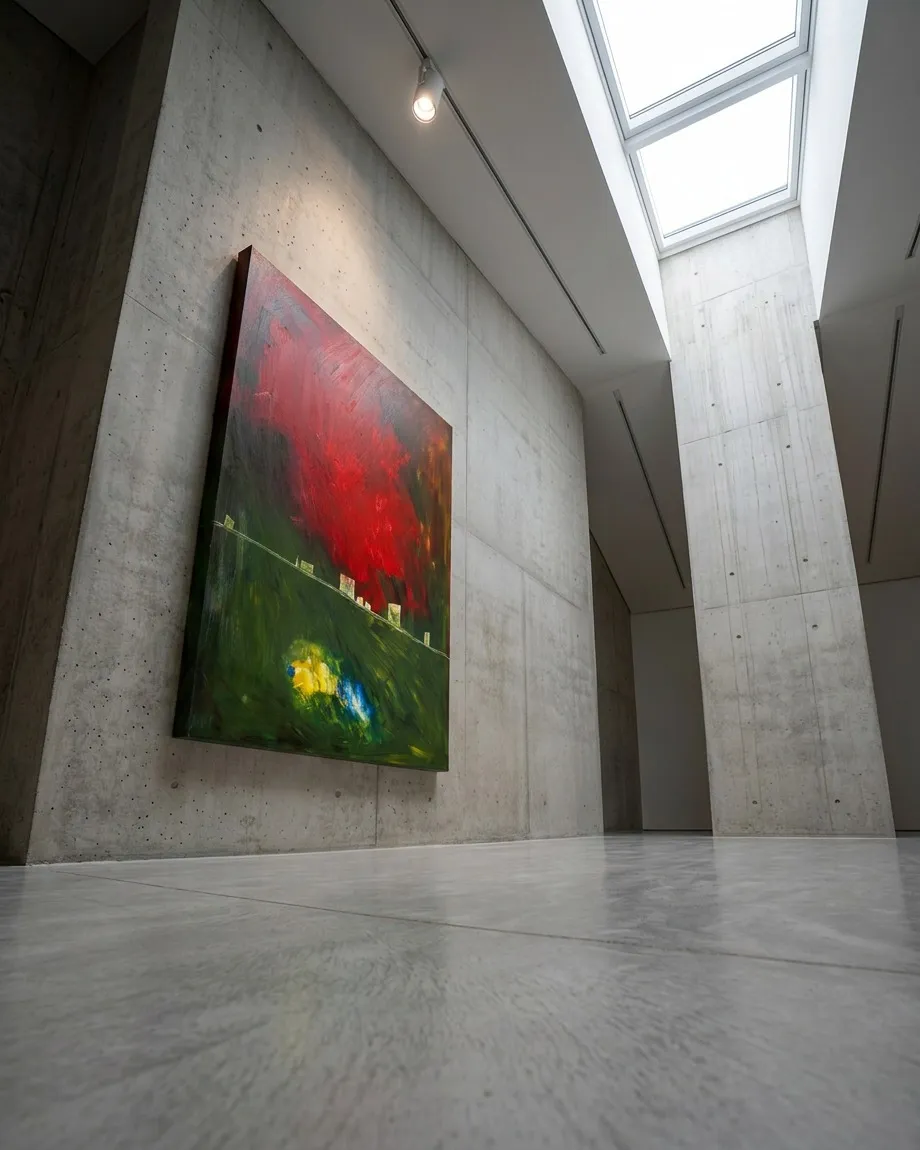
Context study / A THEORY OF LIGHT AND SHADOWS
A Theory of Light and Shadows - Maurizio Valch | Original Artwork
Pictorial matter often behaves like a geological accumulator. Before the eye attempts to decipher an organization of space, it is confronted by the sedimentation of weight: a dense, sulfurous red sky that does not seem to expand into infinity, but rather presses down with the force of a physical block upon the territory below. In "A THEORY OF LIGHT AND SHADOWS", the painting is divided by a sharp border, a cutting plane that separates the glowing atmosphere from an opaque, greenish twilight. Traditionally, light is understood as a downward projection, a clarity bathing objects from above and casting their silhouettes onto the ground. However, on this surface, the physical order is inverted. The true emitting source does not reside in the heights of the red, but lies buried in the lower stratum, pulsing beneath the ground like a core of yellow and cobalt blue pushing from the subsoil, seeking a gap to seep through to the surface.
My painting is born from territory understood not only as landscape, but as a surface of origin, memory, and transformation. When confronting this canvas, I sought to resolve the tension within the friction of the materials themselves, accumulating layers of oil and acrylic through successive superpositions that I then had to wear down or wound. The fine incised line running across the painting from side to side is not an added stroke to decorate or define a horizon; it is a physical cut in the pigment, an incised trace that penetrates the matter and remains there as a real trace of separation. By dragging the tool over the wet impasto, I opened that narrow channel, a crevice acting as a threshold where the forces of the painting meet and resist blending. I do not seek to illustrate a map or explain an inner geography; I seek for the gesture of cutting into the paint to sustain the weight of that division.
Upon this threshold, aligned along the incision, rest small quadrangular structures that evoke the sobriety of minimal architecture, mere signs suspended in a suspended limbo. They recall the units of scale with which Paul Klee tested the balance of space, or the logical labyrinths of Jorge Luis Borges, where geometry is the only method to contain the chaos of the universe. In In Praise of Darkness, Borges suggests that shadow is not the mere absence of light, but a dense substance that guards a secret, a necessary support so that thought and memory do not fade under excessive clarity. In this work, the rectangular forms act as sentinels of that border, logical boundaries established over the crevice to measure the pressure of the subterranean light pushing from below. Here, shadow does not hide; it sustains and protects the spark within.
The process forced me to change course when the density of the lower quadrant began to destabilize. At first, I conceived the lower area as a territory of absolute stillness, a dark counterweight intended to receive the weight of the large red block above. But color has its own demands in the studio and, as I applied the green glazes, the yellow and blue core began to claim its own space with a physical insistence that I had not foreseen. I could not bury it entirely. Every attempt to cover it with a palette knife only increased its vibration beneath the surface, as if the matter remembered what lay below and demanded that this geological glow remain active, pressing against the boundary of the incision. I had to yield to that resistance, allowing the palette knife and scraping to reveal the presence of that trapped light, transforming what was to be a passive shadow into a latent force that sustains the entire painting.
In the end, "A THEORY OF LIGHT AND SHADOWS" proposes an alternative physics where knowledge is reached not through transparency, but through the resistance of strata. The painting does not unveil the mystery of what is hidden in the subsoil, nor does it pretend to clarify the nature of that energy glowing beneath the green; it limits itself to granting it a visual existence, a material consistency that the viewer can verify through the density of the pigment and the depth of the cut. Between the red storm of the sky and the blue and yellow pulsation of the background, the small line of geometric signs remains as a testament to our need to order the world, to trace boundaries and thresholds over a background whose true depth always eludes us.
- Original artwork
- A THEORY OF LIGHT AND SHADOWS
- Actual dimensions
- 31.5 × 47.2 in / 80 × 120 cm
- Presentation
- Digital contextual visualization
Context references
red and green abstract painting · large scale abstract painting · contemporary hallway art · maurizio valch paintings · incised painting on canvas · minimalist art decor
About this visualization
This visualization places the artwork within an architectural context to help collectors and viewers imagine its presence in a real space. It is an interpretive reference, not an exact reproduction: the original work remains the sole authority for scale, color, surface and material presence.