I. The Transparent Palace and the Wound of Time
An invisible architecture has watched over us from the moment we stopped playing. The novelist and philosopher Fyodor Dostoevsky called it the "crystal palace"—that utopia of absolute coherence, a building of pure logic and transparency where every one of our desires must be justified, where error is a calculation error, and contradiction is an anomaly to be excised. In this perfect palace, we are neither permitted the imperfection of fear nor the elemental right to stick our tongue out at the established order. Yet, to inhabit this seamless transparency, we are charged a devastating tribute: the renunciation of our own shadow, the forgetting of the child we once were, and the adoption of a rigid, polished, and sterile maturity.
Faced with this palace of forced coherence, the lyrical voice of Adele in Million Years Ago rises not as a political manifesto, but as an intimate, wounded lament from the underground of the soul. The song begins by acknowledging an uncomfortable truth: "There is something good in pain / that teaches us to be better." In this verse, there is no apology for suffering, but rather the observation that the wound is the only place through which the light of learning can enter a system that claims to be perfect. Pain is the physical reminder that we are incomplete, that time is not a domesticated river flowing under the bridges of progress, but a force that "did not wait." The nostalgia for childhood—that territory where it was possible to "play, run"—is no mere sentimental whim; it is the longing for a state of grace prior to the construction of the palace, a time when the heart did not need to justify its beats before the tribunal of reason.
The conflict arises when we discover that time has slipped away and we find ourselves standing in the middle of life, caught in the open exposure of the present: "but life goes by, I am still here." The crystal palace demands that we be productive, stable, monolithic. It asks that the reflection we cast back to the world be identical to the expectations deposited upon us. But when we look inward, what we find is a fragmented territory, a map of unfulfilled desires and unconfessed fears. The fear of "the reflection of who I am" is nothing other than the panic of discovering that the mask of maturity has cracked, and that behind it still beats the same frightened child who does not know how to reconcile their desire to fly with their terror of suffering.
II. The Refuge of the Split Gaze
I pause before the words you have just traced on paper, and I cannot help but feel a familiar echo in my own thoughts. As a painter, I watch you try to decipher that invisible border between the light outside and the refuge of the underground. Reading your notes on the loss of innocence and the fear of that crystal palace that measures and judges everything, I realize that the true conflict is not within the walls surrounding us, but on the very surface of our skin. How can we show ourselves whole to a world that demands a coherence we do not possess?
The dispute between the desire to hide in the darkest corner of the underground and the audacity to present ourselves to others is the engine that animates the representation of our identity. The Dostoevskian underground is no mere hole of dirt and rats; it is the space of personal sovereignty, the only corner where we are permitted to be incoherent. When we think of identity, we tend to imagine it as a straight line, a single-piece marble monument. Yet honesty lies precisely in admitting that we are made of halves that do not always fit, of gazes that aim toward different horizons while sharing the same face. Showing this division is not an act of weakness, but of resistance against the tyranny of transparency.
III. The Split Mirror and the Broken Flight
If the crystal palace is the temple of total visibility, the painting of Maurizio Valch presents itself as the threshold of an unexpected resistance. In contemplating this monumental, split face, the Dostoevskian suspicion takes on a physical and conceptual dimension. We are not looking at the illustration of a clinical pathology, nor at a simple Cubist decomposition of form; we are facing the revelation of our double. This face divided into two halves, inhabited by a gaze that seems to bear the weight of an immemorial memory, acts as a broken mirror where the fantasy of a single-piece identity crumbles once and for all.
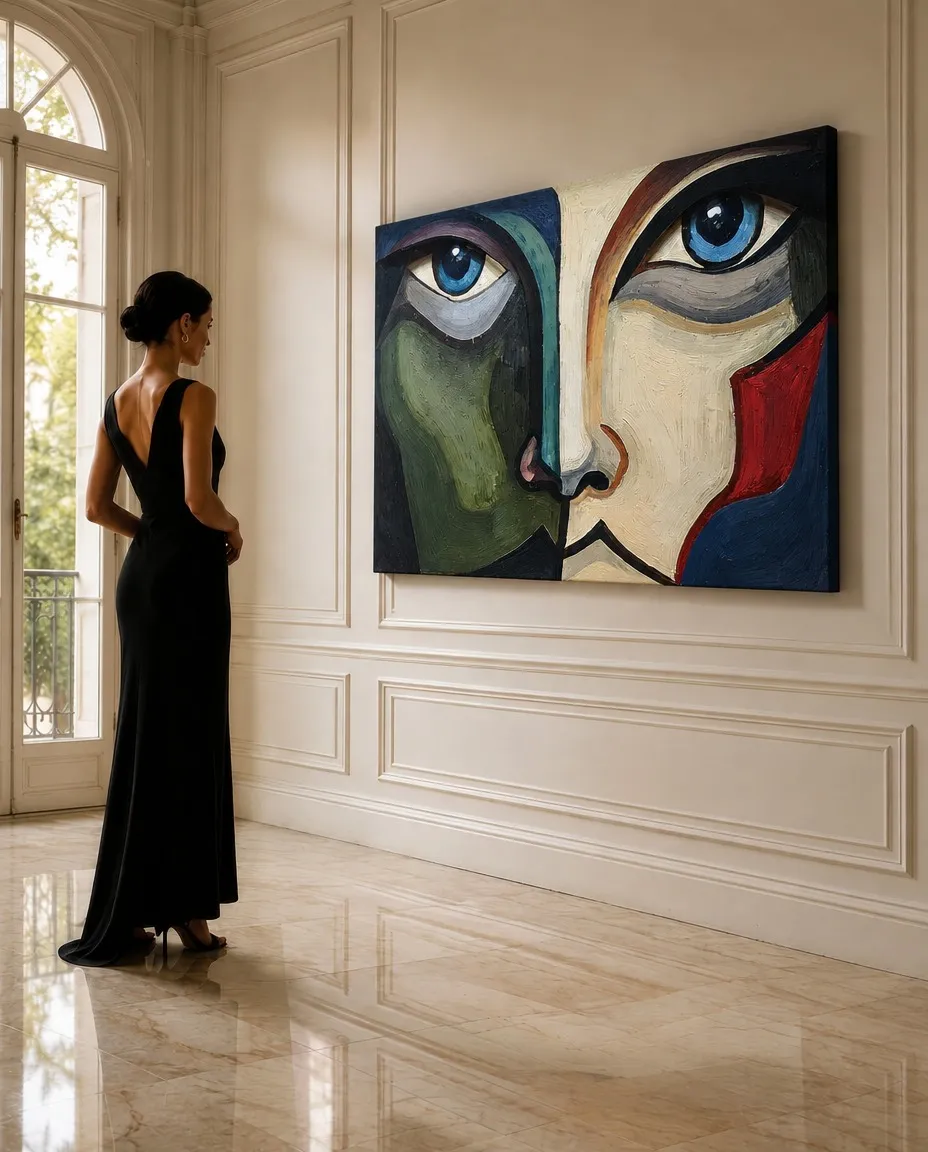
Adele's song warns us of this inevitable encounter: "but the reflection of who I am / is coming for me." And who is this coming to claim us in maturity? It is the fragmented self, the silent witness inhabiting our own private underground. The left half of the painting, submerged in cold, earthy tones, evokes that dark refuge where the soul hides to protect its right to contradiction; the right half, more exposed and washed by a light that seems to seek reconciliation with the outside world, represents our attempt to integrate into the daily order. The bridge between the two halves is no perfect suture, but a line of tension—a scar that divides the face but also grants it its monumentality.
It is within this fragmentation that the painting meets the lyrical longing to "want to circle the sun" and "have such a desire to fly." Flight demands lightness, but the weight of our underground—the memory of our fears and pains—anchors us to the earth. The split face observes us with enormous, disproportionate eyes that do not seek to judge us, but rather to make us share in its own duality. Those eyes are the windows of a being that has renounced the lie of absolute coherence. Looking at them, we understand that maturity does not consist in eliminating our dark half, but in learning to hold the gaze of our double without running away from ourselves.
IV. The Honesty of the Split
Seeing how you interpret this play of reflections, I perceive that we are drawing near the core of an essential paradox. You wonder about our inability to be a single piece, and I wonder if desiring that unity is not perhaps our greatest condemnation. The mask is not always designed to deceive others; often, it is the only shield protecting us from the disaster of being fully understood. In your words resonates a search for honesty that deeply interests me: one that does not consist in stripping entirely bare in the light of day, but in accepting the validity of our own shadow.
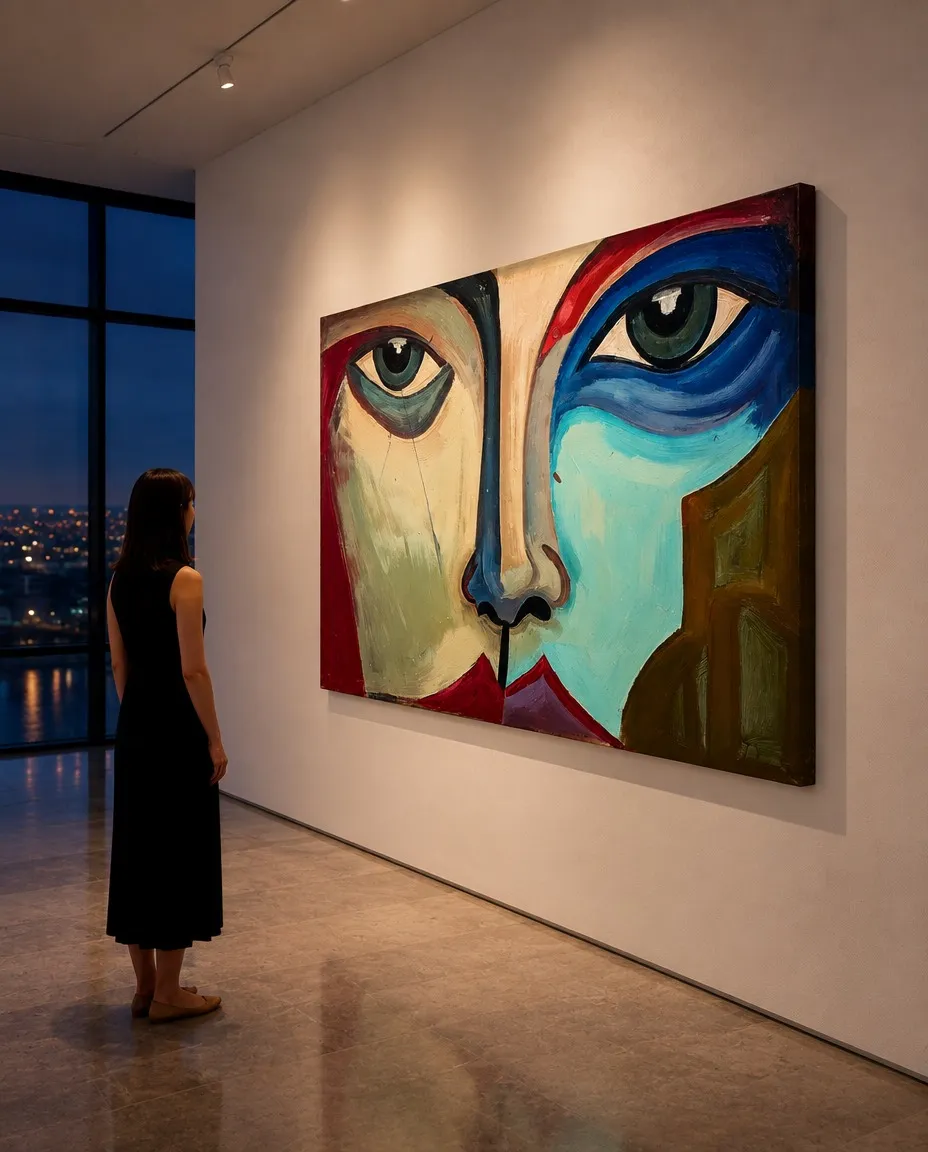
Self-division is not a falsehood; it is the form our freedom takes when cornered by the demands of reality. If we were transparent, if we did not have an underground to retreat to when pain tightens, we would be as fragile as the glass of that utopian palace. True courage lies not in transparency, but in the ability to inhabit the border between what we reveal and what we choose to keep silent. That face you analyze, suspended between two worlds, is testament that one can be wounded and, at the same time, preserve a monumental dignity. The mask, in splitting, does not hide the truth: it reveals it by showing the very seam of our existence.
V. The Habitable Exposure
Having reached this point in our inquiry, music and painting cease to be objects of external contemplation and become the coordinates of our own intimate geography. There is no simple resolution for the tension between the crystal palace and the underground. To pretend we can return to childhood definitively, as Adele's lyric voice yearns for when evoking the world of yesterday, is to ignore that time is a one-way street. Likewise, believing we can take refuge forever in the depths of the underground is to condemn ourselves to a paralysis that smothers our 'will to live.'
The way out of this labyrinth is not a perfect synthesis, but the acceptance of our state of permanent transition. At the end of the road, we are left with the declaration of humility that closes the lament's most lucid verses: "And my path is what I am: / a learner." To be a learner means renouncing the crystal palace, the hubris of definitive answers, and the illusion of a seamless maturity. It means accepting that the face reflected back to us will always be divided, inhabited by both the child who longs to play and the adult who must learn to suffer.
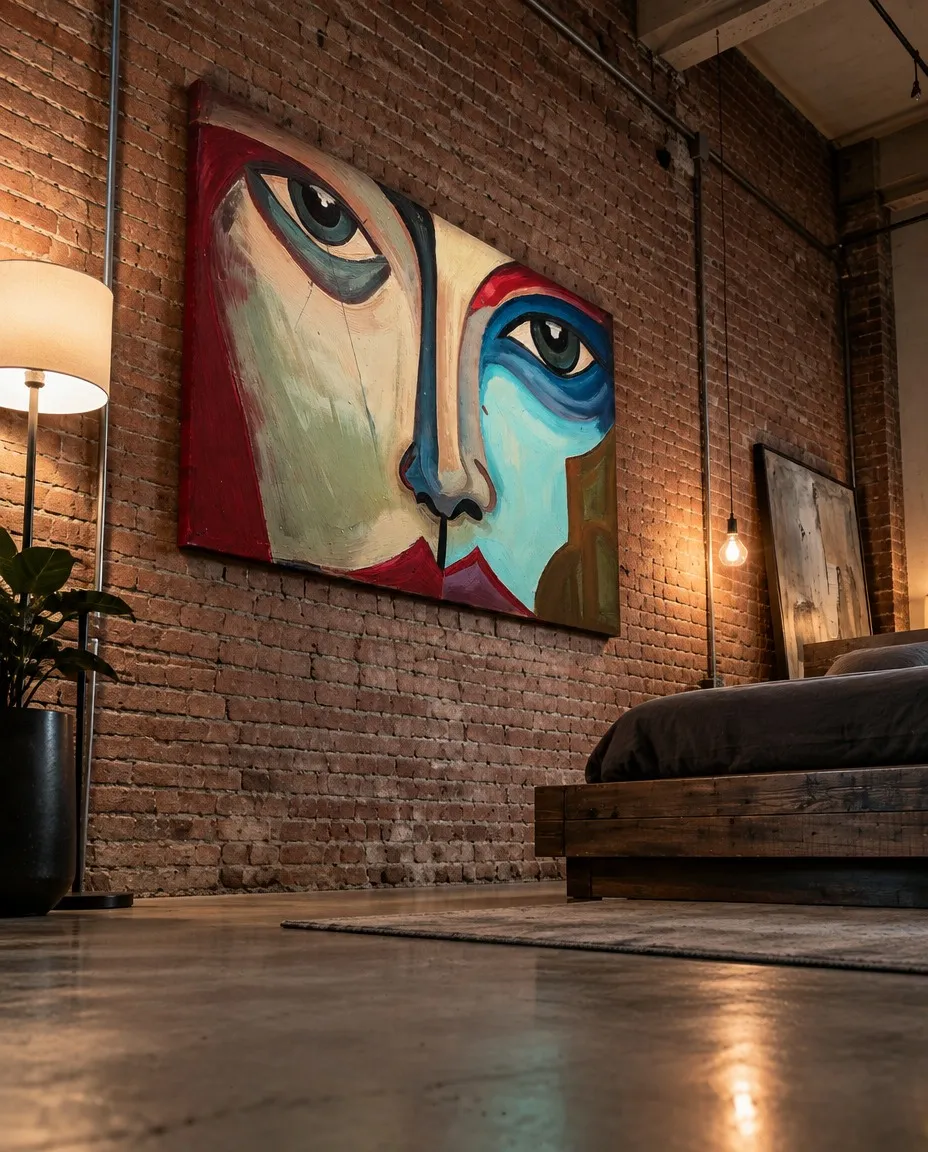
The underground mirror offered by Maurizio Valch does not return a comforting image, but it gifts us something far more valuable: the certainty that we are not alone in our fragmentation. Looking at that face observing us from its monumental duality, we discover that contradiction is our most sacred right and that the underground is, ultimately, the only home where our freedom remains safe. On that shifting border, between the open exposure of time that does not wait and the refuge of our own shadow, we learn to inhabit the mystery of being, quite simply, ourselves.