I. The Paradox of the Boundary Wall
If we raise a wall to protect ourselves from the freezing north wind, the first impact of stone upon earth yields a promise of order: the interior is now a predictable space, a portion of the wild elements tamed. Yet, before the mortar has even dried, the shadow cast by that very wall upon the ground traces a silent warning. The wall that keeps out the frost is also the obstacle that intercepts the first morning light; the boundary that secures ownership is the line that fragments the continuity of the horizon. At what exact moment does the shelter turn into a fortress, and the fortress into a cell?
This question does not belong to defensive architecture, but to the intimate geography of consciousness. We live under the constant suspicion that our structures of shelter—the maps with which we organize chaos, the identities we cultivate to avoid dissolving, the certainty we accumulate like sediment—undergo a process of irreversible calcification. The artist Maurizio Valch has synthesized this friction in a premise that acts as a catalyst for his entire physical and mental inquiry: "Thought is territory; memory is occupied territory." If memory is a space colonized by the traces of what has already been, where does the present moment rest? How can we clear a space on a ground where every stratum claims its right to stillness?
Painting that resists being a mere illustration of an idea becomes the ideal place to test this doubt. It is not a matter of deciphering a symbol, but of weighing matter. When we observe a surface worked through accumulation and wear, we are not looking at a representation of time, but at its physical body. Painterly matter accumulates layers in the same way thought accumulates interpretations, until the original occurrence—the simple event of light or gesture—lies buried under the weight of its own historical archaeology.
II. The Secret Channel Versus Fixation
To understand the urgency of a protected space that does not degenerate into confinement, we must interrogate the structure of transmission. In a world saturated with interference, where external noise seeks to colonize every free frequency, defending the message requires a strategy that challenges the rigidity of the plane.
Here enters the brilliance of Hedy Lamarr. Her mind, accustomed to seeking the underlying logic behind the apparent disorder of physical phenomena, did not understand boundaries as static containment walls, but as a dynamic system of geometric relationships. For Lamarr, the security of a transmission did not lie in the solidity of its armor, but in its ability to mutate—to leap from one point to another before a hostile observer's gaze could lock onto its coordinate.
Let us listen to her reconstructed voice, reflecting on the nature of this protection:
"It always seemed naive to me to believe that security lies in the isolation of a concrete fortress. In Vienna or Hollywood, I saw too many people build magnificent walls of respectability and certainty only to find they had locked themselves alive in their own mausoleums. The real danger is not external attack, but interception: that someone steals your frequency, that your mental territory is decoded and thus occupied.
When I designed the spread spectrum communication system, the solution was not to build a thicker, heavier channel, but to fragment the message. To make the signal constantly hop frequencies, like a piano whose keys are pressed in an order known only to transmitter and receiver. Protection is movement, not fixity. If you stay in one spot on the dial, you will be found and destroyed. Belonging to a stable territory is a fantasy of the static mind; the only safe space is one that knows how to disappear and reappear elsewhere, leaving the enemy firing at a ghost on the map."
Lamarr’s warning resonates deeply when we confront heavily textured painting. Much like in the work of Antoni Tápies or the material crusts of Alberto Burri, the plane presents itself to the viewer as a wall marked by wear. Yet, it is not a closed wall; it is a surface wounded by incision. The physical slit, the line cutting through the matter, is not a mere cartographic division, but a scar through which the support breathes. The cut is a frequency hop on canvas: the point where the monotonous order of the black plane breaks to reveal the underlying stratum.
III. The Weight of the Soil and the Drift of the Wind
Contrasting the geometric rigor that seeks safeguarding through coordinate coding, another sensibility arises—one that completely distrusts perfect machines and guarded perimeters. It is the gaze that recognizes time as a geological and atmospheric force, an organism breathing not through frequency hops, but through slow transitions, the accumulation of moss over ruins, and the whistle of the wind eroding the proudest stone.
Hayao Miyazaki has dedicated his visual poetics to this silent resistance against the rigidity of human structures. His floating castles, his root-covered fortresses, and his flying machines made of weathered wood and worn leather bear witness to a profound conviction: true life only occurs where the bureaucratic order of the map has failed and has been reclaimed by the non-human.
Let us allow Miyazaki to share his perspective on this persistence of the soil:
"When a man draws a straight line on the earth and calls it a border, the forest smiles with an ancient melancholy. I have seen so many walled cities, so many iron fortresses built with the sole purpose of keeping out the uncertainty of the wild world. But iron rusts and stones eventually yield to the pressure of a single dandelion seed germinating in a crack.
True territory is not owned; it is traversed with tired feet, feeling the weight of the fog dampening your shoulders and the scent of wet clay under your fingernails. When we build too perfect a shelter, we block the wind, and without wind, water stagnates and the mind fills with dust. The five journeys on foot made by that painter along ancient paths were not a search for spiritual answers written in stone, but the physical record of fatigue, the real weight of the body on gravel, and the encounter with empty rooms where no one claims ownership of the shadow. The map tells us where we should be; the wind reminds us we are already elsewhere."
This tension between the boundary-defining wound and the eroding fluidity finds an insurmountable point of friction when we confront the concept of the map with the direct experience of transit. The map is an abstraction that eliminates fatigue, mud, and the uncertainty of detour; it is territory purged of its physical weight. But when we walk, when the body experiences the real resistance of distance, the grid's illusion of control crumbles.
IV. The Map Against the Wind: A Discussion on the Threshold
Imagine a meeting in the twilight of a painting studio, where canvases pile up, their black surfaces seeming to retain the density of compacted earth. In one corner, on a metal table, spread spectrum frequency diagrams, oscilloscopes, and ballistic trajectory blueprints are laid out. In the other, by an open window letting in the scent of damp afternoon grass, rests a rough clay tea bowl and a handful of acorns gathered from the forest floor. Hedy Lamarr and Hayao Miyazaki are looking at a large dark surface, cut by a thin silver diagonal.
—It is an impeccable line of incision—Lamarr observes, barely touching the surface with her fingertip.—It structures the space with the precision of a differential equation. It divides the canvas into two zones of differing potential. Above, the frequency is clean, free of background noise; below, the relief introduces a resistance that disrupts the signal. It is a perfect map of a phase transition.
—It is not a map, Hedy—Miyazaki replies, smiling gently as he watches the thread of grayish smoke rising from a tiny chimney at the edge of the line.—It is the profile of a hill at dusk, just when the smoke from the hearths tells us that people are cooking the evening rice. That diagonal is a sloping roof designed to let the rain roll off so it does not rot the wooden beams. What you call 'resistance' is simply the weight of the earth asserting its right not to be flat.
—The weight of the earth is a gravitational fact, Hayao, but without a coordinate to fix it, that weight becomes an shapeless labyrinth—she retorts, pointing to the golden incisions emerging from the lower mass.—Look at these marks. They are not accidental. They obey a geometry of tension. They are point discharges, coded impulses attempting to pierce the density of the medium. If you do not code the channel, the secret fire pulsing down there will simply dissipate into useless heat. You need the grid to salvage the light.
—The grid is what imprisons the light, my dear friend. The moment you lock the fire into a safe frequency, it ceases to be fire and becomes a military transmission. Those golden cracks are the claws of the landscape stretching under the heavy blanket of asphalt we have forced upon it. They do not need to be decoded; they need to be listened to. Your spread spectrum seeks to avoid interference, but interference is life itself: the rustling of dry leaves, the error of the stroke, the imperfection of the pulse that betrays a trembling heart behind the tool.
—Uncontrolled imperfection is mere static noise, Hayao. For the wind to be visible, you need the weather vane; for the flow to be measurable, you need the limit. If the map completely dissolves into transience, memory is not occupied territory—it is lost territory. We would be left without memory, without origin, floating in a coordinate-free space.
—Perhaps losing the map is the only way to find the path. The walker traveling the northern route does not carry a GPS to secure his position; he carries the fatigue of his own legs. When you arrive at an empty room at the end of the day, belonging no longer matters. You do not own the room; you inhabit it for a few hours of darkness and then leave it untouched for the next stranger. Why insist on coding what is destined to evaporate like that gray smoke?
Lamarr contemplates the silent smoke, then the metallic diagonal.
—Because if we do not code it—she says quietly—no record will remain that we were here, trying to protect this tiny channel of light against the abyss.
V. The Geology of the Secret Fire
This discussion of map and wind finds its physical embodiment in contemporary painting when it renounces the comfort of the flat plane to become a tectonic relief. Observing the STRATA series, we understand that territory is not a subject to be painted, but a process of sedimentation taking place on the canvas. Painting no longer imitates the landscape; it behaves like it.
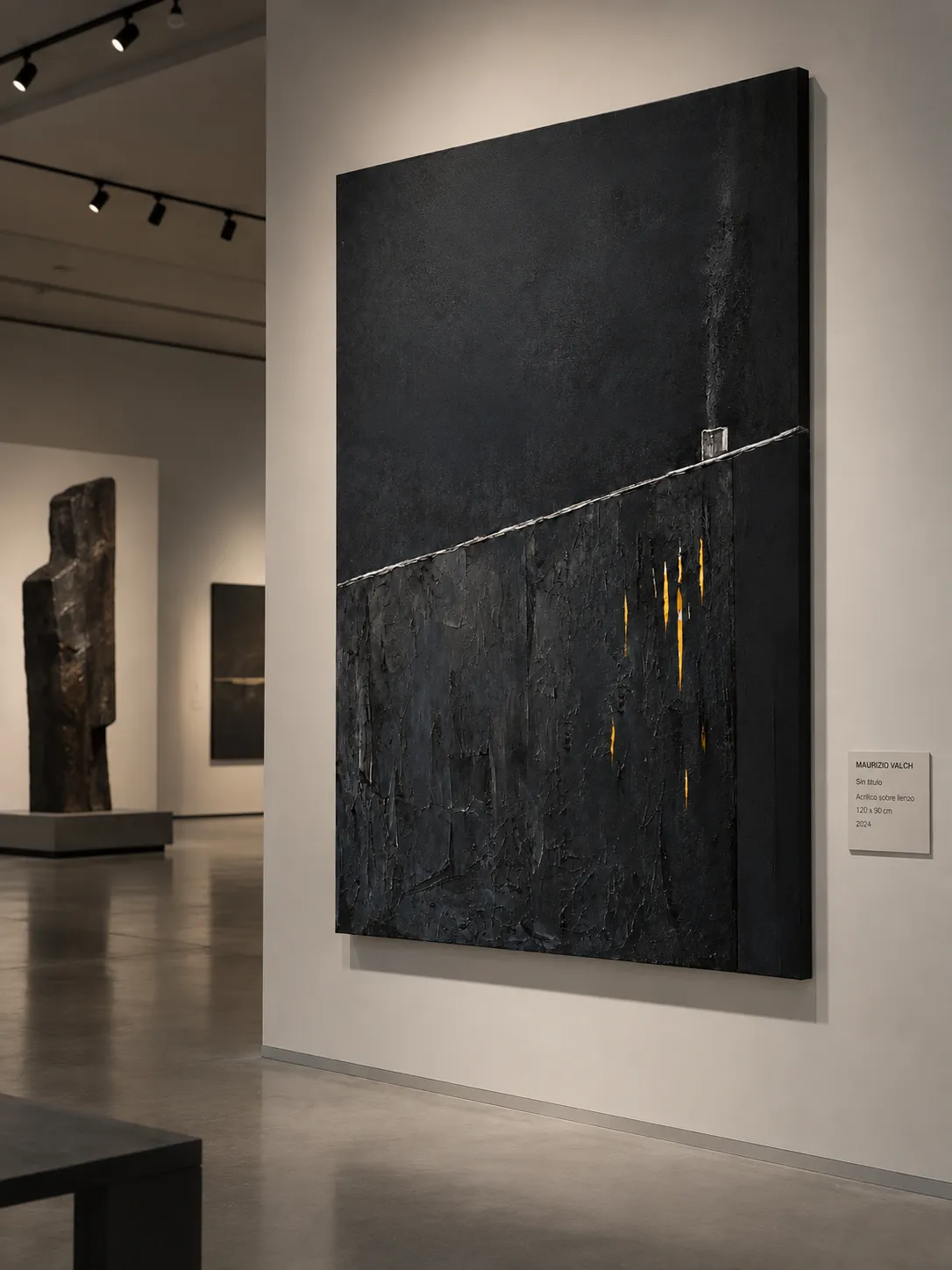
Il confine del fuoco segreto, from Maurizio Valch's STRATA series (2024). Oil and mixed media on canvas, 120 x 90 cm. The severe silver diagonal separates the upper atmospheric void from the lower material crust through which the golden incisions weep. In this gallery installation, the work establishes a direct dialogue with the scale of the viewer's body, presenting itself as an intimate, geological boundary.
In the upper half of this work, the black behaves like a silent atmosphere, a void of absolute stillness evoking the poetics of oblique horizons found in Richard Diebenkorn. There is no acoustic vibration in this space; it is the plain of the air where time seems suspended. In absolute contrast, the lower portion unfolds as a geological crust, a rough wall holding the weight of compacted earth. The silver diagonal crossing the painting is not a line of truce, but a physical scar dividing silence from the scream.
What disturbs the body contemplating this surface is the presence of the tiny cubic structure and its thread of gray smoke. This detail drastically alters the scale of the abstraction: suddenly, what seemed to be a purely formal exercise in color fields reveals itself as minimal architecture, an improbable shelter on the edge of the abyss. It is the embodiment of our paradox: a minimal space of belonging—the chimney, the hearth—perched on a perilous slope, at the exact threshold where matter collapses.
Beneath that boundary, the absolute black fractures. Vertical incisions of a burning golden-yellow pierce the dark crust, revealing a shimmering background that seems to pulse with volcanic heat. This is no mere chromatic embellishment; it is the material tension of the wound theorized by Burri. Light does not bathe the surface from without; it wells up from within through the cut, as though the canvas harbored a latent fire that the heavy dark layer of the present tries, unsuccessfully, to bury.
VI. The Observer and the Dissolution of the Boundary
At the end of this inquiry, we must return to Jiddu Krishnamurti’s observation on the nature of human conflict: "the observer is the observed." When we attempt to map territory to protect ourselves from it, we forget that the mind drawing the grid is the very mind suffering the confinement of the cell. The conflict between the need for belonging and the fear of domesticity is not resolved by building better walls or destroying all maps; it is understood when the observer realizes that the noise they try to keep out is the reflection of their own inner resistance.
The true journey—like the five Caminos de Santiago walked on foot by Valch—is not an accumulation of destinations on a credential, but the record of a progressive dispossession. Walking in the rain, experiencing fatigue, and inhabiting empty rooms we will never own, the weight of accumulated memory begins to erode. Thought ceases to be occupied territory and becomes a space of transit.
Painting, then, does not function as a monument celebrating certainty, but as an unstable threshold. The tiny chimney in Il confine del fuoco segreto continues to exhale its thread of smoke over the void, reminding us that the most intimate shelter always rests on a precarious boundary. To stay close to what is difficult, as Rainer Maria Rilke suggested, implies not running away from this contradiction: to love the question itself, to inhabit the slope without demanding the security of the plain, and to understand that the only territory that truly belongs to us is that which we are willing to abandon with the next change of wind.