Fragment I: The Theater of Understanding
There is a silent fatigue that does not come from physical exertion, but from the constant supervision of one's own soul. We live in an era obsessed with diagnosis, a time when the direct experience of being has been confiscated by the demand to explain it. We police ourselves like guards of an interior museum, classifying every tremor, every anxiety, or every glimpse of beauty under reassuring labels. In this landscape, spirituality and psychology risk becoming technologies of domestication, subtle armors that distance us from the primal pain of being alive.
This paradox of vigilance finds a precise limit in the work of John Welwood, an American psychotherapist and transpersonal thinker who integrated Western psychology and Buddhism, dedicated to showing how the longing for transcendence can become an elegant refuge from feeling the pain of our human wounds. Welwood coined the term spiritual bypassing to describe that ego maneuver which uses the absolute—silence, detachment, emptiness—to evade the harshness of everyday trauma, the fear of rejection, or the humiliation of needing others. The spiritualized mind constructs a "higher self" that observes the wound from a safe distance, falsely believing that understanding the mechanism of the wound is equivalent to having healed it. Yet that impassive observer is nothing but another mask in the theater of understanding, a sophisticated persona that refuses to descend into the mud of bodily vulnerability.
In the face of this attempt at pacification through analysis, the radical presence of Seung Sahn bursts forth. A Korean Zen master of the Kwan Um school, he was celebrated for his insistence on keeping a mind free of concepts against the traps of speculative intellect. Seung Sahn offers neither therapy nor a path of personal reconciliation; he hurls the seeker into the void of the pre-thought instant with his constant reminder: "Only don't-know." For the Zen master, the fundamental question is not why we suffer or how we repair ourselves, but what we are in this exact second, before language begins to weave its web of explanations. While Welwood's psychology seeks to illuminate the shadows of the personal basement to integrate them, Seung Sahn throws the windows wide open and turns off the flashlight: the mind that does not know has no need for an integrated self because it has stopped defending a territory.
This friction defines the territory of the INCARNATE series. In declaring that "we do not pretend to explain that multiplicity; we intend to give it pictorial existence," Maurizio Valch’s painting assumes a radical ethical and aesthetic stance: a renunciation of diagnosis. To paint is not to illustrate a theory of trauma or decorate a state of Zen enlightenment. The canvas is the space where the unknown manifests without the obligation of submitting to the known in order to be accepted. The paradox of vigilance is dismantled when the observer grows tired of self-observation and simply allows the material to speak.
Fragment II: The Weight of the Archive
Sometimes I enter the studio with the feeling that the space is already filled with people I cannot see. It is the archive—the occupied territory of my own memory demanding justification. I realize that I spend much of my life suspended in what I call "psychological time": that mental trap that postpones real existence toward a future where, at last, all my contradictions will be resolved and I will be worthy of being loved. It is an immense fatigue. It is the constant demand to prove worth through work, through the accumulation of canvases, as if each painting were an identity document I must renew before an invisible court.
I feel the insurmountable distance between intellectually understanding my defense mechanisms and managing to live them differently. I can give a brilliant lecture on detachment, I can dissect my fears with surgical precision, but when the afternoon cold enters through the studio window, theory dissolves and only the contracted body remains, the old suspicion that real life is happening somewhere else. I am tired of the tyranny of this self that pretends to govern itself, this spiritual manager planning my healing. How does one live before justifying oneself? Is it possible to paint without the ambition of the painting being proof of my existence?
Painting, at its best, is a sabotage of that vigilance. When I drag the palette knife across the wet canvas, there is a moment of pure friction where the past is useless. The oil has no memory of my intentions; it only responds to the physical pressure of the arm, the density of the medium, the accident of pigment breaking. In that struggle with the material, the archive falls silent for a second. There is no tomorrow or yesterday, only the resistance of the black and the insistence of the red seeking a path beneath the surface.
Fragment III: The Geometry of Vulnerability
Where does the body take refuge when the mind runs out of answers? Not in concepts, but within the limits of concrete matter. In the gallery experience, the encounter with monumental painting becomes a matter of physical pressures and tactile distances. The canvas is not read; it is inhabited with the weight of the shoulders and the rhythm of breathing.
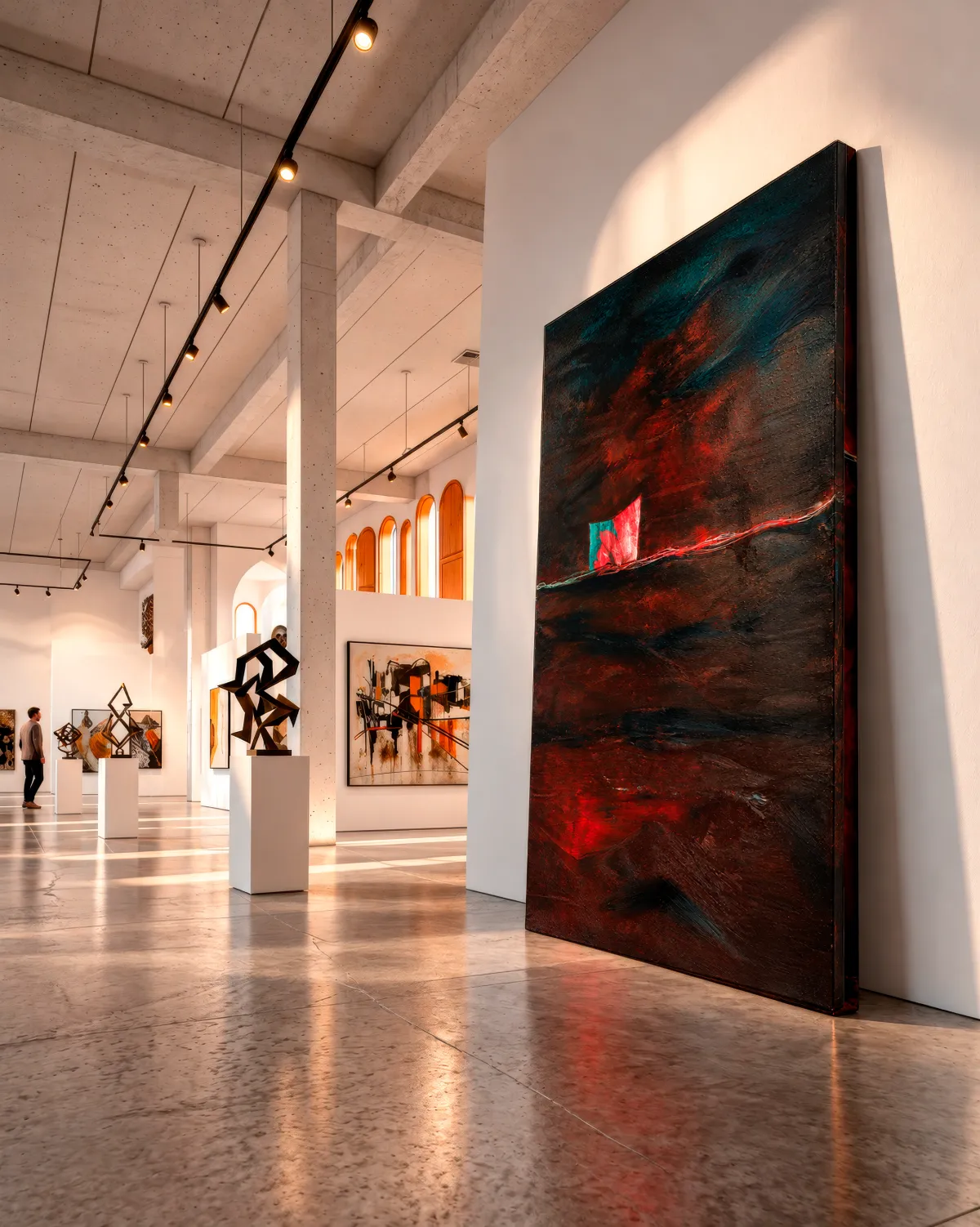
What the Night Left Burning exhibited in a gallery room, showing its 160 cm height scale against the architectural space.
In the work What the Night Left Burning, belonging to the STRATA series, the surface presents itself as a tectonic crust where charred black presses against an incandescent background. Here, space is not a mental abstraction; it is a mass pushing from top to bottom, threatening to bury the thin horizontal line that divides the painting. In the midst of this storm of organic forces, a small geometric block, bicolor and three-dimensional, floats in precarious equilibrium upon the scar of the canvas.
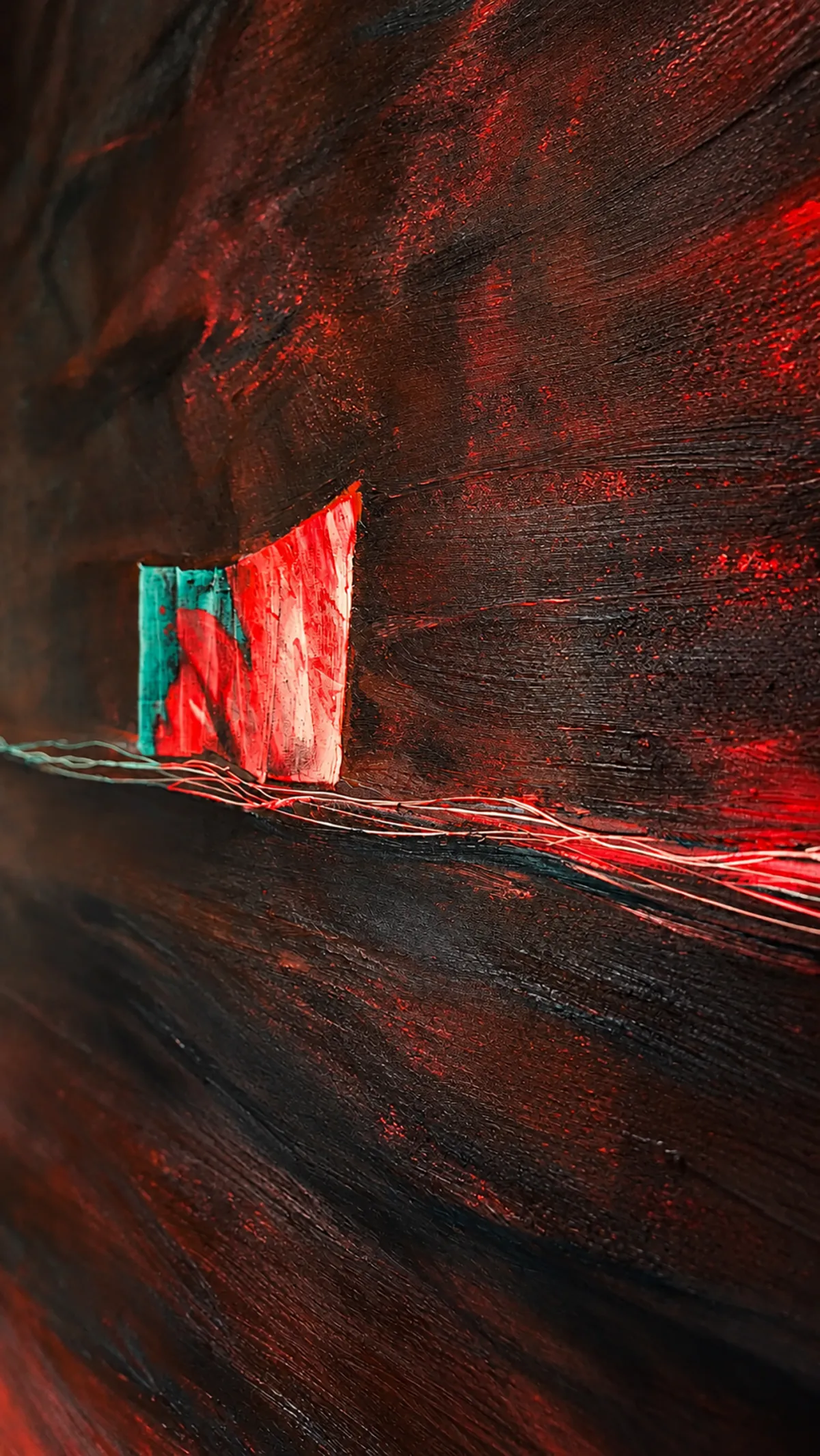
Macro approach to the material: the incision cuts through the dark paint layers, revealing the flash of the suspended bicolor block.
That block—turquoise on one side, burning red on the other—is the geometry of vulnerability. Welwood would see in that prism a representation of the human heart: a desperate attempt to construct a safe habitat, a boundary of belonging and protection in the midst of a burning universe. The turquoise is insulation from the cold; the red, the intimate warmth being defended. It is the wound seeking a contour so as not to spill over into chaos. Yet Seung Sahn would burst before the painting to dismantle the analyst's distance: where is that refuge when you close your eyes? That block is not there to be interpreted as a symbol of ego resistance; it is a physical discontinuity, a chromatic fact that interrupts the monotony of the ash.
True vigilance does not consist in defending that block from the dark tide, but in holding one's gaze upon the exact point where geometry breaks.
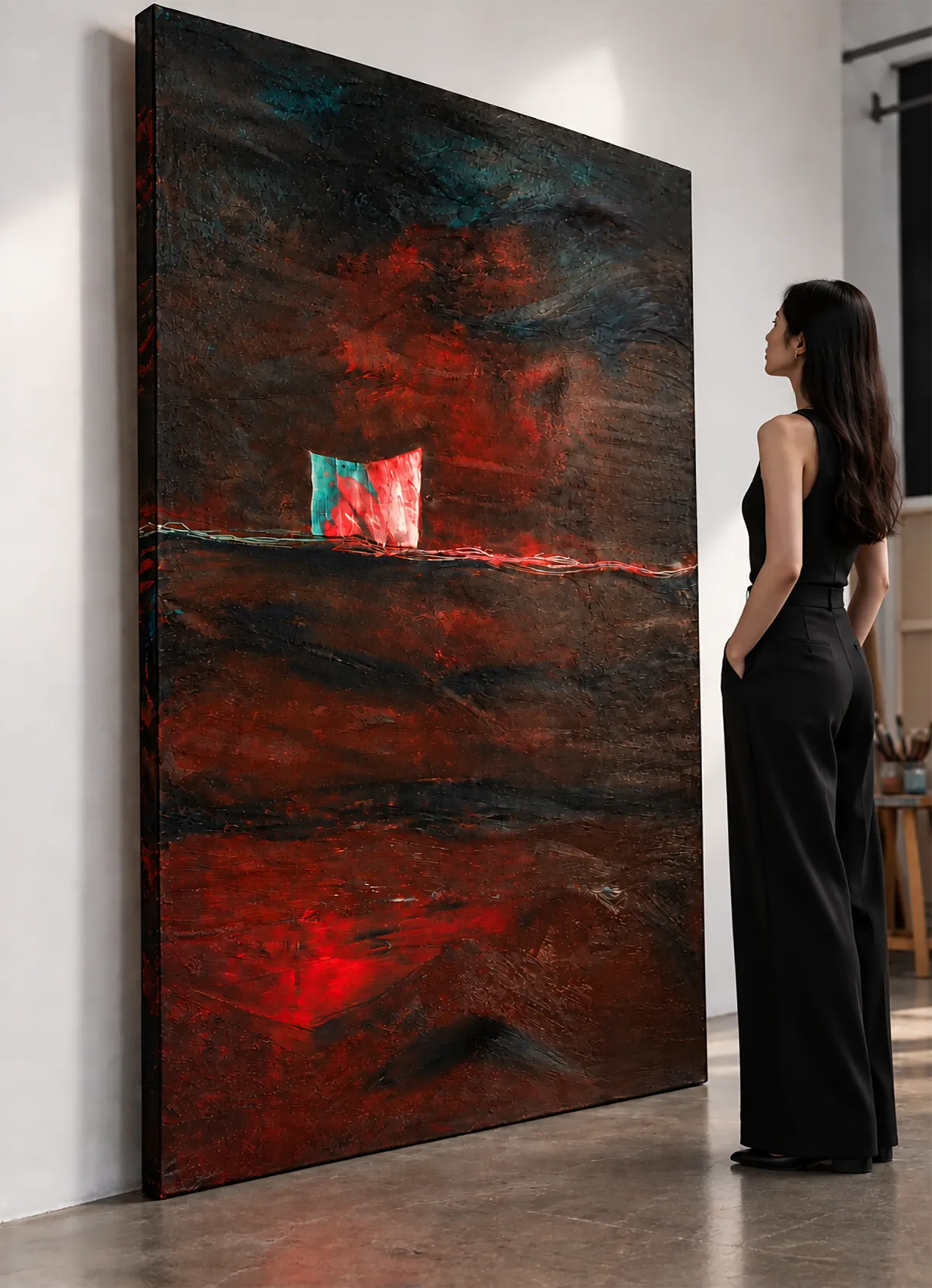
Close-up of the work, showing the physical incision cutting the canvas and the tension of the bicolor block against the accumulated dark matter.
In this close-up, the incision cutting the canvas reveals that order and chaos are not hostile forces, but strata of the same skin. The line of light is not a safe bridge; it is an open wound on the surface of the painting. The experience of vulnerability occurs when the mind renounces explaining the fall and the body accepts the gravity of the ground.
Fragment IV: The Open Door
My dogs and cats know nothing of the "don't-know mind," nor do they worry about spiritual bypassing. When they approach in the silence of the night, they simply lie down beside me, seeking my warmth or offering their own without demanding explanations. In their presence, psychological time truly suspends. There is no self that must prove its worth to be deserving of an animal's love; there is a simple communion, a grounding that does not pass through the sieve of intellect. Caring for them is my anchor, the only territory where the ego cannot advertise itself.
I have begun to sense that art, if it has any real meaning beyond the market and vanity, is an open door to love. Not an abstract, mystical love, but the painful and liberating acceptance of my own shadows. Painting is no longer for me a way of constructing a higher self to dominate my lower parts, but a way of letting all my selves—the frightened child, the ambitious painter, the tired man—sit at the same table. In that hierarchy-free multiplicity, unnecessary conflict dissolves.
At the end of the day, when I clean the brushes and the smell of oil floods the studio, I am left with a strange sense of gratitude. The painting in front of me no longer entirely belongs to me; it has its own temperature, its own silence. I have stopped asking it to save me. Accepting my vulnerability does not make me stronger, but it makes me more human. And in that unfinished humanity is where the door of love remains open.
Fragment V: The Dismantled Monolith
The investigation of INCARNATE brings us back to the ground of a painting practice that renounces the sovereignty of explanation. At the end of this journey, the voices of Welwood and Seung Sahn do not reconcile into a perfect synthesis, but remain in a fruitful tension upon the surface of the canvas. The human wound of which the therapist speaks does not need to be repaired with neurotic urgency to pass the examination of spirituality; nor does the Zen master's emptiness demand the annihilation of our tender and disastrous individual psychology.
Maurizio Valch’s painting proposes that we inhabit the space in between: that threshold where the monolith of our certainties is dismantled. Contemplating an artwork is not deciphering a psychological hieroglyph, but witnessing the presence of that which cannot be completely explained yet insists on existing. The line of light in the painting continues to lose itself toward the edges of the stretcher, reminding us that the visible territory is only a minimal part of the mystery. Understanding ceases to be a demand and transforms into a state of being; an active silence where the canvas's night continues to burn, in secret, everything we do not need to defend.