THE CAUTION OF THE ABYSS
Fragment I: The Useless Seismograph
On my worktable lies an accumulation of materials that, at first glance, repel each other with the violence of two identical magnetic poles. There is no logical path linking the transcription of a song by Giuseppe Anastasi—marked by a visceral pain climbing through internal organs—with the laboratory diaries of Marie Curie, whose pages still emit a silent, lethal radiation in the basements of the National Library of France. Nor does it seem sensible to seat at the very same table the old sage Confucius, determined to order the cosmos through ritual and moral rectitude, alongside the wandering shadow of Zarathustra—that Nietzschean character fleeing the melancholic dampness of Europe to sing grotesque, unfinished verses under the shadow of a lame palm tree in a desert oasis. And crowning this disorder, a series of representations of a painting where a two-toned block of red and blue-green rests in an impossible balance on a taut wire filament, set against a dark and turbulent background.
As a useless seismograph, my task is not to heal these fractures or to force a cosmetic reconciliation to restore the reader's peace of mind. My task is to inhabit the distance between them, to record the vibration of their friction, and to understand that the abyss separating them is, in truth, the only common ground we have left. When external certainties collapse, when the environment turns into a barren desert, the human being does not immediately dissolve; instead, we retreat into our own matter. The body becomes the sole battleground, and consciousness clings to any horizontal line, no matter how thin, to avoid being dragged down by the gravity of nothingness.
To look at these materials is to peer into a well where scientific precision and mystical babbling fail in equal measure before physical pain and sleepless nights. Anastasi's song insists that words in the air are only "half-words" (parole a metà), reminding us of the failure of any language that attempts to diagnose suffering without having passed through the stomach, the liver, the vomit. Faced with this verbal failure, painting counters with the sovereignty of its own matter: it does not explain, it does not comfort, it does not narrate. It simply holds itself upon the wire, reminding us that existence is not an intellectual triumph, but a physical exercise of resistance against freefall. Let us begin, then, this cartography of precariousness, accepting in advance that we will emerge from it half-defeated, but with the stubborn certainty that life, despite everything, will go on.
Fragment II: The Anatomy of the Desert
Giuseppe Anastasi's song opens a wound that is not metaphysical, but strictly biological. From the very first verses, the text tears us away from lyrical abstraction to plunge us into the mud of somatization: "Non basta un raggio di sole in un cielo blu come il mare / Perché mi porto un dolore che sale, che sale / Si ferma sulle ginocchia che tremano...". This "rising pain" is not an elegant sadness that can be dissolved by gazing at a beautiful landscape; it is a heavy fluid, a dense poison beginning its ascent through the foundations of human architecture. It begins in the knees. The knees are the joints of verticality and submission; for them to tremble means the subject's support is crumbling, that the physical capacity to stand is being sabotaged by an internal current of anguish.
Yet the symptom's ascent does not stop at the bone structure. It advances relentlessly toward the soft organs: "Ora è allo stomaco, fegato, vomito, fingo ma c'è." By mentioning the stomach and the liver (fegato), the lyrics break away from the entire tradition of abstract romantic or existential lament. The liver—which in classical antiquity was considered the seat of the darkest passions, of gall, and visceral courage—appears here in its raw metabolic reality, associated with vomit, the involuntary spasm of a body rejecting nourishment and reality itself. This real, damp, organic pain is what sits at the sleepless writer's table through the night, becoming the sole witness to their isolation.
This geography of the symptom dialogues tragically with the famous warning Nietzsche places in the mouth of Zarathustra's shadow in his song "Among Daughters of the Desert": "The desert grows: woe to him who harbors deserts within!". What is this inner desert if not the absolute dryness of a spirit that has lost all connection with the outside world and become a barren plain? Zarathustra's shadow flees Europe because he finds it "damp, melancholic, cloudy"—a continent of heavy thoughts and gray skies. He seeks the pure, luminous, Eastern air of the desert, a thoughtless space where the oasis girls (Dudu and Suleika) sit like "cloudless enigmas," small mute mysteries demanding no deciphering. Yet the desert that promises liberation soon reveals itself to be a deadly trap.
When the outer world is erased and turns to sand, the exile's body becomes the only active seismograph. In the absence of external horizons, pain can no longer be projected onto the landscape; it retreats inward, concentrating in the viscera. The dryness of the outer desert corresponds to the swelling of the inner desert. Anastasi describes this somatic invasion with almost clinical precision: "Arriva al cuore lo vuole picchiare più forte di me / Prosegue nella sua corsa, si prende quello che resta / Ed in un attimo esplode e mi scoppia la testa." The head on the verge of bursting is the final station of this physical Stations of the Cross. Consciousness, unable to process the void surrounding it, becomes pure intracranial pressure—a machine spinning in a vacuum, searching for a "why" that does not exist.
Zarathustra's shadow attempts to conjure this dryness through parody and regression. He sings to the palm tree which, like a dancer, stands on a single leg, seemingly having forgotten the other in the hot sand. This image of the lame palm tree has a grotesque tenderness: a living thing that has lost half its supports and yet arches and sways its hips under the scorching sun. The palm tree is the resilient body, choosing mutilation and an improbable posture over being buried by the advancing dune. Like Anastasi's sufferer, who pretends nothing is wrong while their liver twists, the palm tree dances on its single leg to deceive the yellow lion lying in wait.
The drama of the European, in both contemporary Italian lyrics and nineteenth-century German thought, lies in an inability to inhabit the desert innocently. "Ah! Upward, dignity! Virtue's dignity! European dignity! Blow, blow again, bellows of virtue!" bellows Zarathustra's shadow, unable to shed his moral armor even when surrounded by cat-girls in a tiny oasis. The European needs to "roar morally" like a wounded lion; he needs to justify his suffering through a theory, a theodicy, or a medical diagnosis. He cannot accept pain as a simple physical fact, as the matter of his own existence scraping against the void. He wants an answer, but as Anastasi's song concludes in a devastating whisper, "in fondo risposta non c'è"—at bottom, there is no answer. At the bottom of the desert, both of sand and of the stomach, only the silence of the suffering organ remains, alongside the stubborn insistence of a pulse that refuses to stop.
Fragment III: The Gravity of the Thread
Faced with the verbal collapse of the subject suffering in the sleepless night, painting presents itself not as an explanatory discourse, but as a physical wall arresting the fall. The visual work analyzed here asserts itself from the very first moment through the violence of its textures and the severity of its composition. There is no room here for the complacent illustration of abstract melancholy; what we see is matter subjected to extreme tension—paint treated as if it were earth, coagulated blood, and wire.
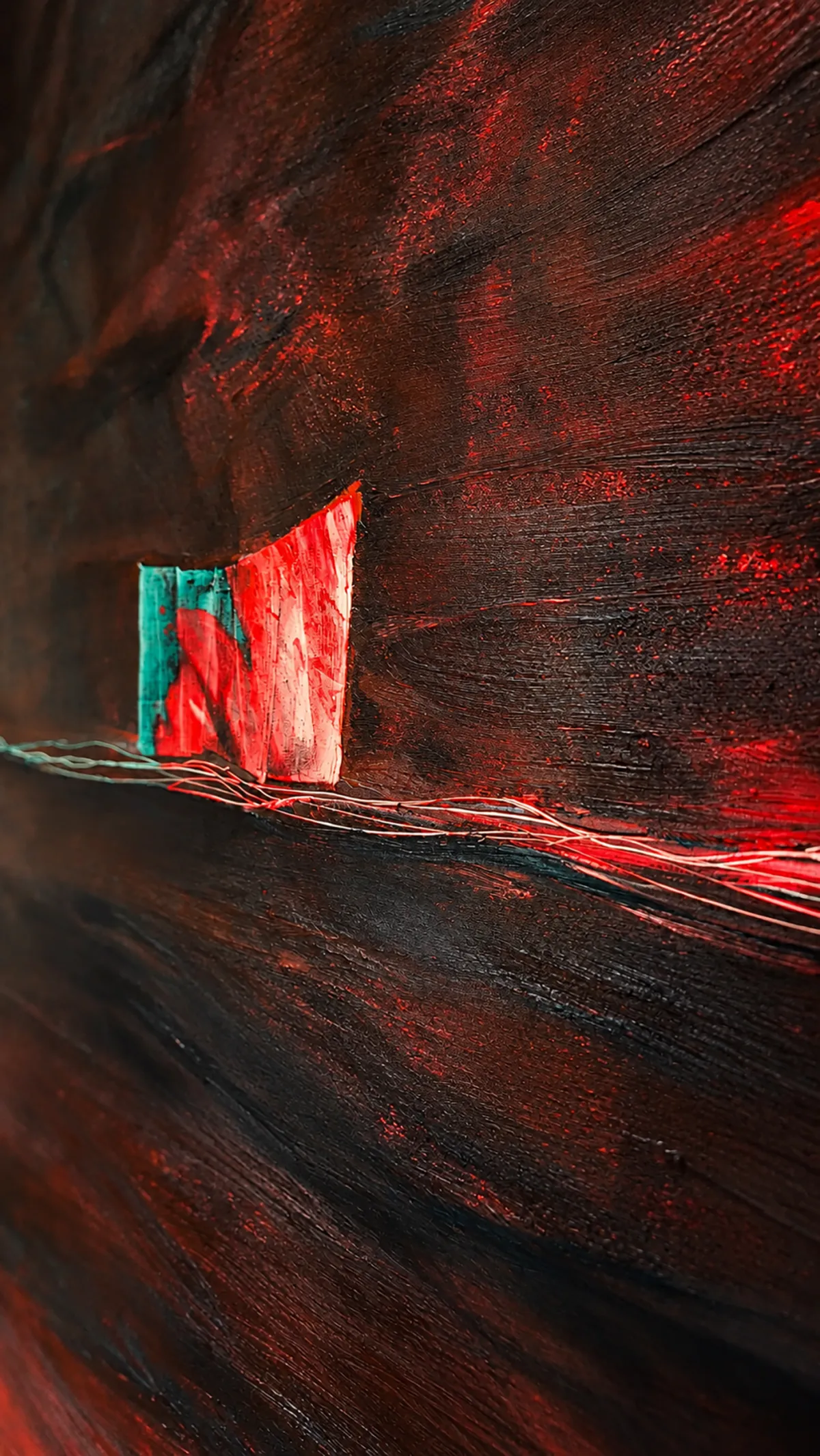
Up close, the canvas's surface reveals a turbulent geography of dark impasto. The background is no flat, sterile black; it is a dense accumulation of earthy browns, ash grays, and brushstrokes of a dark cadmium red that seems to ooze from the cracks of a volcanic crust. Cutting across this atmosphere of contained storm runs a thin horizontal line, a three-dimensional wire stretching from one side of the painting to the other. This line is not merely graphic; it has relief, a metallic materiality resisting the fluidity of the background. Upon this thread, like an improbable apparition, rests a small, two-toned block. Its left side is painted in a blue-green hue, the color of stagnant water or oxidized copper; its right side is a fiery red, an open wound of pure matter.
This block is not integrated into the background; it seems to have been deposited upon the wire with microscopic care, like an object salvaged from a shipwreck seeking a foothold in the middle of a void. The visual tension is unbearable: the dark, heavy mass surrounding it presses down from above and up from below, suggesting a space of hostile gravity, while the horizontal thread sags slightly under the weight of this minimal structure. How is it possible that this block does not fall? What physical or poetic law sustains such a precarious equilibrium in so turbulent an environment?
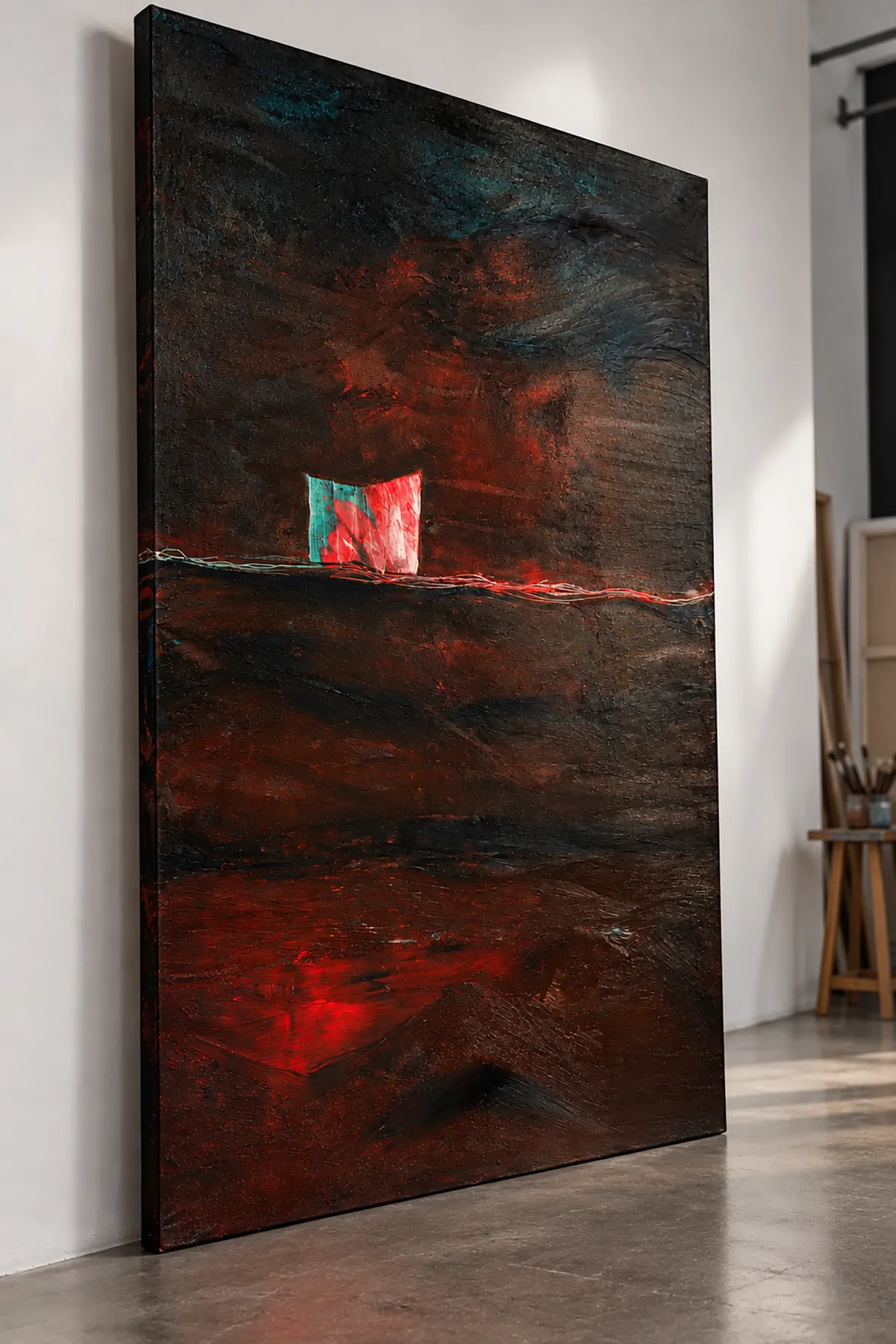
Contemplating the canvas leaning on the studio floor against the white wall, its true physical dimension becomes clear. It is no longer a digital image to be swiped away with a finger; it is a monolithic object, a physical presence imposing its own scale upon the viewer's body. The ridges of paint, applied with a thick palette knife, catch the studio's natural light unevenly, casting real shadows across its surface. Here we understand that the painting is not imitating a desert of the mind; it is behaving as a desert of actual matter. The red of the central block gleams with a mineral, almost heraldic intensity—a beacon seeking not to light the path, but to mark the exact site of danger.
This taut wire is the very boundary of the subject. In Anastasi's lyrics, the poetic voice speaks of being "sconfitti a metà" (half-defeated)—a state of suspension where victory over suffering has not been achieved, yet complete capitulation has been refused. The block on the thread is the perfect representation of this half-defeat: it cannot rise into the blue sky, but it refuses to sink into the muddy abyss roaring beneath it. Its existence is purely horizontal; it slides along the line of the wire, resisting the magnetic pull of darkness through sheer material stubbornness.
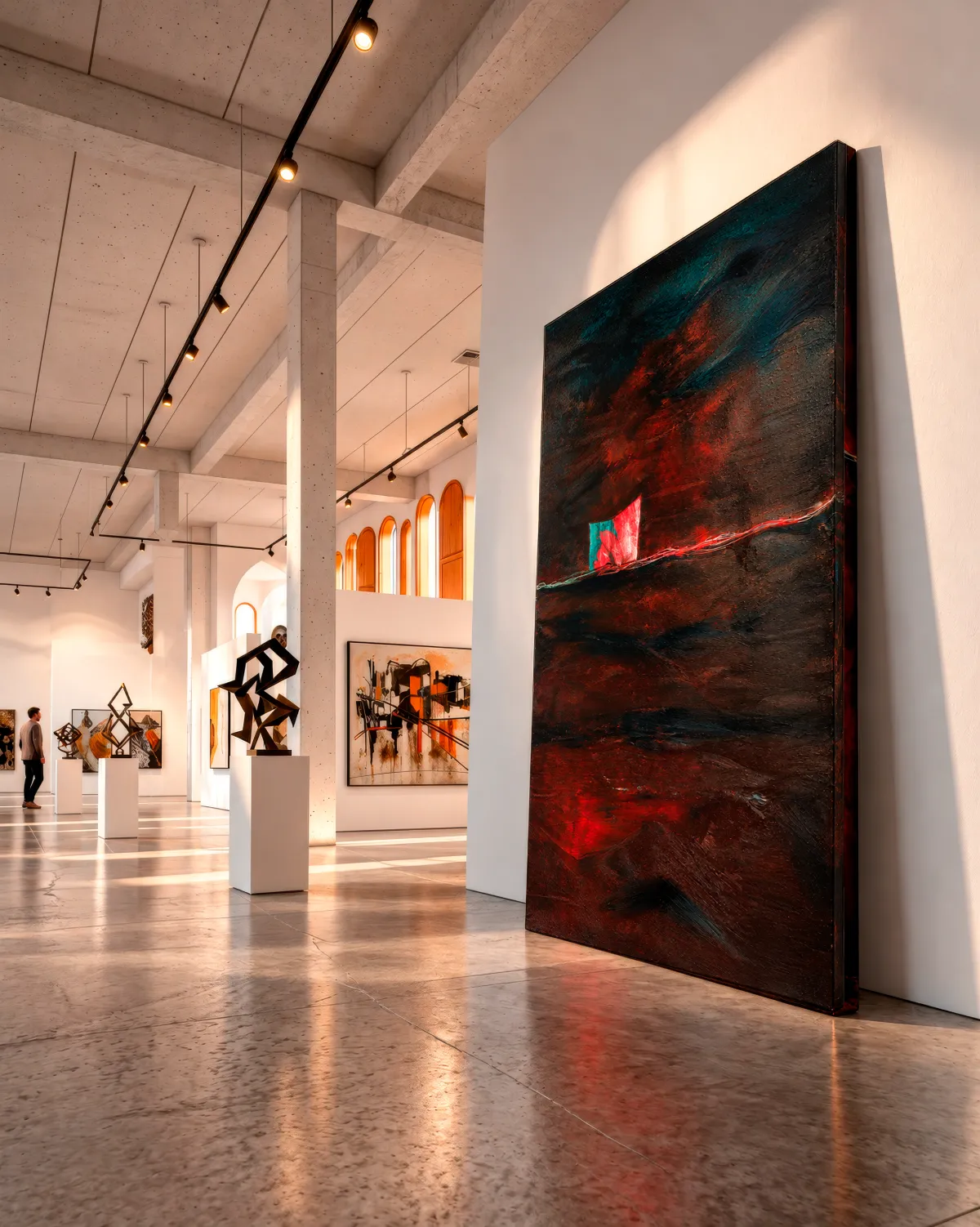
In the context of an art gallery, surrounded by abstract sculptures that play with the geometry of the void and the lightness of metal, the painting stands out for its tragic density. While contemporary art often seeks to dematerialize, to dissolve into concept or light irony, this canvas clings to its condition as a heavy body. The wire line cutting through it acts as an impassable boundary for the spectator: we cannot enter the painting; there is no perspective inviting us to stroll through its landscape. We are forced to remain outside, watching this small block of color resist the pressure of its environment. The painting refuses to be a clinical diagnosis of the body's pain or a map of Zarathustra's doubts; it presents itself as a physical object that interrupts thought and imposes its own gravity.
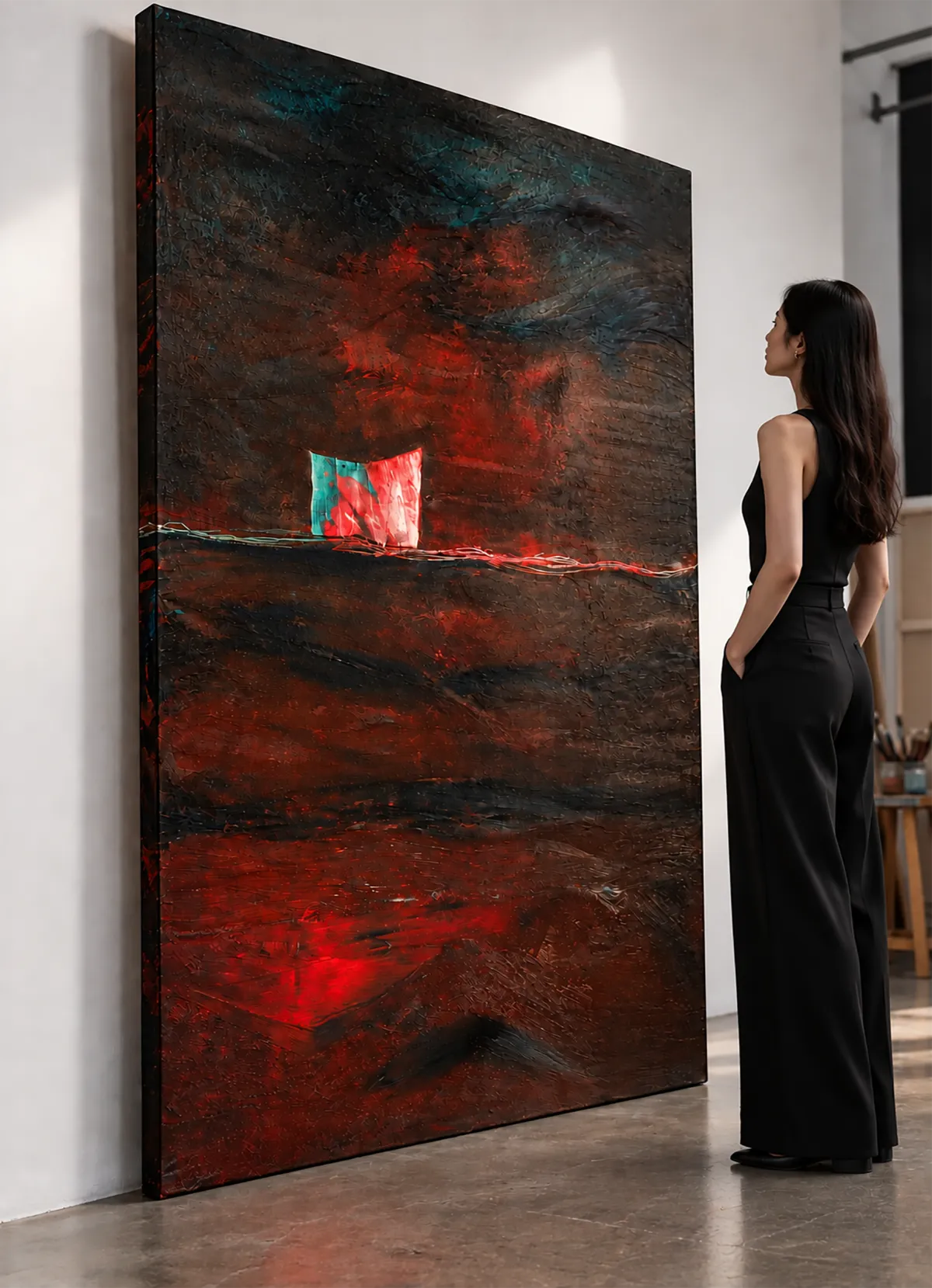
A viewer pauses before the large canvas, her dark silhouette silhouetted against the gallery wall. In this encounter, the painting reveals its true function as a somatic mirror. The viewer's body—upright, symmetrical, supported by its own knees—confronts the body of the painting, where symmetry has been reduced to that two-toned block and stability depends on a single strand of wire. To stand before this painting is to experience physical vertigo: we feel the weight of the dark background on our own shoulders, the heat of the red in our own chest, and the fragility of the wire beneath our own feet. In the end, there is no difference between the viewer holding her breath before the canvas and the block holding its place upon the thread; both are provisional structures defying the gravity of the void through a silent act of attention.
The painting teaches us that holding ourselves "halfway" is not cowardice, but the only possible miracle when the environment is pure hostility. We do not need wings to fly over the abyss; it is enough to have a taut thread and sufficient weight not to be swept away by the desert wind. Matter does not lie: it has no "half-words" because it has no words at all. It has only weight, texture, and resistance, and upon these three elements rests the only dignity we have left in the midst of the storm.
Fragment IV: Invisible Forces (Curie and Confucius)
To understand how the human spirit holds together when the surrounding matter is disintegrating, we must temporarily leave the realm of painting and music and step into the gloom of a wooden shed on Rue Lhomond, in late nineteenth-century Paris. There, a Polish-born woman, Marie Curie, spends endless hours stirring the bubbling contents of a massive cast-iron cauldron with a heavy iron bar. The air is saturated with hydrochloric acid fumes and pitchblende dust—a dark, heavy mineral brought from the forests of Bohemia. The working conditions are deplorable: the shed lacks proper heating, suffocating in summer and freezing in winter, with a glass roof that lets the rain drip through. Yet, in the midst of this physical misery, Marie Curie and her husband Pierre are chasing an invisible force, a property of matter that challenges every known law of nineteenth-century physics.
That force is radioactivity. Marie Curie consecrates her life to measuring, isolating, and purifying elements that cannot be seen, yet reveal their presence through an inexhaustible, lethal energy. The process of refining pitchblende is a task of almost mineral patience: from tons of sterile waste, after thousands of successive crystallizations, Marie manages to extract a mere fraction of a milligram of a new element she names radium. To measure this invisible energy, she uses the electrometer designed by Pierre—an instrument of extreme precision that detects the infinitesimal electrical currents produced by radiation in the air. There is no mystical intuition here, no romantic outbursts of genius; there is an implacable methodological rigor, a physical discipline that subjects the researcher's body to an exhausting routine of weighing, filtering, and measuring.
But this scientific rigor carries a devastating somatic price. Radium—that marvelous element glowing in the darkness of the shed with a beautiful, pale blue-green light—is also an invisible fire destroying cells from within. As Marie Curie draws closer to her discovery, her body begins to register the passage of this untamable energy. Her fingers suffer painful burns that never fully heal, her vision blurs from the premature development of cataracts, her knees tremble with fatigue, and her bone marrow is silently destroyed by the aplastic anemia that will eventually take her life. Marie Curie's pain is, quite literally, that "rising pain" of Anastasi's song: a radioactive current climbing through tissues, penetrating bones, and altering the very structure of her atoms.
Faced with this physical disintegration, how does the scientist's spirit behave? There are no complaints, no appeals to a divine transcendence; there is a tragic stubbornness that closely resembles the ethics of Confucius. The Chinese sage—who lived during the Spring and Autumn period, an era of political chaos, civil war, and the moral decay of the Zhou dynasty—did not propose a religion of salvation or a mysticism of escape. His response to the desert of his time was the construction of an unshakeable inner order based on moral duty (Yi), benevolence (Ren), and the rigorous practice of ritual (Li). For Confucius, ritual was not a mere empty social convention; it was a discipline of body and mind, a sacred choreography restoring harmony to the cosmos through the rectitude of individual conduct.
"The noble man (Chunzi) does not depart from virtue even for the space of a single meal; in times of danger he clings to it, in times of misfortune he clings to it," Confucius taught. This unconditional adherence to duty is the moral equivalent of the iron bar with which Marie Curie stirred her cauldrons of pitchblende. Faced with the disintegration of the social and political structures of his era, Confucius proposed that the individual become an atom of order, an invisible force of stability resisting the temptation of chaos. If society became a desert, the sage had to be an oasis of rectitude, keeping his posture straight even when his knees trembled under the weight of slander or exile.
The tension between Curie and Confucius reveals that scientific reason and the morality of conscience confront the abyss in the same way: through the imposition of a structure. Marie Curie isolates radium in unsanitary sheds, applying the scientific method with a precision bordering on the sacred; Confucius attempts to isolate virtue in a corrupt world, applying ritual with a discipline bordering on scientific precision. Both believe that the vacuum is fought through daily labor, measuring the invisible forces of the universe or the human soul to build a foothold that does not depend on external circumstances.
Yet this attempt to impose order has its own shadow. Marie Curie's laboratory notes from 1899 to 1902 are so contaminated with radium that even today, more than a century later, they must be kept in lead-lined boxes at the National Library of France, and researchers wishing to consult them must sign a liability waiver and wear protective clothing. The written word of science, the precise record of its triumph over matter, has become a radioactive object, a source of invisible death. In the same way, the moral order of Confucius, when stripped of its primordial humanistic meaning and reduced to rigid state formalism, can turn into an oppressive structure—into that "bellows of virtue" denounced by Zarathustra's shadow in the desert: a moral roar devoid of real life, serving only to stifle the spontaneity and pain of the suffering body.
True wisdom, therefore, does not consist in denying disintegration or ignoring pain through a blind faith in order. It consists in accepting that our search for precision and harmony will always be inhabited by decay. The radium Marie Curie discovered cured thousands of cancerous tumors, but destroyed the body of its discoverer; Confucius's teachings structured one of the longest-lasting civilizations in history, yet also served to justify centuries of social stagnation. Order and chaos, radiation and matter, virtue and the desert are two sides of the same coin. Like the two-toned block in the painting, where the green of life and the red of the wound are indissolubly joined upon the same taut wire, the human being must learn to live with their own disintegration, measuring their invisible forces with the caution of one who knows they are handling a beautiful, lethal fire.
Fragment V: The Weight of Half-Defeat
I look again at the materials on my worktable. Outside, the Madrid night moves forward with that thick silence only the insomnia of large cities can produce. In my player, Giuseppe Anastasi's lyrics spin on their hinges once more: "Né vincitori né vinti / Si esce sconfitti a metà / La vita può allontanarci / L'amore continuerà". And then, in that subtle inversion that closes the song like a perfect circle: "L'amore può allontanarci / La vita poi continuerà".
This mirror play between life and love is the keystone of our entire investigation. There is no final victory over the desert, no prize for Marie Curie after her years of martyrdom in the shed, nor is there a pacified empire crowning Confucius's wandering old age. Nor is there a happy narrative to cure the swollen stomach and split head of the song's insomniac. We all emerge from here half-defeated. To be sconfitto a metà is not a cowardly capitulation to suffering; it is, on the contrary, the only honest way to survive. It is the acceptance that gravity exists, that the night will come with its piercing questions, but that despite everything, there is a horizontal line holding us up.
At this final point, the painting once again imposes its silent presence upon me. The small two-toned block is still there, suspended on its wire thread. It has not fallen into the black mud of the lower canvas, nor has it flown off into the storm-like atmosphere pressing down from above. Its balance is not static; it is an imperceptible tremor, a constant vibration responding to the invisible air currents of the studio. The painting offers me neither a moral answer nor a scientific formula for my insomnia; it offers me a physical example of suspension.
Marie Curie's science taught us that matter is neither created nor destroyed, only transformed. Her pain, therefore, was not lost in the Rue Lhomond shed; it was transmuted into the bluish glow of radium, into the yellowed pages of her diaries still emitting an invisible light in the basements of Paris, and into the legacy of a rigor that continues to measure the universe with trembling but precise fingers. Confucius's order did not prevent his own body from dying in exile and political disappointment, but his upright posture before the chaos of his time still resonates as a necessary choreography for anyone wishing to maintain their dignity when their knees threaten to buckle. And the song, with its painful rhythm and its insistence on the fegato and the vomit, does not ask us to pretend that pain does not exist; it asks us, even with a head on the verge of bursting, to listen to how life, by sheer biological inertia, continues its march.
Let us not seek, then, to emerge victorious from this night. Victory is an invention of generals and systematic philosophers, an abstraction devoid of fegato or stomaco. We, inhabitants of the desert, heirs to the wire and the pitchblende cauldron, must content ourselves with the caution of the abyss: keeping ourselves suspended upon the thread, allowing pain to rise and fall through our eyes like a sun we cannot place, and accepting half-defeat as the only real boundary where life, stubborn and silent, goes on.